
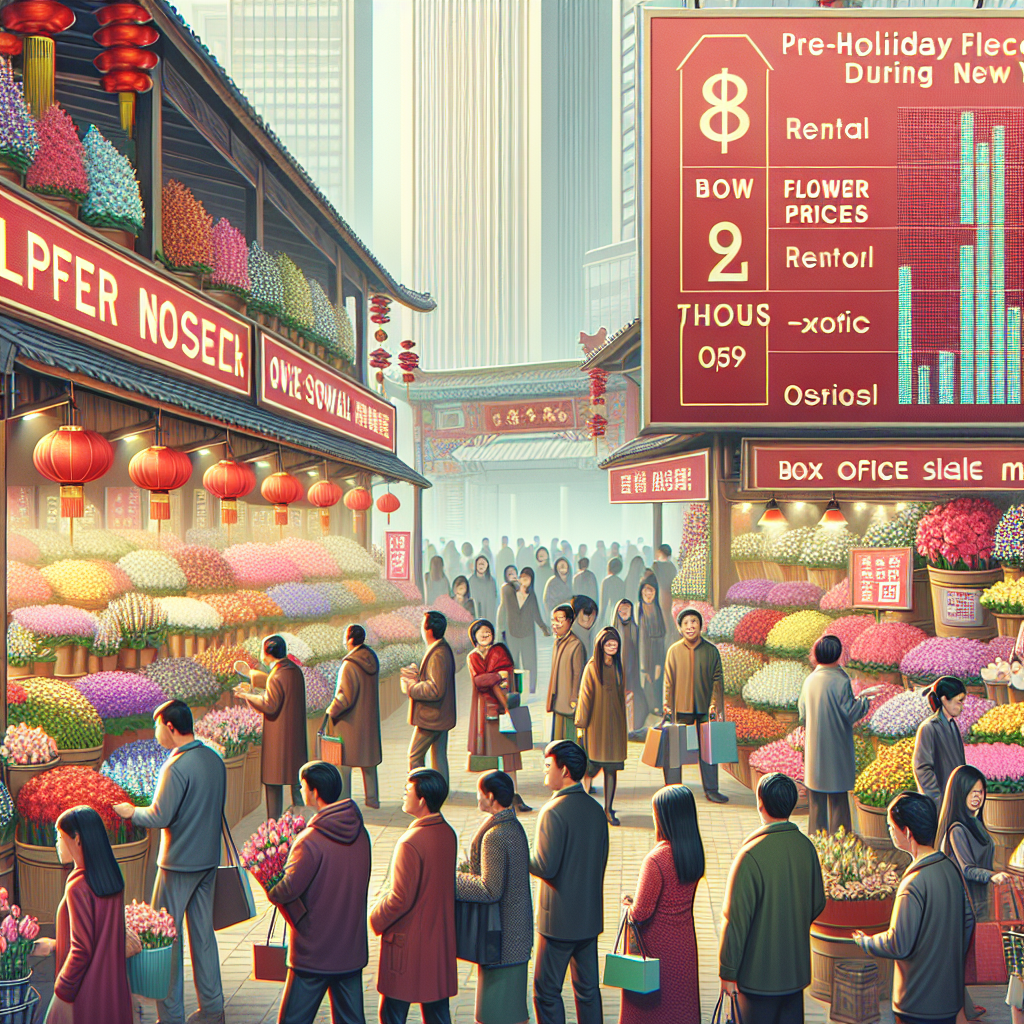
The Chinese economy continues to slump, with weak domestic demand. During the Chinese New Year period, cautious consumer spending among the general public has led to a sharp drop in rental prices and flower prices at pre-holiday flower markets.
Data on flower markets, box office sales, tourism, and dining industries are important indicators of Chinese holiday consumption levels, with the Lunar New Year being a crucial period for assessing domestic demand in China.
As the Chinese New Year approaches, various flowers and citrus plants symbolizing auspiciousness are traditionally purchased for celebrations by people across China, especially in southern regions like Guangdong.
Reported by the South China Morning Post on January 26, some large flower markets in the South China region are set to open this week, but flower suppliers are not optimistic about sales prospects for this year. They revealed that consumers are reluctant to splurge on celebration and holiday decorations, coupled with unusually warm temperatures leading to an oversupply of flowers.
Judy Yang, business development manager at a flower market in Guangzhou, stated that compared to last year, during the two-week holiday period starting from January 29, the average retail prices of flowers have dropped by around 10% to 20%, while the supply has increased by about 10%.
Tang Ying, who works in a small private tech company, mentioned that last year she spent about 500 yuan (69 USD) on buying orchids, daffodils, peach blossoms, and other flowers for the Lunar New Year, but this year she plans to cut her budget by about half.
“For last year, my return on investment wasn’t high,” Tang Ying sighed. “Of course, I will try to reduce my budget, such as cutting back on purchases of goods and fresh flowers, and keep my New Year expenses within one month’s salary (about 6,000 yuan), including clothes, banquets, and red packets for parents and relatives.”
Another flower market customer mentioned that the large bouquet of orchids she bought this week continues the tradition of purchasing orchids every Chinese New Year, but this year she spent 268 yuan on flowers, lower than the previous years’ over 300 yuan, saving more than 10%.
In Guangzhou’s Yuexiu West Lake Flower Market, approximately 115 stalls sell traditional flowers symbolizing good luck, with the cost of renting the most expensive stall to sell fresh flowers this year being 12,800 yuan, around 40% cheaper than the 21,970 yuan when the flower market reopened two years ago after the pandemic.
The ongoing zero-COVID measures for nearly three years have severely impacted the Chinese economy, with years-long real estate crisis shrinking the wealth of many Chinese citizens. The economic stimulus measures by the Chinese Communist Party in 2024 all failed to boost the market, with a sluggish job market, falling property prices, uncertainty regarding national pensions and other welfare further undermining Chinese consumer confidence. Most people feel pessimistic about job security and future prospects.
The 2025 Chinese New Year Consumer Report released by global market research company NielsenIQ shows that Chinese consumers remain cautious about their financial situation this season, leaning towards purchasing lower-priced products.
Not only have flower prices plummeted, but the prices of high-end fruits and seafood have also plunged, and Baijiu (Chinese white liquor) sales are not as strong as before.
As reported on January 14 by the Qianjiang Evening News, in a fruit shop in Hangzhou, the price of cherries has been continuously decreasing since they hit the market. Initially priced at around 1200-1500 yuan per 5kg, they are now selling at around 220-230 yuan per 5kg, an 80% decrease.
Due to its huge size, delicious meat quality, and high fishing risks, the King Crab has become one of the most representative high-end seafood in the world. According to the 21st Century Business Herald on January 26, during the Chinese New Year, when the King Crab is in high demand, its price has dropped below 500 yuan.
A small business owner from Jiangsu, Mr. Lu, told Radio Free Asia that Baijiu is a must-have alcoholic beverage for every household during the Chinese New Year, but this year, the sales volume is noticeably lower than before.
“The consumption situation is very bad. Although it’s the end of the year, everyone needs to prepare for the New Year, but if we can save money, we will. Alcohol sales are very poor this year, probably down by more than 50%. I just returned from a friend who sells alcohol, and he said sales are definitely lower than before. Alcohol is a must-have for the New Year. If even alcohol is difficult to sell, it’s a clear sign of an economic downturn,” Mr. Lu said.
The tight purse strings of the Chinese people are also evident in holiday travel choices, with most opting for domestic or nearby country trips, while popular destinations like the US and Europe are no longer a top choice for Chinese travelers. Subramania Bhatt, CEO of China Trading Desk, a digital marketing and research company, told Bloomberg that Chinese people are looking for value and experience, no longer flocking to large luxury stores abroad for bulk handbag purchases.