
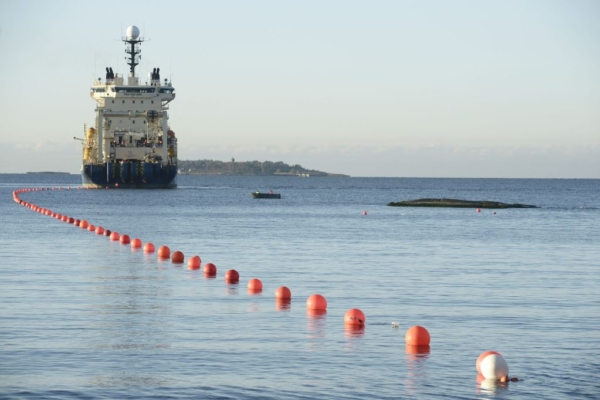
NATO member countries stated on Tuesday (January 14) that they will deploy warships, patrol aircraft, and maritime drones in the Baltic Sea to protect vital infrastructure such as undersea cables and prevent any future sabotage activities. China and Russia have long been suspected as the masterminds behind such destructive actions.
Since Russia’s invasion of Ukraine in February 2022, a series of incidents involving damage to power cables, communication cables, and natural gas pipelines have occurred in the Baltic Sea. These incidents have put European authorities on high alert.
In response, NATO has launched an operation called “Baltic Sentry.”
NATO Secretary-General Mark Rutte announced at a press conference that this mission will reinforce NATO’s presence in the border regions, including deploying warships, maritime patrol aircraft, submarines, drones, and a “small naval drone fleet” to enhance surveillance.
Rutte stated that NATO will collaborate with allied nations to integrate monitoring assets and respond when necessary. He also mentioned working with the industry to further explore methods to protect critical infrastructure and enhance underwater asset recovery capabilities.
Rutte underscored the importance of robust law enforcement, stating that Finland has demonstrated that taking decisive action within legal boundaries is feasible.
“Ship captains must understand that potential threats to our infrastructure will result in consequences, including possible boarding, detention, and arrest,” Rutte said.
Last November, two undersea cables in the Baltic Sea were severed. China’s bulk carrier vessel, “Yi Peng No. 3,” was accused of disabling its Automatic Identification System (AIS), dragging anchor over 100 miles, and subsequently cutting communication cables between Sweden and Lithuania, as well as Germany and Finland.
The company registered the “Yi Peng No. 3” in Ningbo, China, with a Chinese captain and a Russian crew member. Departing from the Russian port of St. Petersburg with a cargo of Russian chemical fertilizers bound for China, the vessel was later intercepted by the Danish Navy and held at sea, prompting international investigations.
Last month, Finnish authorities seized an oil tanker carrying Russian oil, suspecting deliberate anchoring maneuvers that damaged the Estlink 2 power cable and four communication cables between Finland and Estonia.
Although Finnish President Alexander Stubb cautioned it is premature to draw conclusions, he believed the sabotage on December 25 last year was “definitely” linked to Russia.
Stubb told Reuters, “The ship is part of a Russian ‘shadow fleet.’ We also know that many of the goods on board come from Russia. This connection is definitely there.”
These incidents closely resemble another event in October 2023. At that time, a vessel named “NewNew Polar Bear” was found dragging anchor over 100 miles, causing damage to an important natural gas pipeline connecting Estonia and Finland and two communication cables in the Baltic Sea.
European Union High Representative for Foreign Affairs and Security Policy Kaja Kallas told Fox News, “Russia is not the only challenge we face.”
Kallas added, “Chinese vessels are believed to be connected to the recent sabotage of Baltic Sea cables, something we’ve seen in the Taiwan Strait for years.”
“Given China’s strong support for Russia in the Ukraine war, it’s hard to see these events as coincidental,” she said.
Taiwan authorities have repeatedly accused Chinese ships of deliberately dragging anchor and cutting undersea cables in the Taiwan Strait.
In the latest incident on January 3 this year, the Taiwanese Coast Guard reported that the cargo ship “Shunxing 39,” headed for Busan, South Korea, stopped transmitting location information in international waters and allegedly dragged anchor over international undersea cables in the northeast Taiwan maritime area.
Although the Taiwanese Coast Guard briefly detained the vessel, inclement weather conditions prevented personnel from boarding. Subsequently, assistance was requested from Korean authorities for the investigation.
German Chancellor Olaf Scholz stated after the NATO summit that as part of protecting critical underwater infrastructure, NATO member countries are considering sanctions against Russia’s “shadow fleet” in the region.
Scholz remarked, “We will continue taking action against Russia’s ‘shadow fleet,’ including the sanctions already in place, and possible further measures, including targeting specific vessels and shipping companies that pose threats.”
Stubb emphasized the need for further examination of relevant regulations to assess appropriate actions to take against suspicious vessels while maintaining freedom of navigation.