
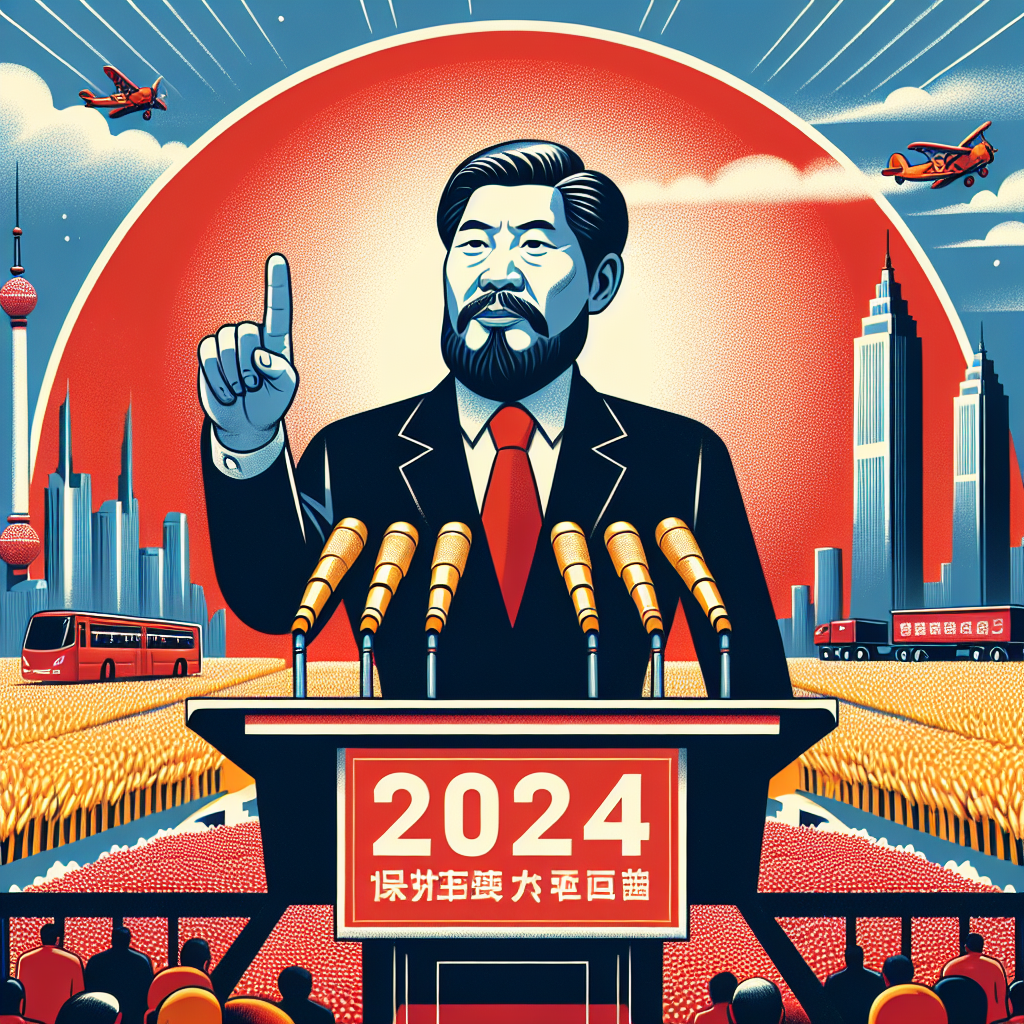
On December 31, 2024, Chinese Communist Party leader Xi Jinping delivered a New Year’s message, boasting about China’s economic performance in the past year. He highlighted achievements such as surpassing 1.4 trillion jin in grain production and producing over 10 million new energy vehicles. Despite acknowledging external uncertainties and challenges, Xi emphasized that with effort, these difficulties can be overcome.
Critics often question the accuracy of China’s economic data and raise concerns about the oversupply and international disputes generated by the export of new energy vehicles.
Reports from The Wall Street Journal suggested that Xi’s message was aimed at reassuring the international investment community amid concerns of a potential new trade war. With Trump poised to return to the White House, Xi aimed to bolster confidence in Beijing’s ability to navigate economic transitions and resist external pressures.
During his address, Xi also touched upon improving people’s livelihoods, claiming that “everyone’s lives are colorful.” However, observers like Professor Hong Jingfu from National Taiwan University’s Department of Political Science pointed out a stark contrast between Xi’s narrative of progress and the actual hardships faced by many Chinese citizens. Issues such as pay cuts, unemployment, shuttered businesses, and social unrest are prevalent, suggesting a disconnect between Xi’s portrayal and people’s lived experiences.
Political commentator Zhong Yuan noted a lack of vigor in Xi’s 2025 New Year’s message compared to previous years, with no mention of the hardships endured by the Chinese populace. Xi’s reference to visiting the historic Sixi Lane in Anhui and hinting at a potential retirement plan sparked speculation about his future intentions.
In addressing the sensitive Taiwan issue, Xi emphasized the inevitability of reunification under the “historical trend.” However, Taiwan’s leadership insists on its sovereignty as the Republic of China, with the island’s future to be determined by its 23 million inhabitants.
Following the official release of Xi’s New Year’s message, state-controlled social media platforms in China were flooded with praises. However, overseas platforms saw Chinese netizens ridiculing the message, questioning Xi’s leadership and the Party’s policies.
Xi’s mention of job creation, elderly care, education, and healthcare in his message was met with skepticism by some netizens who raised concerns about broader political and social issues facing China.
Recent incidents, such as the persecution of three nuns near the Nanhua Temple in Guangdong Province, have shed light on alleged deception and manipulation by the Chinese Communist Party. The nuns launched a counterattack, accusing the Party of deceit.
In a recent interview with Epoch Times, a long-time employee in a local finance department, referred to as Lu Ming, highlighted the collapse of local finances with overwhelming evidence and insights. He mentioned that most officials within the system are pessimistic about China’s economic future and even express discontent towards Xi, hoping for a change in leadership.
The dissatisfaction and challenges faced by the Chinese populace remain a critical aspect to monitor in China’s evolving socio-political landscape.