
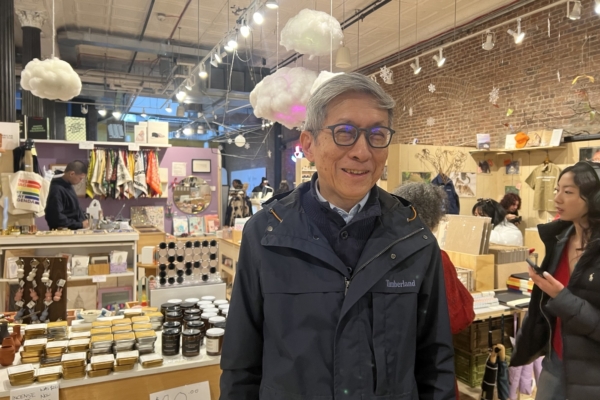
Adjacent to the Canal Street subway station in Manhattan’s Chinatown, the “Canal Street Market” is set to close on the 29th of this month. Many small businesses are considering their next steps, with several expressing gratitude for the opportunities the market provided for their entrepreneurship and dreams. Regular visitors also express nostalgia for this unique market that combines food and shopping experiences.
Ran, who runs an eco-friendly candle and ornament shop, mentioned that over the past two years, his products have expanded beyond the market. He is planning to shift to online sales, encouraged by the recognition of customers that gives him confidence for the future. However, he expressed a desire to stay longer at the market and appreciates the various activities organized by the market management that attracted customers and helped promote his brand.
The market often invited different artists to showcase their work, including renowned artists and students from Parsons School of Design. Helen So, a young painter from Hong Kong, utilized her inspiration and creativity to create stickers, postcards, tote bags, and hats, selling them in various locations in New York and gaining popularity among tourists. Since 2021, she has been invited to showcase her work here.
Hanna, a visitor from California, always visits this market whenever she comes to New York. Learning about the market’s closure this year, she expressed sadness, saying, “I hope I could come more times. Every winter, I come here to taste food and experience the culture.”
The closure of the market highlights the dilemma of Chinatown, which lacks a large modern shopping center due to its long history and challenging renovation prospects, especially concerning facilities capable of accommodating large crowds.
Local residents believe that the East Broadway Mall, located at 88 East Broadway and managed by the city government, not far from the Canal Street Market, could be a potential location for young entrepreneurs to consider opening businesses if it undergoes significant renovation.
Insiders revealed that the new contracting party for the East Broadway Mall withdrew from the city government agreement due to a heavy burden. Consequently, management rights reverted to the original owners, with ten years remaining until the lease expires. The mall still has numerous vacant shops, with elevators out of service, and the second-floor hotel sitting vacant. Shop owners who remain hopeful are aiming for more small businesses to move in, including those affected by the closure of the Canal Street Market, in hopes of driving more foot traffic. However, a travel business operator mentioned that the community relies mainly on local customers, while gift shops need visitors to sustain business.
The East Broadway area, where the mall is located, has been a bustling gathering place for the Fujianese community since the 1990s, with people traveling to and fro for holidays and celebrations, creating a constant flow throughout the year.
With nearly 600,000 passengers per year, it used to be bustling with over 200 bus routes from Chinatown to more than sixty towns on the East Coast. Concerns over safety and the environment ultimately led to the discontinuation of long-haul buses, resulting in outward migration and vacancies in the East Broadway area. Nowadays, local customers are the main consumers in the area.
Currently, there are no new competitors stepping in for the East Broadway Mall, but community members express their hope for its revival.
However, Chen Zuozhou pointed out that short-term limited investments might not fundamentally reverse the situation. The key lies in anticipating substantial investments, implementing new long-term operational strategies, along with robust management, and complementary measures from all parties.
“A business improvement district can help set up signage over their outdoor plaza to attract passersby on the Manhattan Bridge,” he said. To revitalize the East Broadway area in Chinatown, the East Broadway Mall must be active.