
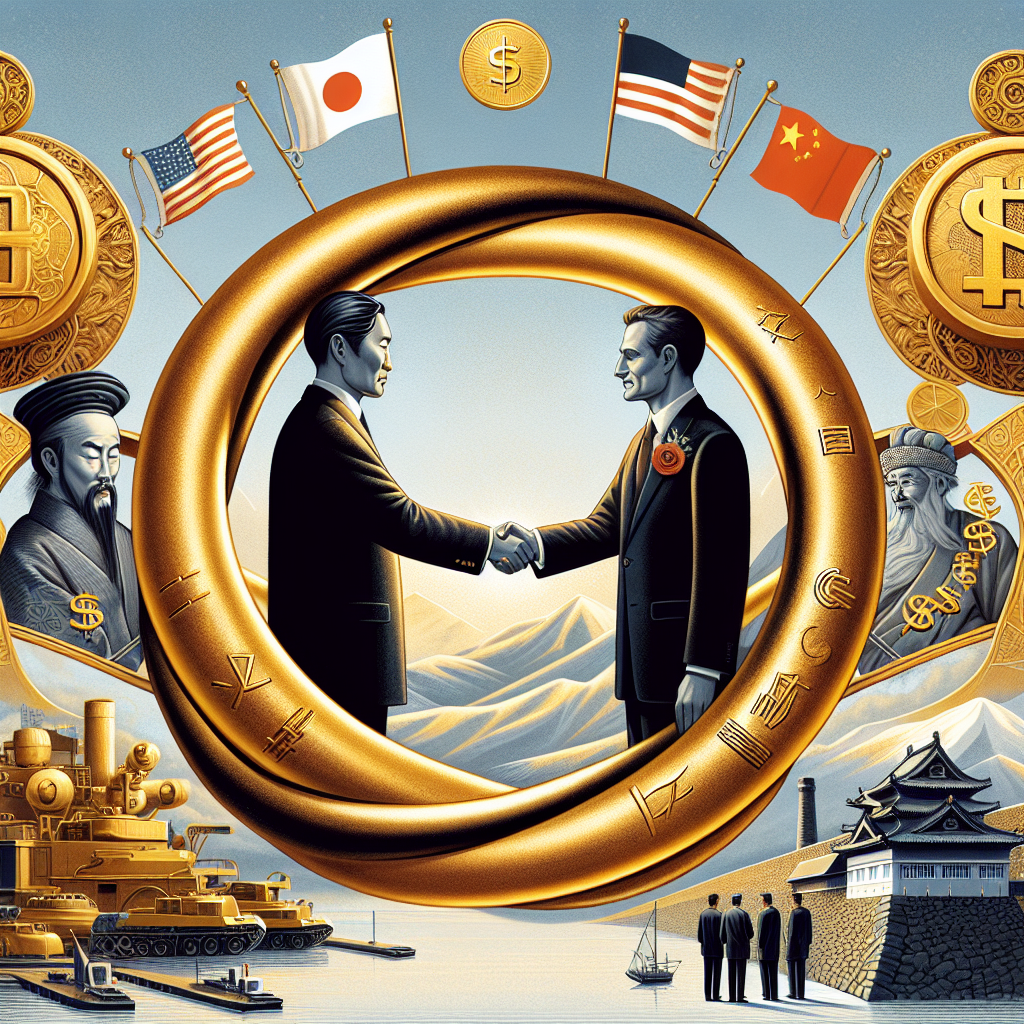
Following the recent interactions and collaborations between Japan and the United States, three key elements stand out in the bilateral relationship: close personal ties at the highest levels, strong economic connections, and shared values along with a common security framework. These three pillars play a crucial role in maintaining and strengthening the alliance between Japan and the U.S.
On December 19, President Trump officially informed Japan that it would be feasible to hold the first meeting with Prime Minister Kishida around the middle of January next year. This communication sets the stage for potential discussions regarding Kishida’s visit to the U.S. in January.
During the upcoming meeting with Trump, Prime Minister Kishida is expected to reaffirm the significance of the Japan-U.S. alliance. To build mutual trust with Trump, Kishida is considering ensuring ample time for the meeting.
Japanese Chief Cabinet Secretary Yoshimasa Hayashi stated that the meeting would take place at a mutually convenient time to facilitate substantial exchanges of views and the establishment of personal connections. The meeting is expected to be held before Trump’s inauguration on January 20th.
The successful diplomatic efforts, including the formal response from Trump, are attributed to the initiatives led by Mrs. Abe. Foreign Minister Takeshi Iwaya praised Mrs. Abe’s meeting with the Trumps as “very good” during a session at the Foreign Affairs Committee on December 18. He emphasized the crucial role Mrs. Abe plays, despite being a private individual, in the realm of Japan-U.S. relations. The renewal of old ties is deemed meaningful and deserving of applause.
Mrs. Abe expressed gratitude on X platform on December 17 for meeting and dining with the Trump couple. She mentioned, “The Trump couple was really warm. Speaking with both of them must have made Prime Minister Abe very happy.”
On December 15, the Trump couple reunited with Mrs. Abe at the Akasaka Palace. During the following press conference, Trump emphasized the crucial importance of Japan as a U.S. ally and expressed the desire to meet with Prime Minister Kishida before taking office.
In the backdrop of these diplomatic maneuvers, Mrs. Abe’s interaction with the Trumps played a supportive role in facilitating the meeting between Kishida and Trump, garnering praise from several members of the ruling Liberal Democratic Party.
Citing former lower house member Akimasa Ishikawa of the LDP, the Sankei Shimbun reported, “This is the path Mrs. Abe paved.” Ishikawa highlighted from the photo of Mrs. Abe with the Trump couple that Trump’s demeanor was naturally gentle, a countenance reserved for old friends. Trump may be shrewd in business matters, but he values personal connections.
Former lower house member Mio Sugita of the LDP was moved to tears by the photo, stating, “All three of them were dressed in dark clothing in the picture, and they must have reminisced about Shinzo Abe during their conversation.” Numerous LDP members acknowledged the importance of interpersonal relationships in diplomatic affairs through this event.
Elon Musk, appointed as Secretary of Efficiency in the Trump administration, expressed honor on X platform on December 16 for extending his respects to Mrs. Abe during her dinner with the Trump couple. When Musk visited Japan in September 2014, he met with Prime Minister Abe at the Prime Minister’s Residence. Following Abe’s unfortunate passing, Musk mourned in a post on X platform.
Just as Shinzo Abe and his wife demonstrated, the enduring cooperation between Japan and its ally, the United States, is underpinned by the personal friendships and trust established at the highest levels. Apart from the Abes, former Japanese Prime Ministers Yasuhiro Nakasone, Junichiro Koizumi, and the recently retired Fumio Kishida have all cultivated varying degrees of personal friendships and trust with American leaders, fortifying the Japan-U.S. alliance further.
During Trump’s press conference on December 16, SoftBank’s founder and CEO, Masayoshi Son, announced alongside Trump that SoftBank is set to invest $100 billion in the U.S. within Trump’s second term, creating 50,000 job opportunities. Son and Trump held this joint press conference following their meeting at Mar-a-Lago.
Son previously held a meeting with Trump in December following Trump’s first election victory in 2016, when they decided on a $50 billion investment in the U.S. with the creation of 50,000 jobs.
With Trump securing a second term, the investment commitment was doubled by Son. Showcasing increased confidence in the American economy, Trump’s investment also doubled accordingly.
Though details of the investment were not explicitly stated by Son, it is speculated that artificial intelligence fields could be a focal point, possibly including data centers for AI development.
During the press conference, Trump commended Son as a “great leader and investor.” Upon hearing Son’s plan to invest $100 billion in the U.S., Trump immediately urged him to increase the investment to $200 billion. Son, with a smile, replied that he would strive for this goal but needed Trump’s support. Responding, Trump assured him with a firm handshake, saying, “Support.”
Son is renowned for his bold decision-making. SoftBank has invested in numerous startups in Silicon Valley, as well as hundreds of companies such as semiconductor design company Arm, Alibaba, T-Mobile, Deutsche Telekom, Microsoft, and Nvidia.
Japanese Minister of Economy, Trade, and Industry Yoji Muto praised SoftBank’s investment in the U.S., acknowledging that the investment plan “contributes to further strengthening the economic ties between Japan and the U.S., which is a commendable move.”
According to statistics from the U.S. Commerce Department, Japan’s direct investment in the U.S. reached $783.3 billion in 2023, marking the fifth consecutive year Japan has held the top spot globally in investments in the U.S. SoftBank’s $100 billion investment will further augment Japan’s direct investment in the U.S.
The robust economic ties between Japan and the U.S. are reflected in their trade relationship. As per the Japan External Trade Organization (JETRO) rankings, the U.S. surpassed China in 2023 to become Japan’s largest export destination for goods, reclaiming the top position since 2019. Moreover, the U.S. remains Japan’s second-largest source of imported goods, a position that has been consistent over time.
The close economic links between Japan and the U.S., coupled with intimate personal bonds among the top leadership, undeniably strengthen the Japan-U.S. alliance. However, the primary underpinning of this alliance lies in the shared values and common security framework between the two nations.
Regarding the significance of the Japan-U.S. security framework, Japan’s National Defense Program Guidelines highlight that the Japan-U.S. security framework, along with Japan’s own defense apparatus, is the cornerstone of Japan’s national security. The Japan-U.S. alliance, centered around the security framework, plays a crucial role not only for Japan and the Indo-Pacific region but also in upholding peace, stability, and prosperity in the international community.
The Japanese Ministry of Defense announced that on December 16, joint military exercises were conducted by the air forces of Japan and the U.S. in the western Pacific airspace around the seas of Japan and East China Sea, as well as southeast of Okinawa. Japan deployed 13 F-15 fighter aircraft, while the U.S. Air Force participated with 22 aircraft including B-52 bombers, F-35s, and EA-18G Growlers to engage in various tactical exercises.
The Defense Ministry’s briefing noted that given the increasingly active activities causing serious security concerns around Japan and the growing harsh security environment surrounding Japan, the Self-Defense Forces and U.S. military conducted the joint training exercises mentioned above. Through these joint military exercises, both Japan and the U.S. reaffirmed their strong resolve against any unilateral attempts to change the status quo by force and demonstrated their readiness for rapid responses, thereby enhancing the deterrence and response capabilities of the Japan-U.S. alliance.
Situated at the northernmost end of the first island chain, Japan plays a pivotal role in curbing challenges posed by the Chinese Communist Party against universal human values, their attempts to alter the current state by force, and disruption of regional and global peace and stability. Japan is regarded as the most faithful and reliable ally of the U.S. in Asia.