
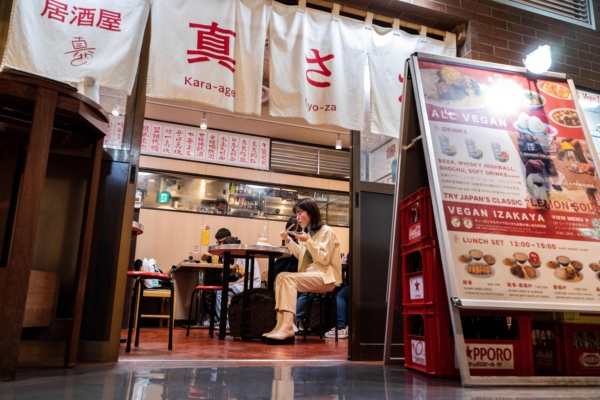
Japan, known as the country with the world’s oldest population, has a unique social landscape where many elderly people embody the motto of “life goes on, work never stops”. A significant part of this phenomenon is the traditional Japanese izakayas, small pubs run by elderly couples. However, due to the continuous rise in various costs, many of these izakayas are facing heavy pressures from owners and an increasing number are closing their doors.
Izakaya is a traditional Japanese pub that serves alcohol and food. Originating from the Edo period in Japan, izakayas started as sake shops where customers could also enjoy simple dishes after purchasing alcohol. Evolving with time, izakayas became an integral part of Japanese dining culture. Known for their unique concept, izakayas have become a place for people of all ages to relax and unwind, where both young and old can enjoy themselves.
Many izakayas are family-run businesses, where couples dedicate their entire lives to the operation of the pub. According to statistics from relevant departments in Japan, the country’s food and beverage industry is facing its biggest challenge in a decade. From January to October of this year, 650 izakayas – mostly family-owned – had to close down, marking a 16.5% surge compared to the same period last year. It is projected that around 870 dining establishments may shutter this year, exceeding the 780 closures during the peak of the pandemic.
Nakamura, who has been working at an izakaya in Osaka for 15 years and is now 65 years old, shared with a reporter, “Apart from the rising costs and decreasing customer base, many elderly couples running izakayas are too old and with no successors, which eventually leads to the closure of their businesses.”
Mie Yamada, aged 76, reminisced, “I started helping my mother run the izakaya right after high school. It was during Japan’s rapid economic growth when many customers would drop by after work for a couple of beers and conversations, feeling content. The izakaya became a trendy spot and gradually evolved into a form of gastronomic culture.”
Reflecting on her experiences, she expressed, “Dealing with mostly white-collar workers daily made my standards of choosing a partner higher, so I never found a suitable spouse. After my mother’s passing, I continued to run the izakaya alone. As the clientele aged and retired, the frequency of visits decreased with the original loyal customers becoming elderly.”
During the three years of the pandemic, many establishments, including ramen shops, Western restaurants, bars, and Japanese eateries, have faced closures, predominantly concentrated in major cities like Tokyo and Osaka. Despite the gradual growth in the post-pandemic food market, the costs of ingredients, labor, and rent have escalated, leading to about 40% of izakayas experiencing losses and struggling to continue operations.
“Operating an izakaya has become increasingly challenging,” Nakamura explained. “With the eruption of the Russia-Ukraine conflict, oil prices surged, leading to overall inflation. The prices of our dishes have also risen. As izakayas primarily serve small plates, the average cost per dish has increased by 70 Japanese yen. For instance, what used to be a 100 yen tomato costing 400 yen when divided into smaller servings, now costs 200 yen and sells for 500 yen. High costs with low profit margins result in reduced income.”
He further elaborated, “The regular daytime customers at izakayas are usually retirees and single individuals, while the evenings attract more middle-aged office workers. Overall, the customer count has reduced by about one-third compared to pre-pandemic times.”
According to statistics from the Japanese Ministry of Internal Affairs and Communications, there are nearly 30 million people aged 70 to 75, accounting for 23.1% of the total population; and over 20 million people aged 75 and above, constituting 16.1% of the population, with the labor force under 65 significantly lower than in other countries. Hence, it is common to find elderly people over 70 still actively working in Japan, such as the grey-haired taxi drivers often seen on the roads.
In Japan, taxis have automatic sliding doors with the driver’s name tag displayed in front of the passenger seat, and the seats are covered with pristine white covers. A taxi driver once shared with a reporter that before retirement, he worked at a certain corporation and felt bored staying idle at home after retiring, thus applied to work as a taxi driver. He mentioned that his current contract allows him to work until 77 years old.
Wada, a 68-year-old driver at a senior welfare center in Osaka’s Miyakojima, revealed to a reporter, “My wife passed away a few years ago, and since my daughter moved out to rent her own place for university, I found myself alone at home with nothing to do. So, I decided to get involved and started working at the welfare center, providing transportation services for the elderly every day.”
Ono, a 77-year-old self-employed individual who used to run a women’s lingerie shop until closing it two years ago, shared, “After that, I occasionally volunteered in the community. Still, I felt it wasn’t fulfilling enough, so I applied for more volunteer work. Starting from April next year, I will be assisting as a traffic safety coordinator near a nearby elementary school, helping students with safe crossings.”
“In Japan, the elderly rarely stay idle at home,” she emphasized. “It’s not about money; it’s mainly about feeling the need to contribute to society to give life a sense of value. Just look at the retired elderly directing traffic during road construction on the streets, showing that seniors are actively engaged in various industries.”
Nakamura added, “In Japan, retirees refuse to be idle at home. At the izakaya where I work, we have four employees aged 60 to 65 and three aged over 70, who work with more enthusiasm than the younger ones. Perhaps this exemplifies the spirit of the Japanese people – life carries on, work never stops.”