
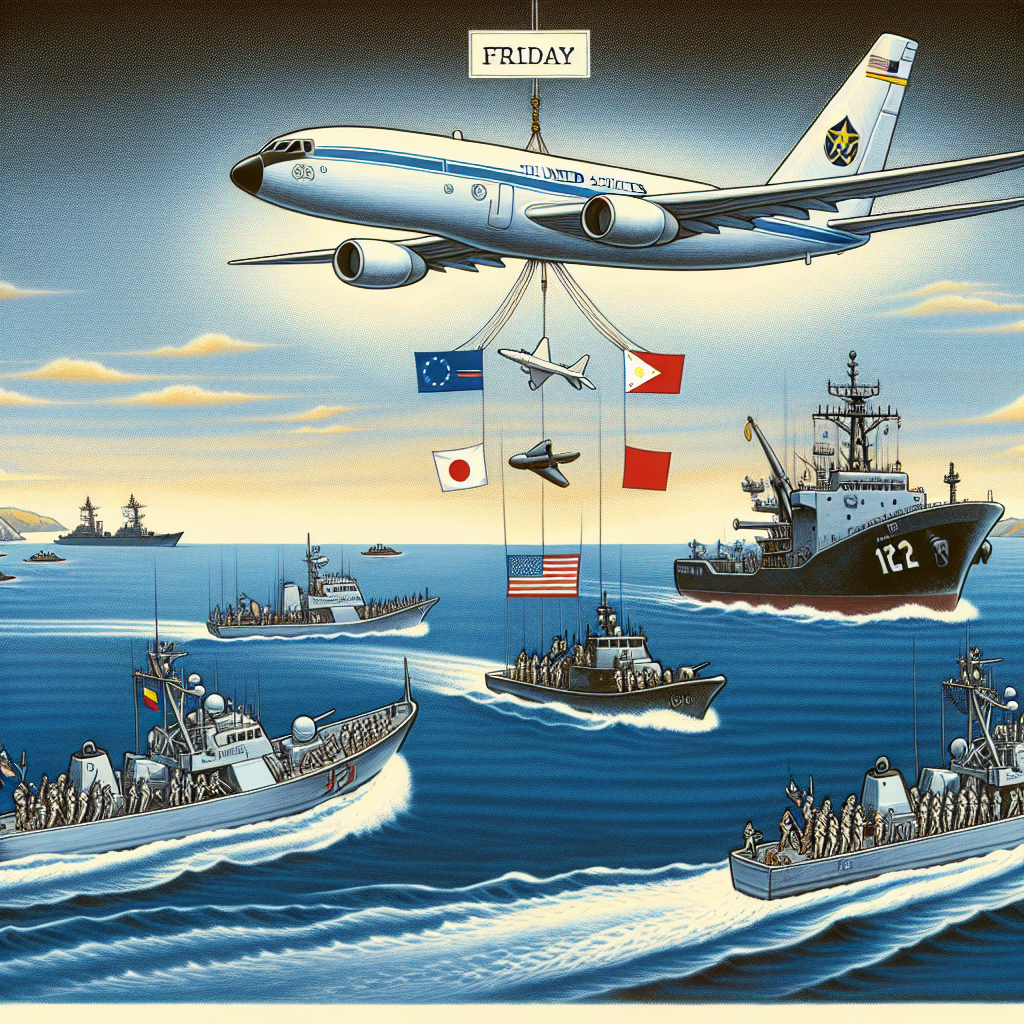
On Friday, December 6th, the United States deployed a reconnaissance aircraft, while Japan and the Philippines dispatched naval vessels to conduct joint patrols in the South China Sea. Just two days ago, the allies condemned the aggressive and provocative actions of Chinese coast guard ships against a Philippine patrol vessel.
The Indo-Pacific Command of the United States stated that the joint patrol was carried out by allies and partners in the Philippine Exclusive Economic Zone (EEZ) with the aim of upholding the rights of freedom of navigation and overflight, as well as other legitimate rights to use the seas and international airspace.
An Exclusive Economic Zone extends 200 nautical miles (370 kilometers) from a country’s coastline, granting that nation sovereignty over the exploration and exploitation of water and seabed natural resources.
According to reports from Reuters, the US Navy’s P-8A Poseidon aircraft, the Philippine Navy’s BRP Andres Bonifacio, a C-90 light aircraft, and Japan’s Murasame-class destroyer JS Samidare participated in Friday’s joint patrol exercise. This exercise, amid China’s increasingly assertive actions in the South China Sea, represented the latest round of joint training between the Philippines and its allies.
As per the Associated Press, two Philippine security officials disclosed that the patrol took place approximately 40 nautical miles (74 kilometers) from Scarborough Shoal. Scarborough Shoal is a highly disputed fishing ground near the northwest part of the Philippines.
The Philippine Coast Guard reported that Chinese coast guard ships, with the support of navy vessels, used powerful water cannons to intercept and attack a Philippine Bureau of Fisheries vessel escorted by a Coast Guard ship near Scarborough Shoal, ultimately blocking and ramming the small vessel.
The United States, Japan, the European Union, and other Western allies have expressed shock at China’s increasingly frequent hostile actions since last year.
Japan’s Ambassador to Manila, Endo Kazuya, stressed that “the use of high-pressure water cannons and obstructive maneuvers compromised the safety of the vessels and crew.” Japan, which also has territorial disputes with Beijing in the East China Sea, emphasized that it upholds the rule of law and opposes any actions that escalate tensions.
The Philippine vessels were en route to deliver fuel, food, and other aid to Philippine fishermen at Scarborough Shoal. Since the tense standoff with Philippine vessels in 2012, Scarborough Shoal has been closely guarded by Chinese coast guard patrols.
The Philippine Department of Foreign Affairs has continued to protest China’s actions.
China’s coast guard offered a different account of the incident, alleging that Philippine vessels violated Chinese territory, prompting the Chinese response, and claimed that the maneuvering of a Philippine vessel led to the collision without providing evidence.
According to Reuters, the Philippines also expressed astonishment at the presence of Chinese naval vessels near Scarborough Shoal, citing the vessel’s blockade and tailing of a Philippine Coast Guard ship as “a sharp escalation and provocation.”
China asserts sovereignty over the entire South China Sea and staunchly defends it with coast guard, navy, and suspected militia fleets against rival military forces from claimant states like the Philippines, Vietnam, Malaysia, and Brunei.
China has rejected a ruling by the Permanent Court of Arbitration at The Hague in 2016, which stated that its claims have no legal basis.
The sovereignty of Scarborough Shoal remains unestablished, but the tribunal did rule that China’s blockade violated international law, and the region is a traditional fishing ground used by fishermen from multiple countries.
The United States cautioned that if Philippine forces are attacked in the South China Sea, it is obligated to defend its ally the Philippines under the US-Philippines Treaty.
The defense commitment of the United States to the Philippines enjoys strong bipartisan support. Philippine officials anticipate that this commitment will continue under the incoming Trump administration.
Japan is set to provide 1.6 billion yen (approximately $10.6 million) in security aid this year, equipping the Philippine Navy with coastal radars, inflatable boats, and other defense equipment to enhance surveillance of the Philippine maritime domains, including the South China Sea. The two countries announced on Thursday that Japan also assisted in upgrading the Philippine Air Force’s airborne surveillance radars.
In the southern reaches of the South China Sea where the Natuna Sea, rich in natural gas, borders Indonesia, there have been standoffs between Indonesian fishermen escorted by Chinese coast guard ships.