
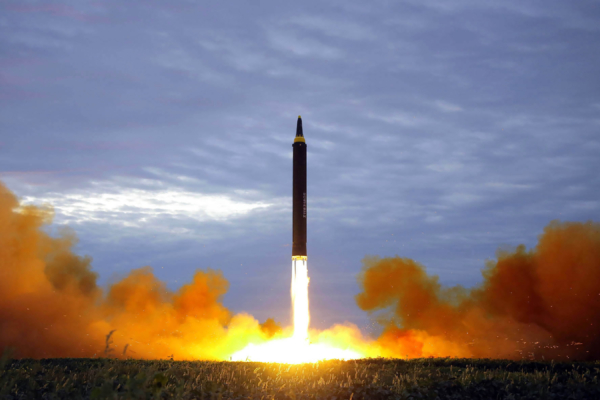
A Russian deserter has revealed that on the first day of the invasion of Ukraine by Russian forces in February 2022, his service at a nuclear weapons base entered a state of full combat readiness, capable of launching a nuclear attack within 2 minutes.
During an interview with the BBC, the Russian deserter who goes by the alias Anton, disclosed that he previously worked at a classified nuclear weapons base in Russia as part of the security team dedicated to safeguarding nuclear weapons. This security team serves as a rapid response unit for nuclear defense.
Anton mentioned that the soldiers serving at the base went through a rigorous selection process. Each individual was a professional soldier without conscripted soldiers among them.
He explained that everyone underwent continuous security checks and polygraph tests. Their salaries were significantly higher, and they were not deployed for combat missions. Their task was to respond to nuclear strikes or carry out nuclear attacks. Regular training was part of their routine, and their response time was just 2 minutes.
However, their lives were tightly controlled.
Anton stated, “My responsibility was to ensure that the soldiers under my command did not bring mobile phones into the nuclear weapons base. It was a closed society with no strangers. If you wanted your parents to visit, you had to apply to the Federal Security Service (FSB) of the Russian Federation three months in advance.”
He mentioned that on the first day of the Russia-Ukraine war, his unit was “locked in the base” and cut off from the outside world, only able to watch Russian state television.
He expressed that he did not understand the significance of it all. He was merely fulfilling his duty. They were not participating in the war; they were solely defending the nuclear arsenal.
Anton added that the combat readiness status was lifted after two to three weeks. Three days after Russian forces surged into the Ukrainian border, Russian President Putin declared that the nuclear deterrent forces had entered a “special combat mode”.
The Federation of American Scientists reported that Russia possesses around 4,380 usable nuclear warheads, but only 1,700 warheads are “deployed” or ready for use. This figure is comparable to the combined nuclear warheads of all NATO member countries.
Concerns have arisen about whether Putin would opt to deploy “non-strategic” (commonly referred to as tactical) nuclear weapons. These are smaller missiles that generally do not cause widespread radioactive fallout.
While some Western experts believe that most of Russia’s nuclear weapons are from the Soviet era and may be unusable, Anton rejects this perspective, believing that the experts’ views are too simplistic.
He asserted that while some regions in Russia may have outdated weapons, the country boasts a vast nuclear arsenal with numerous warheads, continuously conducting combat patrols on land, at sea, and in the air.
Anton insisted that Russia’s nuclear weapons were fully operational and combat-ready, with the maintenance of nuclear weapons ongoing without interruption.
As for why Anton chose to desert the Russian military, he received a “disgraceful command” shortly after the start of the Russia-Ukraine war. The order was very explicit in a written manner, instructing unit members that “Ukrainian civilians are combatants and should be eliminated”.
He stated, “This was a red line for me, it’s a war crime. I said, I will not spread this propaganda.” As a consequence, he faced reprimand from senior officers and was reassigned to a regular assault brigade in another region. He was informed that he would be sent into combat.
Some Russian deserters informed the BBC that these units were often among the “first wave” sent to the battlefield. Those who dissent against the war are seen as “troublemakers” by the state and treated as “cannon fodder”.
Before being sent to the front line, Anton signed a declaration refusing to take part in combat, leading to criminal charges against him. With the assistance of a volunteer organization aiding deserters, he managed to escape from Russia.
He expressed his hope that the world would know that many Russian military personnel opposed the war. Despite having fled from Russia, the Federal Security Service is still searching for his whereabouts.
Anton harbors no illusions about the risks involved in aiding other soldiers to escape. He said, “I know that the more I do, the greater their chances of trying to kill me.”
Epoch Times could not independently verify the authenticity of Anton’s statements.