
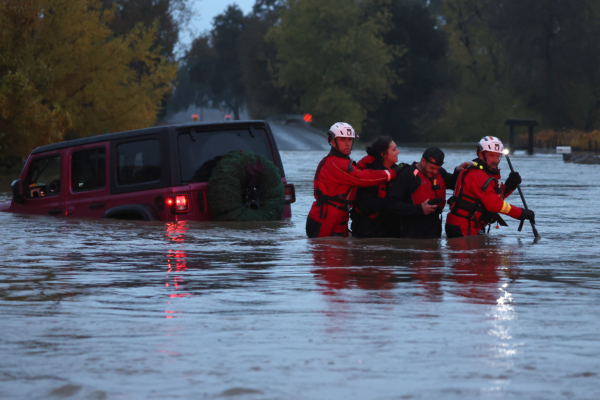
On Saturday, November 23, a major storm brought heavy snow and record-breaking rainfall to California, causing small-scale mudslides and flooding on some streets. At the same time, from the northeastern United States to the Appalachian region in the Midwest, blizzard warnings (winter storms) were in effect.
According to the report by the Associated Press, the West Coast storm arrived earlier in the week in the Pacific Northwest region, resulting in two fatalities and hundreds of thousands of power outages, with the majority concentrated in the Seattle area, followed by strong winds sweeping through Northern California.
The National Weather Service in the Bay Area of California reported that as of Friday night, Santa Rosa, California had experienced the wettest three days on record, with rainfall totaling about 12.5 inches (32 cm).
According to the California Department of Transportation, flooding has led to the closure of portions of the scenic Highway 1 (also known as the Pacific Coast Highway) in Mendocino County, and it is currently unclear when it will reopen.
On the East Coast, New York and New Jersey have recently been battling rare wildfires for a few weeks, but another storm arrived just in time to bring much-needed rain and heavy snow to northeastern Pennsylvania. Some areas in West Virginia remained under blizzard warnings on Saturday morning, with snow accumulation reaching up to 2 feet (61 cm) and strong winds posing dangers for travel.
As the weekend approached, over 112,000 people in Seattle were still without power. Earlier this week, the region faced the most powerful atmospheric river assault of the season. An atmospheric river is a long narrow strip of water vapor that forms over the ocean and flows over land. Cleanup crews were working to clear fallen power lines, tree branches, and other debris, while the city set up warming centers to provide hot meals for residents who had been without power for four days, as well as to charge their phones and other devices.
On Tuesday, the storm system hit the West Coast in the form of a “bomb cyclone.” This occurs when a cyclone rapidly intensifies—strong winds toppled trees, damaged roads, vehicles, and homes.
Debra Campbell from Crescent City, California, recounted how that night she sat in the dark with a flashlight, unable to sleep. The strong winds were fiercely pounding against her house. With a loud crash, a 150-foot (46 meters) tall tree fell onto her house and car.
“It was truly terrifying,” Campbell said as she grabbed her car keys and wallet and headed out the front door, only to find a big tree blocking the way.
Washington, Oregon, and coastal and northern California all issued high wind warnings. The California Cascades and Sierra Nevada regions also had winter storm warnings in effect.
In the drought-affected Northeast, as of Saturday morning, areas north of New York City were expected to receive over 2 inches (5 cm) of rain, with higher elevations likely seeing snowfall.
Despite the “chaos,” it is expected that this precipitation will help alleviate the abnormal drought that the state has been facing this fall.
“This won’t completely solve the drought problem, but it will definitely help when this snow melts,” said meteorologist Bryan Greenblatt from Binghamton, New York.
In northeastern Pennsylvania, including the Pocono Mountains, heavy snow fell, leading to school closures. Snow accumulation in high-altitude areas reached 17 inches (43 cm), while valley cities like Scranton and Wilkes-Barre saw less snow. Over 85,000 customers in ten counties experienced power outages, and the state’s Department of Transportation implemented speed restrictions on certain highways.
Meteorologists predict that as the Northeast storm moves into eastern Canada and the Western storm shifts southward, the storms on both coasts will begin to ease.
By Friday night, some relief had already started to appear in California, with the Humboldt County Sheriff’s Office downgrading evacuation orders near the Eel River to warnings, as meteorologists stated that the river was not projected to experience major flooding, at most moderate flooding.