
【Epoch Times, November 20, 2024】”King of Gambling” Stanley Ho is seen as a legendary figure. While the residents of the Asia Vegas City in the Hpakant Valley of Myanmar pray for his safe return, the Thai government is preparing to initiate his repatriation process. The latest news indicates that he was once again brutally assaulted in a Bangkok prison.
Chinese dissident Fu Yifeng, who recently fled Southeast Asia, informed Epoch Times reporters on November 18 that he learned of Stanley Ho’s assault on the evening of the 17th. Stanley’s current situation is dire, having been transferred to the death row section on October 9. Human rights lawyers have demanded prison authorities provide video evidence, which has been refused with no explanation.
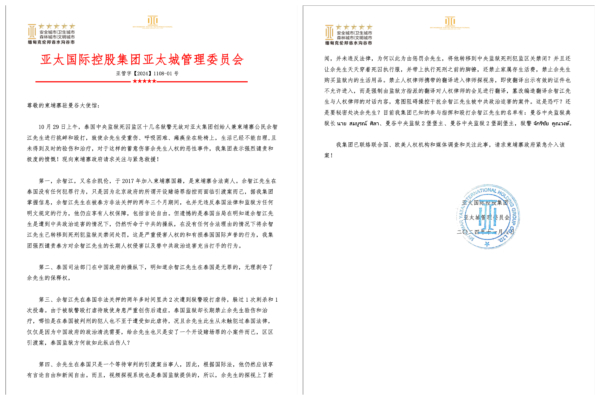
According to a statement issued by the Asia Pacific Group on October 30, on the morning of October 29, over a dozen prison guards at the Thai Central Prison’s death row section provoked and physically attacked Stanley Ho, founder of the Asia Pacific Group, causing him serious injuries, difficulty in breathing, and paralysis. He is now wheelchair-bound and unable to care for himself. He was not promptly examined or given medical treatment. The group strongly condemned this deliberate act of violence and lodged a formal protest with the Thai government.
On November 8, the Asia Pacific Group officially requested the Cambodian government to pay attention and provide emergency assistance (Stanley obtained Cambodian citizenship in 2017). The letter accused Thai authorities of following the manipulative instructions of the Chinese Communist Party, arbitrarily depriving Stanley Ho of his bail rights and subjecting him to mistreatment in prison. During his unlawful detention of over two years, Stanley was assaulted by prison guards twice, survived an assassination attempt, and a poisoning incident.
The letter stated that as a subject of an extradition case awaiting trial, under international law, Stanley still has the right to freedom of speech and press freedom.
Journalists reached out to the Thai Ministry of Justice for comments on the reported abuse Stanley Ho endured in the Central Prison but received no response as of the time of reporting.
In September of this year, Stanley Ho participated in an interview on the “East 101” program by Al Jazeera through a video visitation system provided by the Thai prison (he acquired Cambodian citizenship in 2017). This was his first media interview since his detention, where he exposed some shocking revelations. Previously, he had communicated with the media through a spokesperson.
Stanley expressed regret for joining the Chinese national security service. He mentioned that China (CCP) has colonial intentions, while he only wanted to conduct business.
He revealed that in late 2016, he was recruited by a man in the Philippines (the individual’s name was not disclosed in “East 101”) who presented him with a warrant bearing his name, promising to help clear his case (accused of operating an online gaming platform targeting Chinese nationals) and safely arrange his return home. The condition was that he had to become a spy for the Chinese national security service.
From 2017 to 2019, Stanley Ho made multiple high-profile visits to China. He mentioned that national security personnel in China took him to the northern regions of Myanmar and the Karen State of Cambodia for inspection purposes, while the China Overseas Chinese Association helped in signing agreements for the “Belt and Road” Asia Pacific New City project. Even his renouncement of Chinese nationality in 2017 was orchestrated by the Chinese national security.
In 2019, Stanley Ho was appointed Executive Vice Chairman of the China Federation of Overseas Chinese Businessmen. During an interview with Chinese media at that time, he became a prominent figure among overseas Chinese businessmen. He admitted that he was getting carried away, with the Political Consultative Conference honoring him as a model and a series of politically connected Chinese companies and organizations queuing up to cooperate with the Asia Pacific Group.
By 2020, Stanley Ho had established the Asia Pacific New City. Journalists from “East 101” visited the Thai-Myanmar border multiple times to interview residents of the Asia Pacific New City, which has been dubbed as the “Myanmar version of Las Vegas or Macau.” The population of the Hpakant Valley had increased by tens of thousands within just six years, with many fleeing conflict-ridden areas of Myanmar to settle there.
Earlier, Fu Yifeng was the first to publicly explore the Asia Pacific City. He also filmed numerous videos showcasing the bustling scenes within the city.
Reported by “East 101,” Stanley Ho mentioned that he was a former spy of the Chinese Communist Party and was being persecuted for knowing too much. He had come into contact with a lot of confidential information from the Chinese national security and “Belt and Road” projects, some of which were related to the “highest-level figure.” He feared for his life if extradited to China.
Stanley’s friend Wang Fugui said that Stanley left behind a lot of undisclosed files detailing the names of national security personnel. Currently, only a fraction of the information has been disclosed with authorization.
One of the names in the list, Guo Huaping, caught the attention of “East 101” journalists. Guo Huaping (Alice Guo) is the former Chinese-Chinese mayor of Davao Province in the Philippines, dismissed in 2022 for serious misconduct, including allegations of corruption, involvement in illegal gambling activities, and money laundering. In September of this year, Guo Huaping was extradited from Indonesia back to the Philippines and was also accused of being a Chinese spy.
In the interview, Stanley revealed that he had communicated with Guo via a phone provided by “above,” where she had requested financial support for her political campaign. However, Stanley refrained from providing her with funds, as he wanted to avoid offending the Philippine government.
Guo Huaping repeatedly claimed she was born in the Philippines, a prerequisite for holding public office in the country. However, the files held by Stanley Ho indicated that Guo was born in China with a registered address in Jinjiang, Quanzhou, Fujian. “East 101” journalists even visited Guo’s hometown in Fujian, with locals recognizing her as the daughter of a certain individual, confirming her birth there and departure only at the end of 2002.
Stanley Ho even made a plea to Guo Huaping, stating that China (CCP) cannot be trusted, and she should disclose the truth to the world to avoid any harm.
Fu Yifeng informed Epoch Times that Stanley Ho had been detained for about two years and three to four months, never infringing on Thai laws. Stanley is a target of persecution by the Chinese Communist government. Even though he revealed some sensitive information, the power wielded by the Chinese authorities is immense.
He remarked, “Stanley Ho is the owner of the Asia Pacific Group. The CCP wants to do away with him by tarnishing his reputation, labeling him with the hat of the KK fraud park, which is a death sentence. They aim to strip him of his money and his people. Individuals like Stanley, wealthy, influential, and powerful, can easily be eliminated by the CCP, to send a message to the outside world.
“And Stanley knows way too many national security secrets. He initially thrived in the Philippines, where he encountered many prominent individuals connected to the CCP’s infiltration in the country, including the recent ongoing case of Guo Huaping, well known in the Philippines.”
Fu Yifeng questioned the reasons behind Stanley’s assault, citing his interview with the Peninsula TV and a meeting with Ma Dongli, in charge of the CCP’s Belt and Road projects in Southeast Asia earlier this summer. Ma had visited the prison urging Stanley to voluntarily return to China, which Stanley refused.
According to insiders, Ma Dongli is a Red Second Generation, related to the Chinese national security system. Previously, Epoch Times reported that it was Ma Dongli who recruited Stanley. After becoming an agent of the Chinese national security, Stanley attracted several national security personnel. In 2017, in Yangon (Myanmar), the Asia International Holdings Group reached a development agreement with the local government, with the Chinese Embassy allegedly playing a crucial role. The project was described as a $15 billion economic zone.
Ma Dongli served as the Vice President and Executive Director of the company. During a January 2020 interview on CCTV’s “Chinatown” program, Ma Dongli mentioned plans for turning the Hpakant Valley into the next Hainan, intending to open direct air routes from Meso Airport to China. However, during the program, Ma Dongli’s public identity was presented as a businessman.
According to insiders, the conflict between Stanley Ho and the national security arose because the CCP wanted to take over the Asia Pacific City and intended for Stanley to expand to Taiwan, which became the starting point of the dispute. Stanley had a close relationship with local warlords in the region, possessing wealth, land, and an armed force, making him difficult to control, leading to national security planning to eliminate him.
In August 2022, during a banquet in Bangkok, Stanley Ho was arrested. Kamalin, an advisor to the Royal Thai Police, told “East 101” that they acted based on an Interpol red notice issued at China’s request.
The charge was suspected of operating a casino.
During the same period, the Chinese Embassy in Myanmar issued a statement declaring that the Asia Pacific City in Myanmar was an investment from a third country, having no connection to the “Belt and Road” initiative. Kamalin believed that under pressure from the Chinese government, Stanley would be repatriated to China by the end of this year.
In September of last year, Stanley Ho recorded a video in a Thai prison, publicly admitting to being a former operative of the Chinese national security service, alleging that he was framed and persecuted by the Chinese government, and declaring that he would not commit suicide.