
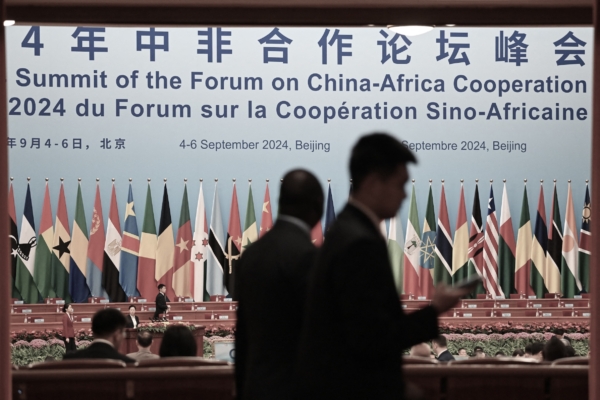
China’s economy has come to a standstill as local finances are in urgent need, and at this critical moment, the Chinese Communist Party (CCP) held a forum for China-Africa cooperation. CCP leader Xi Jinping announced that China will provide 1 billion RMB (Renminbi, equivalent to yuan) in unconditional military aid to African countries, and pledged to provide a funding support of 360 billion RMB over the next three years to promote the so-called “Ten Major Partners Action.” Observers have long believed that CCP’s policies are not genuinely aimed at improving the livelihood of its own people, but are driven by political interests.
According to a report by the CCP’s Xinhua News Agency, the 2024 China-Africa Cooperation Forum Beijing Summit started on the 4th, with the opening ceremony held at the Great Hall of the People on the 5th. Xi Jinping declared in his speech that the relations between China and Africa will be elevated to the status of a “new era of a comprehensive and all-weather community of shared future between China and Africa.”
The CCP claimed that in the next three years, China and Africa will engage in the “Ten Major Partners Action,” encompassing trade, industrial chains, interconnectivity, green development, and furthering the Belt and Road Initiative. China will provide 1 billion RMB in unconditional military aid to African countries, train 6,000 military personnel and 1,000 law enforcement officers, invite 500 young military officers to visit China, and engage in joint military exercises and patrols with African countries.
Regarding the aforementioned “Ten Major Partners Action,” Beijing stated that they will provide a funding support of 360 billion RMB, including 210 billion RMB in credit funds and 80 billion RMB in various forms of aid, while promoting Chinese investment in Africa by no less than 70 billion RMB.
Last night, the CCP authorities hosted a lavish dinner for African leaders.
It is worth noting that, after three years of the pandemic and the subsequent economic stagnation in China following the easing of lockdown measures, various industries are in a state of depression, unemployment is on the rise, and livelihoods are becoming increasingly difficult. The burden of local debts and financial difficulties have already become public knowledge.
A report by the National Institute of Financial and Development Studies of China recently revealed that in the first half of this year, the fiscal self-sufficiency rates of the 31 provincial-level administrative regions in China have declined to varying degrees since 2015. Nearly half of the regions have seen a decrease in fiscal self-sufficiency rates of over 10%. Half of the regions have fiscal self-sufficiency rates lower than pre-pandemic levels, with approximately one-third of the regions having rates even lower than last year.
Fiscal self-sufficiency rate is calculated as the ratio of general public budget revenue to general public budget expenditure. The report indicates that due to the sustained increase in expenditure compared to revenue, the range of expenses that local fiscal revenue can support is shrinking.
Due to fiscal difficulties, many regions in China have resorted to retroactively investigating tax revenues, following Beijing’s directive to sell assets, attempting to sell off debts and convert them to assets, and have continued to impose large-scale fines for revenue generation. Over a decade ago, CCP had gradually abolished tolls on ordinary roads (non-expressways), but now they are reintroducing them, provoking public outcry.
Director Lai Rong-wei of the Taiwan Inspirational Association (TIA) mentioned in an interview with Dajiyuan on September 2nd that the CCP places significant importance on Africa, as it has long engaged in practices similar to “surrounding the cities with rural areas,” aiming to unite with these relatively impoverished and underdeveloped countries to counter the major Western democratic powers.
Regarding CCP’s lavish spending, Lai Rong-wei stated that the policies dictated by the CCP’s dictators have never truly been for the betterment of China’s society and livelihoods, but are driven by political necessity. “Even with the economy in such disarray, in their mindset, these are not important matters.”
It is noteworthy that while CCP has pledged to train 6,000 military personnel for African countries, its own military has experienced significant corruption scandals in the past year, with two former defense ministers, Wei Feng and Li Shangfu, being dismissed, along with dozens of other military officials and high-ranking personnel being involved in collective misconduct.
In fact, throughout the process of promoting the Belt and Road Initiative in Beijing, CCP has been criticized for exporting authoritarian governance models and corruption to countries along the route, and for creating debt traps for the local nations.