
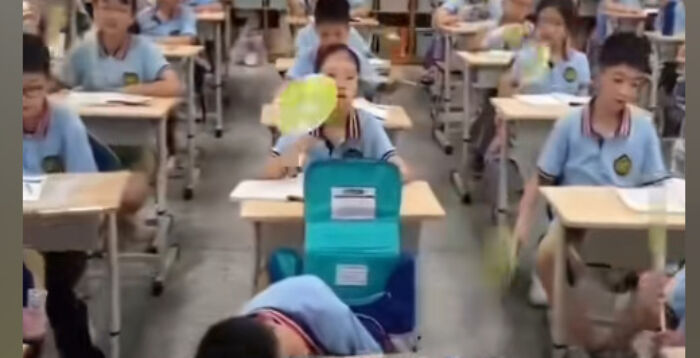
Recently, many provinces and cities in southern China have been experiencing high temperatures, with some areas reaching up to 43℃. On September 2nd, schools in various regions started the new school year, but due to the lack of air conditioning in classrooms, some students began to feel unwell. Some schools purchased ice cubes to cool down the classrooms, and even some parents voluntarily organized to transport ice cubes to their children’s classrooms.
On the first day of school, the regions known as the “furnace” in Sichuan and Chongqing also faced high temperatures. At 44 meteorological stations in Sichuan, Chongqing, and other areas, the highest temperatures exceeded 40℃, reaching up to 43℃. The Sichuan provincial meteorological service predicts that the high temperatures in Sichuan will continue until September 6th.
According to online videos, on September 2nd, at the Beixiao campus of Chengdu Shifan Yindu Ziteng Primary School in the Chengdu High-tech Zone, children in the classroom were fanning themselves with fans, some were even lying on tables due to the heat. It wasn’t until large ice blocks were placed in plastic containers next to their seats that the children finally settled down to study. A teacher recording the video lamented that the high temperatures were truly unbearable.
Many parents in Chengdu posted online about the high temperatures in primary school classrooms causing discomfort to their children. Concerned about heatstroke, parents began to call the complaint hotline.
On September 3rd, officials from the Qingyang District Education Bureau in Chengdu responded, announcing the suspension of classes until Wednesday of that week. If the high temperatures persist after Wednesday, further actions will be taken accordingly. It was reported that due to the prolonged high temperatures, cities like Zigong, Luzhou, and Meishan in Sichuan have postponed the start of the new school year.
Additionally, many other cities along the Yangtze River faced similar challenges of not being able to conduct regular classes due to the high temperatures.
According to the “Hai Bao News,” a parent in Changsha, Hunan, said that all primary schools in their area had students complaining of feeling dizzy and nauseous due to the heat. Another parent in Wuhan, Hubei, mentioned that their son experienced nosebleeds at school due to the heat. To prevent children from overheating, a parent in Hunan posted online on September 3rd, saying that parents were lining up to buy ice cubes to cool down the classrooms.
Due to the high temperatures, some regions have implemented school closures. On September 2nd, public and private primary schools and kindergartens in Jiujiang City, Jiangxi Province, announced that classes would be suspended from September 3rd to the 9th for resumption. On September 3rd, primary schools like Yanshan and Experimental in the Furong District of Changsha, Hunan, declared that from September 4th to 6th, students would have unified home learning.
Currently, many cities in Hunan, Anhui, Jiangxi, Sichuan, Chongqing, and other places have urgently suspended or delayed the start of the new school year.
This news stirred some netizens to question: “In 2024, why do our primary and secondary schools still not have air conditioning?”
In response, the Education Department of Kaifu District in Changsha told “Zhengzai News” that due to current policies, electricity constraints, financial difficulties, among other challenges, the installation of air conditioning is not universally supported. A school staff member in Changsha mentioned that the decision to install air conditioning requires a comprehensive assessment by the education department. Not installing air conditioning is seen as a way to “cultivate the spirit of endurance and hard work in primary school students.”
The responses to this issue sparked heated discussions online. Netizens suggested, “Leaders at all levels should also work in non-air-conditioned offices.” “From top to bottom, leadership should lead by example in promoting endurance and thriftiness.” “Stop forcing it. The Education Department’s office should turn off the air conditioning!” “If there is a lack of funds, dismantle the air conditioners in government offices and install them in schools. The Party should endure a bit of hardship for the people.” “So many public restrooms have air conditioning as part of image projects, yet schools don’t. Offices of various levels of leadership have air conditioning, but classrooms don’t. It’s not about insufficient funds; it’s about money not being used for the benefit of students.”