
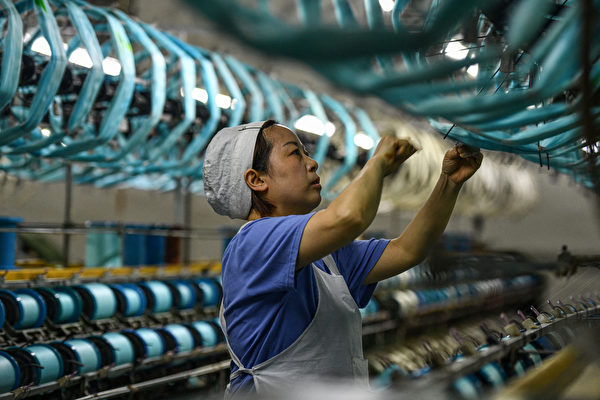
According to official data released by the Chinese government on Saturday, August 31st, factory prices in China plummeted in August, making it difficult for business owners to secure orders, leading to a six-month low in manufacturing activity. This marks the fourth consecutive month of factory activity contraction and puts pressure on Chinese policy makers, signaling potential challenges in achieving this year’s economic growth targets.
The data released by the National Bureau of Statistics of China on Saturday showed that the Purchasing Managers’ Index (PMI) for China dropped from 49.4 in July to 49.1 in August, marking the sixth consecutive month of decline and the fourth month below the 50 threshold line of the PMI index.
A PMI index above 50 indicates expansion in manufacturing activity, while below 50 indicates contraction. In addition to being below 50 in August, the PMI index also fell below the median of 49.5 predicted in a Reuters survey.
Official data also revealed that factory prices hit their lowest level in 14 months in August, dropping from 46.3 in July to 42.
Looking at the breakdown of the indices, the production index was 49.8, below the critical point, indicating a slowdown in manufacturing production activities; the new orders index was 48.9, lower than July’s 49.3, showing a decline in manufacturing market demand; the new export orders index was 48.7. Manufacturers are still maintaining a freeze on hiring.
As trade tensions escalate between the US and Europe, the obstacles facing China’s manufacturing industry are growing.
According to a report by Reuters, Zhiwei Zhang, chief economist at Pinpoint Asset Management, stated, “The fiscal policy stance remains quite restrictive, which may be one of the reasons behind the sluggish economic momentum.”
“To achieve economic stability, the fiscal policy stance needs to become more supportive. With the US economy slowing down, exports may not be as reliable a source of economic growth as in the first half of the year,” he added.
Reuters noted that unless the severe downturn in the real estate sector is alleviated, any efforts to boost domestic demand could be ineffective.
The real estate industry plays a significant role in the Chinese economy, accounting for a quarter of the total economic output at its peak and about 60% to 70% of household wealth in China. The prolonged slump in real estate has been affecting consumer spending in China.
Bloomberg reported that recent data shows a contraction in physical economic loans in China for the first time in 20 years, a surprising slowdown in fixed asset investment, and weaker-than-expected exports. With the real estate slowdown and a weak job market hindering business and consumer spending, credit demand remains low.
Economists Chang Shu and Eric Zhu from Bloomberg stated that the sluggish PMI index for two consecutive months this quarter, including the recent unexpected decline in the manufacturing index, indicates bleak economic prospects.
Economists from UBS Group AG and JPMorgan Chase & Co. predict that China will not be able to achieve its growth target this year.
External demand for Chinese exports is also under pressure. The United States and the European Union have taken action to impose new trade barriers on Chinese products, accusing Beijing of creating excess capacity through government subsidies. The impact of the EU’s new tariffs had already been seen in July, with a decrease in the number of electric cars registered by Chinese automotive manufacturers in Europe.