
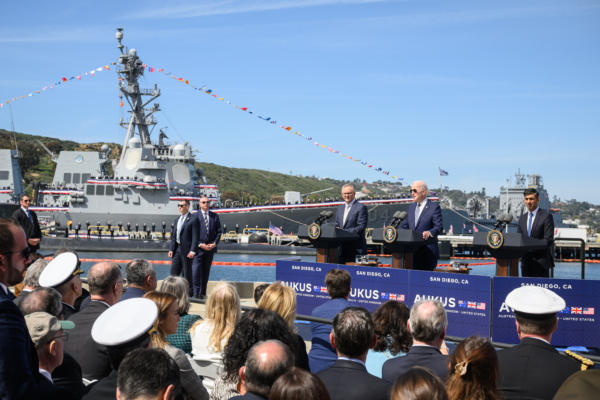
Australia, UK, and US defense ministers have announced that maintenance work on a US nuclear-powered submarine will take place for the first time in Australia on Friday, August 23. This marks a key step in the AUKUS partnership to deter Chinese aggression in the Indo-Pacific region.
According to reports by Reuters, the US nuclear-powered submarine, which is stationed at the HMAS Stirling naval base in Western Australia, has undergone a year of joint military training with the Australian, American, and British navies before maintenance work.
In a joint statement, the defense ministers of the US, UK, and Australia stated, “Our navies are committed to strengthening the same guiding principles within Australia that have ensured the safe operation of US and UK nuclear-powered vessels for nearly 70 years.”
“AUKUS sets the highest standards for non-proliferation for Australia to acquire armed nuclear-powered submarines,” stated US Defense Secretary Lloyd Austin, Australian Defense Minister Richard Marles, and UK Defense Minister John Healey in the announcement.
On August 15, the three partners of AUKUS announced the relaxation of defense export control measures among Australia, UK, and the US, removing obstacles for nuclear submarine maintenance tasks.
The US Virginia-class nuclear-powered submarine “USS Hawaii” and a US service ship carrying equipment and maintenance personnel have arrived at the Stirling naval base. The maintenance work for this nuclear submarine is typically conducted in US ports.
Starting from 2027, a UK Astute-class nuclear-powered submarine and up to four US Virginia-class nuclear submarines will be alternately deployed at the Stirling naval base in Australia. This will allow Australia to establish a fleet of conventional and nuclear-armed submarines over the next decade.
In the next twenty years, Australia will purchase US nuclear-powered attack submarines and collaborate with the UK and US on developing new conventional nuclear submarines.
Due to Australia’s lack of a nuclear industry, the country’s defense department emphasized that there will be no radiation materials brought ashore during the maintenance of nuclear submarines to address concerns over nuclear waste storage.
Two weeks ago, Michael McCaul, Chairman of the US House Foreign Affairs Committee, visited the Philippines before traveling to Australia.
McCaul stated in an interview with the media in Sydney that the rotation deployment of US nuclear submarines through Australian military bases enhances US deterrence in the Indo-Pacific region, especially amidst Chinese pressure on the Philippines in the South China Sea issue.
The US Navy Secretary stated in Friday’s announcement that conducting maintenance of US submarines in Australia is an important step to “better deter aggression in the region and uphold a rules-based international order.”
In early August, the US and Australia held their annual AUSMIN consultations in Maryland. Following the meeting, US Defense Secretary Austin announced that the US would increase rotational troop presence in Australia.
Furthermore, the US and Australia pledged to jointly manufacture guided weapons starting from 2025 to enhance supply to allies in the Indo-Pacific region and increase US military presence in Australia, including bombers.
The Australian Defense Department subsequently announced that training involving B-2 stealth bombers in Queensland on the east coast of Australia will include air-to-air refueling conducted by the Royal Australian Air Force.