
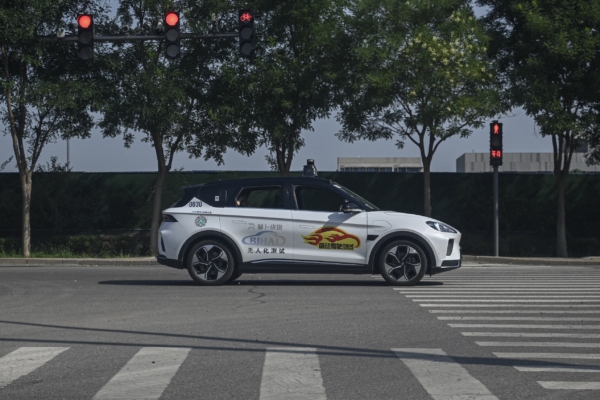
Baidu’s autonomous taxi “Carrot Speed” recently launched a pilot program in Wuhan, China, sparking controversy. The main focus is on the promotion of autonomous taxis in the context of China’s economic downturn and rising unemployment rates, potentially encroaching on the livelihoods of millions of taxi drivers. Numerous experts believe that the Chinese Communist Party (CCP) is not truly considering the livelihoods of the people; instead, its goal is to achieve global dominance in the field of autonomous taxis and turn Chinese society into a high-tech testing ground.
“Carrot Speed” has successfully implemented autonomous passenger services with the support of the Wuhan government. In the streets of Wuhan, slow-moving white electric cars without drivers in the front seats can be seen, with the steering wheel turning on its own and passengers sitting in the back.
Currently, “Carrot Speed” has started passenger service testing operations in 11 cities and launched fully driverless travel services in Beijing, Wuhan, Chongqing, Shenzhen, and Shanghai. Wuhan is the first city in China that does not require autonomous ride-hailing vehicles to be equipped with on-board “safety officers,” as they are monitored remotely.
According to local media reports, the discounted price of “Carrot Speed” in Wuhan ranges from 4 to 16 yuan per 10 kilometers, while the prices of traditional taxis and ride-hailing services range from 18 to 30 yuan.
“Carrot Speed” operates similar to regular ride-hailing services, where passengers can place orders through an app or mini-program. Upon arrival, passengers need to enter the last four digits of their phone number on a small screen near the car’s rear door to unlock it. The screen inside the car prompts passengers to confirm the trip; if not confirmed manually, the car will remain stationary.
One of the most criticized drawbacks of “Carrot Speed” currently is its slow speed and strict adherence to rules, leading to instances of sudden stops or road blockages. On July 7, 2024, a video circulated online showing a “Carrot Speed” colliding with a pedestrian in Wuhan, causing traffic congestion.
According to “Hubei Releases,” each “Carrot Speed” car receives over 20 orders per day, surpassing traditional taxis in order volume. Some ride-hailing drivers believe the current price advantage of “Carrot Speed” is due to capital subsidies.
Baidu’s financial report for the first quarter of this year shows that over 55% of ride orders were for fully autonomous rides, increasing to 70% in April. Baidu predicts that “Carrot Speed” is expected to break even in Wuhan by the end of 2024 and turn a profit in 2025.
Many viewpoints suggest that the days of autonomous taxis replacing ride-hailing and traditional taxis may not be far off, raising concerns, especially against the backdrop of high unemployment rates.
Amid a wave of job losses, the number of ride-hailing drivers in China has surged in recent years. According to statistics from China’s ride-hailing regulatory platform, the number of issued ride-hailing driver licenses increased by 112.4%, from 2.545 million licenses in October 2020 to 5.406 million licenses in April 2024.
In Beijing, “Carrot Speed” has also been introduced. Mr. Gao, a white-collar worker, shared his positive experience with a reporter on July 14, 2024, stating that he recently took a ride with “Carrot Speed” and found it cost-effective. He mentioned concerns from ride-hailing drivers about job insecurity, citing a 40% reported unemployment rate in Beijing’s Haidian district last month, despite the apparent prosperity in the city.
On July 15, the National Bureau of Statistics of China stated that the average urban unemployment rate in the first half of the year was 5.1%, a 0.2% decrease from the same period last year. However, Chinese netizens questioned the scope of the unemployment rate statistics, asking who is included and excluded, and how significant the data is.
Recently, local taxi operators in Wuhan released an open letter petitioning for “strict control of the number of ride-hailing vehicles” and fair competition. They demanded restrictions on the service area of autonomous taxis like “Carrot Speed” to avoid granting privileges and blanket service availability.
Regarding the potential widespread adoption of autonomous taxis, Mr. Gao expressed concerns about the impact on the taxi industry, driving schools, and car sellers. He emphasized the interconnectedness of these industries with people’s daily lives and raised apprehensions about the potential repercussions on China’s manufacturing sector.
Officially controlled mainland media outlets are attempting to address the controversy surrounding displacing traditional ride-hailing drivers with autonomous vehicles to mitigate public outcry.
Reports by various Chinese outlets depict different perspectives on the advent of autonomous ride-hailing services. Predictions suggest that it may take another 10 to 15 years for widespread adoption in China, with several challenges to overcome for large-scale commercialization.
Wang Xiaowen, an assistant researcher at the Taiwan Institute for National Defense and Security Studies specializing in CCP military and operational concept research, noted that autonomous taxis are still in the experimental stage. However, the potential large-scale commercialization could lead to mass unemployment among human taxi and ride-hailing drivers.
In light of the CCP’s accelerated push for the deployment of autonomous taxis, Wang observed that their primary objective is to surpass the United States. Even though the US leads in autonomous driving technology, only in recent years have testing programs for autonomous vehicles been initiated. In February 2022, the California Public Utilities Commission granted permits to General Motors’ Cruise and Alphabet’s Waymo to operate autonomous vehicles for passenger transport in the presence of safety drivers.
Experts highlighted by media reports suggest that achieving widespread commercialization of autonomous taxis requires overcoming challenges like public acceptance and traffic legislation.
Wang pointed out that challenges related to regulations, standards, capabilities, and business models remain unresolved. He noted concerns about safety and slow driving speeds once the initial novelty of autonomous taxis wears off.
The coexistence of new technology with human lives raises safety concerns, such as emergency situations like fires or passengers needing to self-evacuate. Additionally, the potential social instability posed by displaced taxi drivers is a vital aspect to consider.
Wang emphasized that if the number of autonomous taxis exceeds human-driven taxis or ride-hailing vehicles, and if the CCP fails to provide retraining for human drivers, it could result in significant job losses. However, driven by global ambitions and national pride, the CCP is unlikely to prioritize the losses suffered by the people.
Wu Sezhi, a researcher at the Taiwan Strait Policy Association, expressed that the CCP’s development of a fully autonomous vehicle industry serves two main purposes. Firstly, it showcases national competitiveness, yet with current overcapacity in electric vehicle production, combining it with autonomous taxis could exacerbate social issues like unemployment.
Secondly, the CCP aims to demonstrate control over society. If autonomous driving technology expands in China, the government could use it to control social behavior by restricting access based on social credit ratings, potentially leading to the apprehension of suspicious individuals.
Despite the potential benefits of autonomous taxis, there are concerns about the negative repercussions, with society becoming a test subject for high-tech advancements.
David Wong, an American economist, highlighted the stringent legal and safety concerns in the United States that limit autonomous driving research for companies like Google and Tesla. In contrast, the CCP can easily modify laws, regulations, funding, and road rights without such constraints, making China an ideal test ground.
Wong opined that the CCP’s primary consideration is outperforming others in global markets through electric and autonomous vehicles to dominate the industry. The safety of passengers or concerns about unemployment are not top priorities for the CCP, focused instead on technological advancement and global dominance.
As Tesla CEO Elon Musk seeks to introduce Robotaxi services in China, experts underscore that it is a strategic move to tap into the Chinese market. However, from the CCP’s perspective, the key interest lies in securing advanced technology capabilities related to autonomous driving, a tactic commonly employed by the CCP.
For many high-tech industries, China serves as a testing ground for autonomous driving applications. It raises concerns from both the CCP and the international community, as Chinese society and its people become subjects for experimental technologies.
In conclusion, the introduction of autonomous taxis raises complex social, economic, and ethical considerations that necessitate careful evaluation to ensure the well-being of all stakeholders involved.