
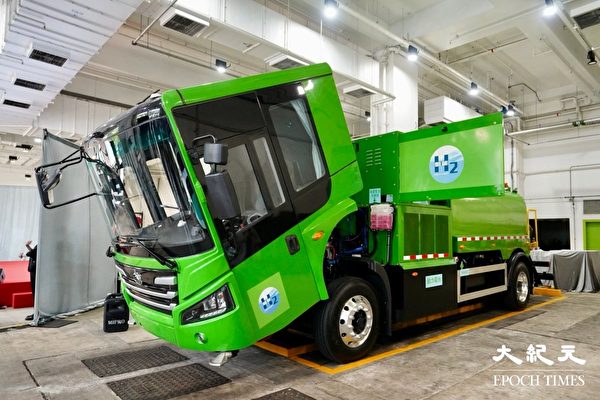
The government has announced the “Hong Kong Hydrogen Development Strategy”, stating that it will propose amendments to the Legislative Council in the first half of 2025 to regulate the use of hydrogen gas as fuel.
Secretary for the Environment and Ecology, Che Zhanhuan, mentioned that the legislation will regulate the production, storage, transportation, supply, and use of hydrogen gas intended for fuel purposes. By 2027 or earlier, they plan to align with international hydrogen energy standards, promote regional cooperation, overseas investment, joint development, or hydrogen importation, with the aim of positioning Hong Kong as a demonstration base for hydrogen energy development in China.
In the preceding year, the government established a cross-departmental Hydrogen Energy Working Group and has formulated provisional standards for hydrogen application in Hong Kong. Of the approved 14 pilot projects, hydrogen buses were put into service in February, with the construction of the first public hydrogen refueling station underway and expected to be operational later this year. Additionally, the Environmental Protection Department will launch a pilot program for three hydrogen fuel cell street washing vehicles.
Furthermore, MTR Corporation is preparing to test hydrogen-powered trams in a non-passenger capacity, with plans to commence testing in the second half of this year. Che Zhanhuan expressed confidence in the hydrogen supply, emphasizing the need to identify cost-effective scenarios through various trials.
Che also highlighted plans to expand the Hydrogen Energy Working Group’s functions, including reviewing and approving pilot projects, coordinating and formulating technical standards and guidelines related to hydrogen application, supporting talent training, and promoting hydrogen energy popularization.
When asked about the future proportion of zero-carbon energy usage, Che mentioned various options such as solar energy, wind energy, nuclear power, all of which are currently approaching large-scale usability and offer price advantages over hydrogen energy. However, hydrogen energy is deemed more stable and convenient compared to other renewable energy sources. The hope is for hydrogen energy to develop on a large scale, although without certainty regarding its future cost-effectiveness, specific usage proportions have yet to be determined, with prioritization of projects with cost-effectiveness in the future.