
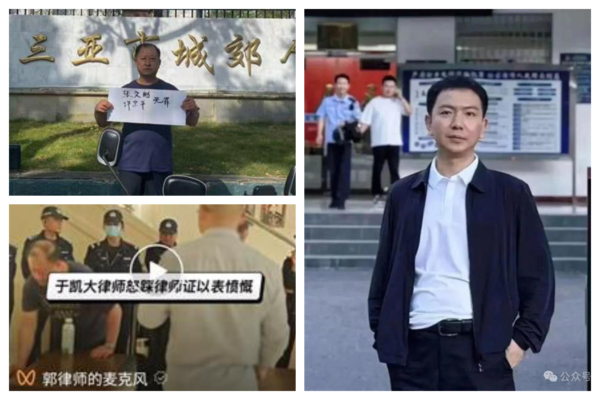
On February 9th, lawyers Zhang Wenpeng and Xu Zongping were charged with “provoking trouble” and appeared in court at the suburban court in Sanya, Hainan. Due to the courtroom being filled with personnel arranged by the court, the defendants’ pre-registered family and friends were not allowed to sit in the gallery, leading to significant dissatisfaction.
Zhang Wenpeng’s former leader, lawyer Yu Kai from Shandong, drove thousands of miles despite being ill, just to see Zhang Wenpeng. Although attendance was pre-registered, they were unsuccessful, and the defendants’ family and friends were all guided to the video viewing room.
Lawyer Yu Kai angrily expressed, “I have believed in the law my whole life, but my faith collapsed in front of the court!” He furiously threw his lawyer’s badge to the ground and stomped on it.
During the trial, when Zhang Wenpeng was brought into the courtroom and saw the gallery, realizing none of his acquaintances were present, he couldn’t help but erupt in angry outbursts, leading to a heated scene. Due to Zhang Wenpeng’s overly emotional state and intense words, the trial was disrupted multiple times and adjourned six times in the morning.
Lawyer Yu Kai later revealed that before the trial, the defense team had submitted a list of individuals for attendance according to the law. However, the court did not make arrangements. The gallery was occupied by a large number of unrelated individuals organized by the court, and the defense team and defendants raised objections multiple times regarding this illegal situation, demanding protection of the lawful right to attendance. However, the presiding judge Lin Fangyi and others ignored these appeals.
Yu Kai believes that the court evades public trial by restricting attendance, which is more malicious than directly declaring a “non-public hearing” because it constitutes a hypocritical execution of the law and a contempt for public intelligence.
The human rights lawyer from Guangdong who attended the trial that day revealed, “Zhang Wenpeng strongly opposes the restriction on attendance. Once in the courtroom, he harshly reprimanded the judge, leading to a confrontation, and when the judge moved Zhang Wenpeng to a secondary courtroom, he resumed his criticism upon speaking.”
He stated, “All defense lawyers were also fighting for our right to attend in the courtroom. Even the pre-registered attendees were not allowed to enter the courtroom for attendance. The court simply does not want a fair trial for Zhang Wenpeng and Xu Zongping.”
According to Zhang Wenpeng’s proxy lawyer, the Hainan authorities have engaged in various illegal activities, including not allowing defense lawyers to meet, refusing lawyers to review the case files, and unjustly revoking defense attorneys’ qualifications.
The Haiyun Group in Sanya, Hainan, is a company valued at over 10 billion yuan. A few years ago, they won a commercial arbitration case against the official Chinese Communist Party, entitling them to a compensation of 2.6 billion yuan. However, the authorities not only refused to compensate but also arrested top executives including the company’s chairman Chen Xianqing and placed the Haiyun Group under trusteeship.
In February 2021, Chen Xianqing was criminally detained and later prosecuted by the Haikou City Prosecutor’s Office on charges of “contract fraud” among other crimes. Insiders revealed that the CCP authorities were illegally detaining Chen Xianqing and placing the Haiyun Group under trusteeship to “criminalize debt” and seize assets.
Subsequently, Zhang Wenpeng, a former intern at the Xiaolin Law Firm in Shandong, was hired by the group as the CEO and chief legal counsel, while Xu Zongping became the deputy general manager of the Haiyun Group in Sanya. Zhang Wenpeng and Xu Zongping led the Haiyun Group in standing up for their rights through proper communication and legal means, which clashed with the vested interests of the Hainan provincial authorities, resulting in retaliation.
Recently, some local courts have sparked social controversy by adopting the practice of “saving seats” for spectators while restricting the attendance of the defendants’ families and friends during public hearings.
An article on the public account “Fair Law and Good Governance, the People’s Aspiration” stated, “It is illegal to ‘save seats’ for spectators! The gallery is not the court’s reserve, and attendance should not be restricted. Does the constitutional law mandate ‘open trial’ still exist? If this requirement is violated, who will be held accountable? Has the attendance system implemented for over 20 years been effectively abolished?”
The article revealed, “On February 2nd, during a trial of the ‘Wish Candle Fraud’ case at the Liaoyuan Intermediate People’s Court, the court was exposed to ‘saving seats’—several court leaders and officials were seated in the gallery, while some out-of-town spectators were denied access, citing that the gallery was full. Those who had coordinated attendance beforehand were unable to enter due to the seat-saving. Consequently, some deemed the court suspicious and mockingly referred to the case as ‘fraudsters judging fraudsters.'”
Furthermore, informants exposed that some gallery seats at the court had been temporarily removed (two rows of seats were taken away). Defense lawyers who raised concerns about “restricting attendance” were rebuked.
Similarly, spectators were limited in the trial of self-media personality Yin Jiangan at the Hefei County Court in Anhui on February 11th in the “provoking trouble” case (also known as the “pen farming case”). The gallery was again filled with individuals arranged by the court, leaving only three seats for the defendants’ family and friends. Upon arriving early in the morning to observe, the families and friends vehemently argued with the court police but ultimately were turned away.