
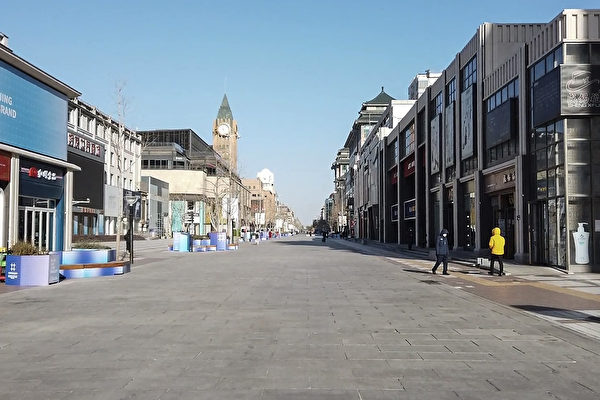
The Chinese authorities’ three-year COVID-19 lockdown policy has officially come to an end, but the “aftermath” it left behind continues to ferment.
In Guangdong, a former entrepreneur who built his company from scratch with professional skills saw his business collapse overnight during the COVID-19 lockdown period, ultimately accumulating debts of millions of yuan. Now, suffering from kidney stones and kidney hydrops, he is unable to afford the surgery costs, resorting to selling his blood to make ends meet and even attempting suicide twice. His experience is a microcosm of the many private entrepreneurs in China who are deeply trapped in difficulties.
Chen Jiahao, a 39-year-old from Maoming City, Guangdong Province, was the first university graduate from a local rural area. He graduated with a major in automation mechanical and software engineering, and started his career by developing industrial control software, gradually accumulating capital for his entrepreneurial venture.
Around 2011, he identified the market gap in refrigeration equipment for edible fungi cold chain, starting from scratch and expanding his business to high-end cold control equipment fields such as artificial climate chambers, hospital blood storage, and research institution seed storage. An artificial climate chamber controls temperature, humidity, light, and CO2 concentration in a room, simulating the climate changes of the four seasons on earth, specifically used for storing national seed resources, plant varieties cultivated by research institutions, and hospital blood banks.
In 2019, Chen Jiahao stood at a new starting point in his career. With the government vigorously promoting cold chain construction at the time, he increased investment, expanded his factory, purchased new equipment, and borrowed a substantial amount of money. By October 2019, the expansion had been completed, and he was ready to make a big move.
“You can imagine, it’s like rehearsing for a play, you’ve set up the stage and are about to start singing, then someone presses the pause button, and you can’t move,” he said.
At the beginning, Chen Jiahao remained optimistic about the situation: “Didn’t we have SARS in 2003? Back then, we thought it would pass quickly, just like that epidemic. But this time, the virus lasted for a full three years, with lockdown looming at any time, frequently resulting in city closures.”
“It was like being trapped for three years, you couldn’t go out, couldn’t change places, you were just stuck, and when they said lockdown, you had to lockdown,” Chen Jiahao said. “Thinking back now gives me chills.”
Orders the company received couldn’t be fulfilled, penalties for breach of contract resulted in losses, equipment sat idle with factory rent and worker wages still needing to be paid. The promising prospective profits from new equipment were wasted. Three years of lockdown completely severed the financial chain.
Chen Jiahao sold all his property, vehicles, and cold storage equipment at a heavily discounted price. “I bought them for one million seven hundred thousand, some cost one or two million, and later the most I got was a one or two percent discount, maximum three or four percent, to offset all those things,” he recounted, still left with over three million yuan in unresolved debts.
“I lost over eight million, sold everything, houses, cars, then offset them, still left with over three million. My girlfriend also left,” he said.
Debt collectors began hounding him with various sources of debt including bank loans, internet financial platforms (Ant Jiebei, Huabei, WeChat Credit Loan, Xiaomi Finance), and private loans.
Among them, third-party collection methods from banks and platforms were the most ruthless.
“Only those who have experienced it know that they stop at nothing. They call in the middle of the night at one or two o’clock, three or four o’clock, if you don’t answer, they keep calling, they even know if you change numbers,” Chen Jiahao told the reporter. “They bombarded all the hundreds of contacts in my address book, sending hundreds of spam messages every minute, sending hundreds in a row, letting everyone know that you owe money, tarnishing your reputation.”
Due to uploading contact lists and authorizing call records during the loan application process, the collection company had access to information on all his contacts. The collection agency also actively contacted the companies he applied for jobs at, sent threatening emails, made harassing phone calls, causing him to be expelled whenever he found a new job.
“I told him nicely, saying if you don’t let me work, and now I have no money to spend. If you don’t let me work, I’ll never be able to repay my debts. They don’t care, if one collection company doesn’t collect, then another will,” he said.
Chen Jiahao described the situation as “like a relentless spirit” – wherever he went, the collectors followed, making it impossible for him to regain foothold.
In 2024, tragedy struck as Chen Jiahao’s father passed away due to liver cancer. “My father passed away in July 2024, and it was quite sad, I couldn’t even afford to handle the aftermath,” he said.
Shortly after, his mother followed, both close relatives passing away within two to three months. He then experienced a gastric ulcer perforation, then broke the fibula of his leg while riding a bike. His two original business partners left him under the heavy pressure of the severed financial chain.
In his downfall, Chen Jiahao also faced betrayal from close relatives. He had generously supported many relatives, even paid the interest for a relative’s entrepreneurial loan. Every time they asked to borrow money, whether it was ten thousand, twenty thousand, or one hundred thousand, he never refused.
“I thought at that time, family, relatives, they wouldn’t mistreat me when they are well-off, right?” Chen Jiahao said.
However, when he was in dire straits and requested leniency, this relative not only refused but also took him to court, spreading news of his losses and closure.
“It wasn’t until I really lost money that I realized, I was wrong. They weren’t thinking of helping me, they were trying to step on me,” Chen Jiahao said, “Conscience is a good thing, but not everyone has one – this is what I have learned from personal experience.”
Under multiple pressures, Chen Jiahao suffered from depression at one point: “At that time, my hair on my head was falling out, I was in my thirties, and my hair was falling out like the Mediterranean Sea.”
In March and May 2025, he attempted suicide twice. The first time, after taking sleeping pills, he woke up on his own. The second time, when village officials came to check the homestead, knocking on the door yielded no response, they broke in and saved him from unconsciousness.
“Perhaps fate didn’t want me to die yet,” he said.
Chen Jiahao posted his experiences online, thinking it was a unique case, but the responses in the comments section were overwhelming.
“I thought I was the only one who had experienced that, but tens of thousands of people said they could empathize. This is something only those who have experienced it can understand, unless you have lived through it, it’s really hard to imagine and understand,” he said.
In mid-2025, penniless Chen Jiahao resorted to selling his blood privately to make a living. He discreetly inquired at blood stations and hospitals, asking whether donating blood came with compensation.
Usually, 400 milliliters only earned him 400 yuan; it was only when he encountered a patient in urgent need of blood for surgery that he received more – once, he was paid 1,500 yuan for donating 400 milliliters.
“That time, the pay was better because the person was kind; for other times, 400 milliliters got me at most 400 yuan, if I didn’t meet anyone, then I didn’t earn anything,” he said.
Having sold blood four or five times, he bluntly stated, “When you’re so poor that you sell blood, who cares about regulations? The government doesn’t care whether you live or die, what does it matter if you die on the roadside?”
Now, Chen Jiahao’s right kidney stone has grown to 1.3 centimeters, leading to moderate kidney hydrops with inflammation. The treatment costs around two to three thousand yuan, an astronomical figure for him.
In the past two months, Chen Jiahao’s health has worsened due to repeated blood loss: he blacked out when standing up from a crouching position, his blood pressure dropped, and blood station staff dared not draw blood from him anymore, warning that “taking more blood would kill him.”
At the same time, the pain intensified. He said, “The kidney stone and hydrops cause excruciating pain, I’ve fainted from the pain several times, and now even with painkillers, I can’t control the pain, I wake up after fainting, and there’s no one else at home.”
Chen Jiahao had appealed to the village committee for assistance but was told that with a university education, he did not meet the criteria for aid. He attempted online crowdfunding, but the platform informed him it was out of their service scope, and withdrawal would incur a service fee.
“Before I go to bed at night, I think to myself that maybe I won’t wake up tomorrow. Forget about two or three thousand, no one gives a damn about two or three hundred – because many people have already given up on me, thinking that’s how my life ends,” he said.
Currently, the only support keeping Chen Jiahao afloat is from three online “Buddhist friends” he has never met. They send him one to two hundred yuan each per month; coupled with the vegetables he grows in his garden, he eats vegetarian, managing to survive.
Chen Jiahao’s experience is not an isolated case. The three-year high-intensity lockdown led to a triple blow for many small and medium-sized enterprises, causing orders to halt, logistics to stop, and cash flow to dry up. Some companies found themselves unable to adjust between abrupt policy tightening and fluctuations in time, leading to bankruptcy liquidation, or entrepreneurs losing all their assets under immense pressure.
According to Chen Jiahao’s account, the media reported that the suicide rate in China had exceeded 800,000 by mid-2025. After new regulations regarding debt collection were issued in 2025, harassment incidents diminished, but the debt pressure remains.
“Now, the collection from Ant Group isn’t as rampant as before, now it’s from 9:00 am to 6:00 pm… unlike before, they could call anytime, day or night,” he said.
Looking back on his journey, Chen Jiahao confessed that he might not have ended up in such a dire situation if he hadn’t blindly expanded based on official policy guidelines. “I was more optimistic back then, bold enough to do things relying on favorable policy environments, it’s just bad luck when you think about it,” he admitted.
Now, he has severed almost all his social relationships, with his sole thought being: if his health improves, he can return to work, repay every debt with not a penny less.
“Several million debts are not impossible to repay, provided you give someone a chance to start over,” he said. The relatives who betrayed and harmed him, that part of his life will never resume.
“If you made it into a movie, people wouldn’t dare to watch – but this is my real experience. When you truly hit rock bottom, you’ll know who sticks around,” Chen Jiahao said.
(The interviewee’s name has been changed to protect the safety of the individual.)