
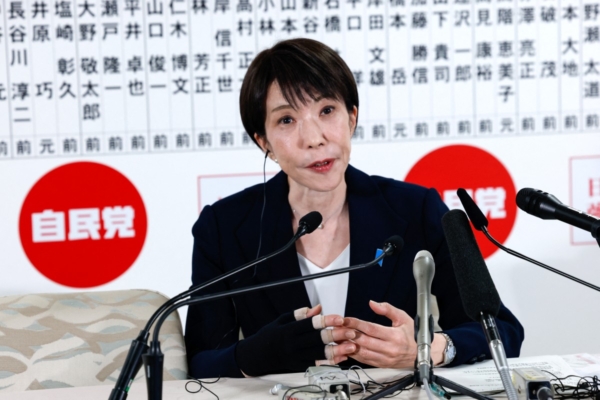
On February 8th, in the Japanese House of Representatives elections, the ruling Liberal Democratic Party led by Prime Minister Sanae Takaichi alone won 316 seats, achieving the three-quarters majority needed to reintroduce bills rejected by the House of Councillors or to propose constitutional amendments. This marks the first time in post-World War II Japan that a single party has won over three-quarters of the seats in the House of Representatives.
In contrast, the largest opposition party, the Constitutional Democratic Party, lost over a hundred seats in the election.
Some analysts believe that this election goes far beyond the scope of domestic Japanese politics and may reshape the geopolitical landscape of Asia in the future.
Renowned media figure Akio Yaita expressed on X platform that the significance of this victory goes beyond Japan and symbolizes the beginning of the “Sanae Takaichi era” in Asia. Japan will break free from the dilemma of frequent changes in prime ministers in recent years and officially enter a period of long-term and stable governance. Takaichi’s position within the party is now beyond comparison.
“This is Japan becoming more realistic in facing threats, placing more emphasis on deterrence, and recognizing the importance of Taiwan.”
Sanae Takaichi’s overwhelming victory has granted her government a strong popular mandate to end the post-war political era in Japan and reshape its international role. The defeat of Japanese political parties openly supported by the Chinese Communist Party signifies a major setback for China’s influence in Japan.
This has left the Chinese Communist Party in a state of panic, resulting in aggressive rhetoric.
The key point of this election result is that the coalition government led by Sanae Takaichi has gained significant momentum for constitutional amendments.
Senator Ishihira of Japan stated on X platform after Takaichi’s landslide victory, “The most important and joyous aspect for Japan from the election results is the significant impetus for constitutional revisions.”
In a TV program on the election results on the evening of the 8th in Tokyo, Sanae Takaichi stated, “Each party has prepared different proposals for amending the constitution. The Liberal Democratic Party has also prepared one, so if the Constitutional Review Committee can thoroughly review specific proposals, I would be grateful.”
On Monday, Sanae Takaichi stated that the coalition in the House of Representatives election achieved an overwhelming victory, providing her government with a popular mandate for implementing “significant policy changes.”
She further stated that the coalition government is ready to begin amending the peace constitution.
Researcher Shen Mingshi of the Taiwan Institute for National Defense and Security Studies stated to Epoch Times that Sanae Takaichi’s Liberal Democratic Party has passed the two-thirds threshold, which means that in the future, whether to amend the constitution to transform the Japanese Self-Defense Forces into the Japanese military, officially referred to as the army, navy, air force, etc., already has such mechanisms and rights in place.
Professor Shi-Hui Lee, Director of the Taiwan-Japan Research Institute at National Chengchi University’s School of International Affairs, expressed to Epoch Times that to make Japan a self-defensive country, constitutional amendment becomes a necessary condition. With the Liberal Democratic Party alone achieving a two-thirds majority, the basic conditions for constitutional amendment have been met. Furthermore, discussions on national security during the election process were widely known by the Japanese public. In the future, Sanae Takaichi will gradually initiate discussions on constitutional amendments to consolidate support from Japan’s conservative factions.
He also pointed out that Japan’s thinking on national security has shifted from the confrontation between pacifism and realism to pacifism gradually marginalized, making realism the mainstream approach.
Lee stated that constitutional amendments require a two-thirds majority in the House of Councillors. Currently, the Liberal Democratic Party and its allies cannot reach this threshold. Therefore, during the administration, they should promote discussions on constitutional amendments and gradually gain seats in the next House of Councillors election in order to effect substantial constitutional changes. A highly probable direction for development is that with the people’s authorization, Sanae Takaichi will, within the framework of the constitution, utilize the maximum interpretative space to comprehensively define Japan’s role in defense and national security without being constrained by intra-party factions or coalition governments.
Professor Xiansan Lin from the Department of East Asian Studies at National Taiwan Normal University believes that it is premature to discuss constitutional amendment at present.
He stated to Epoch Times that although Sanae Takaichi has crossed the two-thirds threshold in the House of Representatives, and while ordinary bills rejected by the House of Councillors can be re-passed by the House of Representatives with a three-quarters majority, the same does not apply to constitutional amendments. Therefore, constitutional amendments cannot be realized until the House of Councillors is re-elected in two years.
Lin emphasized that while elections are one matter, constitutional amendment is another, and it depends on what specific constitutional issues are being discussed. Although the various political parties in Japan have a consensus on constitutional amendments, there is no agreement on which articles to amend and how. In the past, during the Abe era, the Liberal Democratic Party, Komeito, and Nippon Ishin no Kai advocated constitutional amendments. However, Komeito wanted social welfare guarantees to be included in the constitution, and they might not support or even oppose amending Article 9.
He pointed out that even if both houses of the Diet each pass with a two-thirds majority, it is solely a proposal by the parliament to the people, and ultimately, it must be approved by over fifty percent of the national vote. According to current opinion polls, while the general Japanese populace may not have significant objections to constitutional amendments, none have shown support exceeding 50% regarding amendments to Article 9. Therefore, amending Article 9 to reach a majority vote may pose significant challenges.
Lin mentioned that in December 2012, Abe, together with the amendment proponents in both houses of the Diet, had more than a two-thirds majority. However, he did not dare to suggest the essential amendment to Article 9 due to opinion polls not reaching a majority. This led Abe to resort to alternative measures, such as the 2015 security legislation, to facilitate constitutional amendments through regulatory changes or new laws.
The government led by Takaichi has earned an overwhelming victory, paving the way to clear political obstacles for constitutional amendments, likely signaling the end of the post-war system.
Modifying Article 9 of the constitution, which prohibits war and the maintenance of armed forces, poses significant challenges. Article 9 of the Japanese Constitution states that Japan forever renounces the use of war as a sovereign right and the threat or use of force as a means of settling international disputes, hence the Japanese Constitution is also known as the Peace Constitution.
However, the Liberal Democratic Party is seeking to add Article 3 in the constitution, acknowledging the status of the Self-Defense Forces explicitly. During her campaign, Takaichi urged, “Why can’t we write the Self-Defense Forces into the constitution? Allowing us to amend the constitution to highlight their dignity and acknowledge them as a powerful force.”
Prime Minister Takaichi has finalized plans to submit a constitutional amendment to the Diet before March, clearly mentioning the Self-Defense Forces.
Meanwhile, Takaichi’s government has secured a three-quarters majority in the House of Representatives, weakening the veto power of the House of Councillors, thus granting the government substantial practical power.
The Takaichi administration is also seeking to pass an “emergency state clause” to allow the Cabinet to legislate in the event of a large-scale disaster or military attack. Although the opposition criticizes this move as a path to dictatorship, public opinion, considering security concerns, remains supportive.
The Takaichi government is expected to pursue an aggressive security policy, intending to increase defense spending to 2% of GDP from March this year and formally establish a “counterattack capability,” including long-range missiles. The Japanese government has procured 400 “Tomahawks” cruise missiles, deployed improved Type 12 anti-ship missiles with a range of up to 1,000 kilometers, and established the Joint Japan Operations Command (JJOC) in March 2025.
Furthermore, the Japan Innovation Party (JIP) is actively promoting public discussions on “nuclear sharing”—that is, deploying American nuclear weapons in Japan. Although Prime Minister Takaichi upholds a “non-nuclear principle,” discussions on such matters are allowed due to the threats posed by China and North Korea.
Shen Mingshi stated that the positioning of the military in Japan’s amended constitution, as well as the development of nuclear-powered submarines, are constrained by existing regulations, laws, and constitutional restrictions. Without these restraints, Japan will have more flexibility, such as developing long-range weapons, extending the range of Type 12 missiles, purchasing “Tomahawks” cruise missiles from the US, developing nuclear-powered submarines, exporting military weapons technology, and more. Japan also sells related weapon systems currently, like the cooperation with the US in producing “Patriot” missiles, where the demand for “Patriot” missiles is very high, compensating for the insufficient production quantity in the US military industry.
According to Shen Mingshi, the significant victory for Japan has opened up numerous possibilities. Many previous actions that were not feasible or hindered by regulations and legal constraints due to threats from China can now potentially see progress in these areas.
He stated that the normalization of the Japanese military is closely linked to the threat from China, where China’s threat to the Taiwan Strait has prompted Japan to prepare for potential involvement or impact, leading to readiness in this aspect.
Furthermore, Shen Mingshi added that besides constitutional amendments, Japan also observes the so-called Three Non-Nuclear Principles, which state that Japan cannot produce, develop, or deploy nuclear weapons within its territory. Though not constitutional, these principles have been adhered to for a long time. Now, should North Korea develop nuclear-powered submarines, and South Korea also pursue such developments, Japan would need to modify the Three Non-Nuclear Principles to explore the possibility of developing nuclear-powered submarines. With Takaichi’s party holding an absolute majority in parliament, it could aid in achieving better and more diverse weapon systems for Japan’s future development.
During the election results program on Asahi TV before 11 p.m., when asked about the export of lethal weapons, Prime Minister Takaichi stated that the issue is currently under internal party discussion and the scope is expected to broaden. She indicated that as long as friendly and like-minded countries could reliably protect themselves and their people, weapon transfers could be acceptable.
Lin Xiansan remarked that the restrictions on exporting lethal weapons are not legislative but administrative measures, where the Abe Cabinet limited exports to non-lethal five categories of defense equipment. Relaxing or abolishing these restrictions to include lethal weapons raises no issues.
Shi-Hui Lee mentioned that from the Abe administration to the present, the defense budget has increased continuously for over a decade, and quality new technology weaponry has been procured. Takaichi’s future focus lies in implementing these weapons in regional and national security effectively, possibly allowing for adjustments to the Three Non-Nuclear Principles to a certain extent during her tenure.
Lee stated that a significant indicator worth watching is if Japan agrees to allow US nuclear submarines to enter Japanese ports. Once US nuclear submarines can enter Japanese ports, it effectively signifies a form of nuclear sharing.
Furthermore, Lee added that during Takaichi’s long-term governance, her primary focus should not only be on strengthening Japan’s defense capabilities but also on transforming Japan’s defense operation using system reforms to ensure compliance with laws and regulations.
Sanae Takaichi’s strong popular mandate has granted her the power to reshape Japan’s international role, while political parties openly supported by the Chinese Communist Party faced disastrous outcomes, signifying a major blow to China’s influence in Japan.
This has left China in a state of fear, leading to escalations in rhetoric.
On the 9th, a spokesperson for the Chinese Ministry of Foreign Affairs stated that regardless of who leads Japan or which party is in power, they must adhere to the four political documents between China and Japan, as well as Japan’s peace constitution, cautioning against “repeating militarism” and warning that China is “firmly committed to safeguarding the achievements of World War II and the post-war international order.”
Previously, in January and February, the Chinese Foreign Ministry spokesperson pointed out Japan’s “ambitions to reorganize its military and challenge the post-war international order” and demanded deep introspection from Japan.
In fact, it was China’s ongoing suppression of Sanae Takaichi that ultimately led to the Liberal Democratic Party’s overwhelming victory.
Lin Xiansan expressed to Epoch Times that initially, China actively suppressed Sanae Takaichi, attempting to use Japan’s pro-China factions to pressure her and bring her down. Takaichi was also well aware of China’s role in the events and the importance of actively dissolving the House of Representatives.
Lee said that after Sanae Takaichi made remarks regarding Taiwan’s situation, leading to being sanctioned by China, the Japanese public deeply felt external risks and threats. A prime minister with strong political leadership that can be in power long-term is more necessary, hence her significant victory.
He added that this situation is strikingly similar to the impact of the Korean peninsula during important elections from the Abe Shinzo era, where frequent missile tests by North Korea made the Japanese populace feel threatened, leading to victories for the Liberal Democratic Party. This election was no different.
Lee mentioned that the headache now lies with Beijing, which does not want to sever ties with Japan entirely; however, it also has not found a way to interact with Sanae Takaichi.
Lee stated that China currently faces a situation that has not occurred in the past 25 years. Previously, China utilized the Komeito Party to restrain the Liberal Democratic Party government, preventing excessive involvement in constitutional amendments, security, or even Taiwan-related issues. However, now that Takaichi has freed herself from the Komeito Party, China cannot restrain the Liberal Democratic Party internally as before.
Lee mentioned that China may exert pressure on Japan through Sino-Japanese economic and trade relations, but Beijing’s leverage is limited. Japan over the past 15 years has deliberately reduced risks or decoupled in some areas to exclude cooperation with China. Therefore, even when China announced measures like restricting rare earths or banning tourists from Japan, there was minimal impact on the Japanese economy and stock market.
He remarked that Takaichi is wise, and during the recent conflicts between China and Japan, she did not use aggressive language but rather maintained her consistent stance silently, providing Beijing with a new perspective and space for interaction.
Lee stated that a vital strategic focus for Takaichi is to establish an unwavering deterrence force for Japan, unaffected by China’s diplomatic or economic sanctions. Showing China that Japan has the determination not to waver will be essential and will not easily alter the current situation in East Asia.
Looking forward, Lee articulated that Japan cannot completely disengage from China in the short term, as Japan still finds the Chinese market important economically. However, China is the most significant risk to Japan’s security. Hence, both nations must find new ways to interact, possibly with Japan maintaining relatively high diplomatic autonomy while China treats Japan as an equal major power, signifying an important direction in future observations.
Shen Mingshi stated that Takaichi’s firm attitude demonstrates that she does not back down. Even if China backs down, Japan should understand the natures of the Chinese Communist Party’s rule, preventing easy concessions in the future. The development of Sino-Japanese relations may see both sides reduce conflicts and achieve the rare peace along the First Island Chain.
Shen Mingshi added that if the US cooperates with Japan, China’s Eastern Military Region may find it challenging to resist the naval and air forces. Additionally, Takaichi’s firm stance could serve as a deterrent, causing China to retract. This may also present concrete ideas for how various countries handle China-related issues in the future.
Lee indicated that upon assuming office, under conditions of traditional voter reversion, Takaichi is likely to propose a Tokyo position more inclined towards the United States and European Union countries, thereby expanding interaction opportunities between Japan and Taiwan at the political level.