
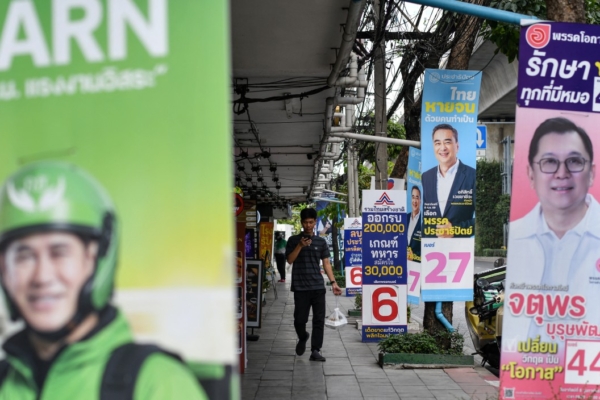
Thailand’s House of Representatives general election took place on Sunday, February 8th, with over 5,000 candidates from 57 political parties running for various seats. A whopping 93 candidates vied for the highly coveted position of prime minister.
This election comes at a time of political turmoil in Thailand. The country has seen three prime ministers in just three years, and a border conflict with Cambodia resulted in 149 casualties, leaving both nations on fragile ceasefire terms.
Polling stations opened at 8 am on Sunday and closed at 5 pm for voting. Vote counting is set to begin shortly after closure, with results expected to be announced post counting. By early Monday, it may be clear which party is leading.
Of Thailand’s 71 million population, approximately 53 million are eligible to vote, and a high voter turnout is anticipated for this election. In early voting held in Bangkok earlier this week, about 87% of registered early voters participated.
The House of Representatives in Thailand has a total of 500 seats, with 400 directly elected through constituency voting and the remaining 100 allocated proportionally based on the parties’ vote percentages.
A total of 5,089 candidates from 57 political parties registered to run in this election. Key competitors include Bhumjaithai Party, People’s Party, and Pheu Thai Party.
Current Prime Minister Anutin Charnvirakul’s Bhumjaithai Party has garnered support from the conservative faction in the kingdom.
Public opinion polls consistently show that the People’s Party is the most popular party in Thailand. With ambitious reform agendas and adept use of social media, the People’s Party has a significant appeal among the younger generation and urban residents, emerging as a force to be reckoned with.
The People’s Party’s campaign platform includes governmental system reform and limiting the influence of non-elected bodies such as the military and judiciary.
In polling conducted by Suan Dusit University from January 16 to 28, the People’s Party received 36% support, Pheu Thai garnered 22.1%, and Bhumjaithai Party ranked third with 18.9%.
A survey by the Thailand Development Research Institute from January 23 to 27 showed the People’s Party at 34.2% support, Bhumjaithai at 22.6%, and Pheu Thai at 16.2%.
In the previous 2023 election, the precursor to the People’s Party, the Forward Party, won 151 out of the 500 seats, while Pheu Thai secured 141 seats, and Bhumjaithai Party obtained 71 seats.
Each participating party can nominate up to 3 candidates for prime minister. Any party with at least 25 seats can nominate candidates for a parliamentary vote.
Out of the 57 parties participating in this election, 43 parties submitted a total of 93 prime ministerial candidates, including popular figures like incumbent Prime Minister Anutin, People’s Party leader Natthaphong Ruengpanyawut, and Pheu Thai candidate Yodchanan Wongsawat.
Candidates need to secure the support of over half of the 500 Members of the House of Representatives to be elected as the prime minister.
Polls indicate that no single party is likely to secure a majority of seats in this election, indicating that cross-party cooperation will be necessary to form a government.
However, the party with the most seats is not guaranteed to lead the government. While the People’s Party has a strong voter base, forming a coalition government may pose challenges. The party’s popularity and policies, including combating monopolies, reforming the military regime, and anti-establishment principles, could potentially disrupt Thailand’s decades-long status quo and threaten the interests of commercial groups, elite figures, and royalist leaders, presenting obstacles. The party also faces some influential opponents.
The precursor to the People’s Party, the Forward Party, won 151 seats in the 2023 election, becoming the largest party in the parliament. However, due to advocating for amending Thailand’s strict lese majeste law, deemed too radical by the conservatives, the party encountered hindrances in appointing its leader Pita as the prime minister. The Forward Party later gave the opportunity of forming a government to the then-second-largest party, Pheu Thai.
Bhumjaithai Party leader Anutin is an experienced negotiator willing to collaborate with any party, and his efforts may likely receive support from influential conservative figures outside the political realm.
The historically dominant Pheu Thai Party, controlled by the billionaire Shinawatra family, still holds considerable power despite defections to Bhumjaithai and declining support. Analysts suggest that Pheu Thai is likely to, as in the past, form a coalition government with Bhumjaithai.
(This article references reports from Reuters and Al Jazeera.)