
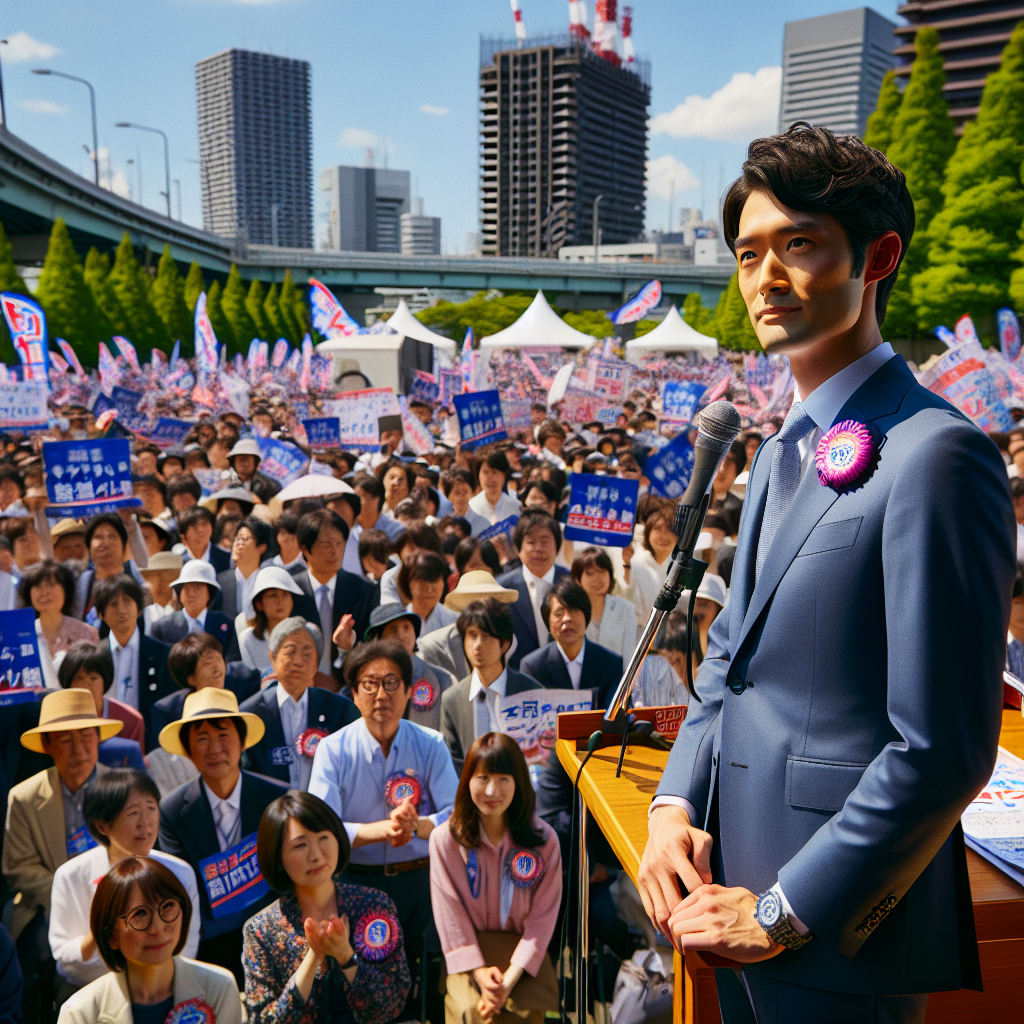
The Japanese House of Representatives election is entering its final sprint. Japanese Prime Minister and Liberal Democratic Party leader Sanae Takai participated in a rally in Tokyo on Saturday (February 7) to boost support ahead of the upcoming election scheduled for Sunday (February 8). This election is crucial for Japan’s future and will also influence the country’s political direction, drawing close attention globally.
On Saturday, Prime Minister Takai braved the cold standing on a mobile truck delivering a speech to supporters. She emphasized the importance of transforming the public’s current anxieties about life and the future into hope, stating that “hope” is crucial for the upcoming year.
“I advocate for a Japan where everyone, regardless of where they are, can live safely, access necessary healthcare and welfare, receive high-quality education, and have employment opportunities,” said Takai. “But to achieve this, we need to strengthen the economy. Healthcare and welfare require financial investment… we need to build a strong economy.”
The ruling Liberal Democratic Party aims to secure a landslide victory in Sunday’s election to expedite Prime Minister Takai’s efforts to enhance Japan’s defense capabilities, hoping to defeat their opponents in the process.
As the U.S. urges other countries to increase defense spending, how Japan’s political parties will protect the country from growing threats posed by China and North Korea has become a key issue in this election.
Known for her hawkish stance towards China, Prime Minister Takai has accelerated efforts to increase defense spending since taking office last October. In December last year, the Japanese parliament approved a supplementary budget for the 2025 fiscal year, raising defense spending to 2% of the Gross Domestic Product (GDP), two years ahead of the original plan.
According to the Japanese news agency “Kyodo”, Masahiro Iwasaki, a professor of political science at a Japanese university, suggested that “if the Liberal Democratic Party achieves a sweeping victory in the election, Prime Minister Takai may take a tougher stance on security issues than at present.”
During a press conference on January 19, Takai explained why she decided to call for early elections, stating she aims to gain public authorization and political stability to boldly push forward policies and reforms that may cause domestic divisions.
The Liberal Democratic Party’s campaign promises include amending the post-war pacifist constitution for the first time and strengthening intelligence operations.
Japan is currently facing its most severe security environment since World War II, with the Chinese military ramping up maritime and aerial operations in the Indo-Pacific region, while North Korea has repeatedly launched ballistic missiles into the Sea of Japan, including two short-range missiles on January 27.
Robert Eldridge, director for North Asia at the Global Risk Mitigation Foundation, stated, “Given the growth in both the quality and quantity of weapon systems and military, Japan increasing its defense spending is understandable and expected.”
“Japan’s defense spending has been minimal for the past 70 years,” he added.
A survey by the “Asahi Shimbun” earlier this week indicated that the Liberal Democratic Party, led by Takai, is likely to win in Sunday’s election. A latest poll released by “Kyodo” on Monday (February 2) showed that the Liberal Democratic Party is poised to secure 233 or more of the 465 seats in the House of Representatives, surpassing the 198 seats it held before the dissolution of the house.
This week’s surveys suggest that with the addition of seats from the ruling coalition partner, the Komeito party, the coalition is likely to win around 300 seats in the 465-seat House of Representatives.
The Japanese House of Representatives election is a critical election that determines the country’s ruling power. The leader of a political party that secures more than half of the seats in the election can be chosen as the new Prime Minister in the post-election Prime Ministerial nomination election held by the “Special Diet.”
If Sunday’s election results align with media predictions, Takai is likely to continue as Prime Minister.
U.S. President Trump publicly endorsed Takai and her ruling coalition on February 5th. Trump emphasized that the outcome of this election in Japan is crucial for the country’s future. He looks forward to welcoming Prime Minister Takai at the White House on March 19.
“Kyodo” quoted political analyst Norio Toyoshima as saying that the Liberal Democratic Party winning this election holds significant importance before Takai’s meeting with Trump.
“To ensure the other party fulfills its commitments, Trump is more inclined to make deals with a strong and stable government,” said Toyoshima.