
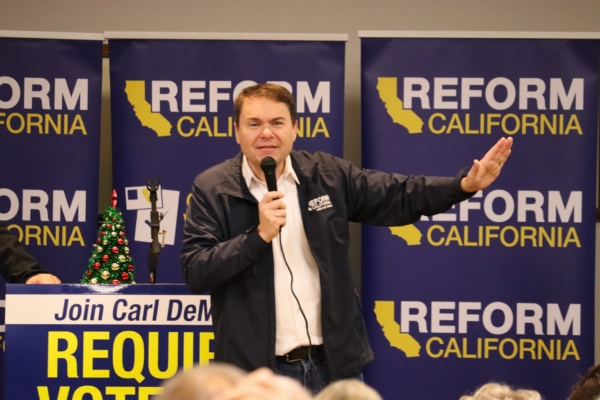
The proposal AB1421, which aims to impose a “mileage tax” on all drivers, has passed through the California Transportation Committee and Appropriations Committee, and will now be voted on by the California State Assembly. Republican Assembly Member Carl DeMaio from the 75th District is urging the public to come together to stop this new legislation.
DeMaio, along with his organization “Reform California,” is leading the charge to block the imposition of the mileage tax. “California politicians have already misappropriated our road repair funds, and now they want to collect even more money,” DeMaio stated. “The proposal calls for tracking the mileage traveled by each driver and taxing them 6-9 cents per mile, which equates to an 80 cent increase in gasoline tax per gallon.”
“If calculated for driving 15,000 miles per year, the average driver will be forced to pay an additional $900-1200 in mileage tax annually. And they are driving on poorly maintained highways that have already been funded through gasoline and sales taxes,” he added. “If a household has two gasoline cars, when you add up the mileage tax and gasoline tax, they will need to pay over $4,200 in taxes per year.”
According to the American Automobile Association (AAA), the average gasoline price in the United States was $2.87 per gallon as of Thursday (29th), while in California, it was $4.27 per gallon, which is $1.40 higher, largely due to fuel taxes.
The federal gasoline tax is 18 cents, the same for all states, but California’s fuel tax also includes state gasoline excise tax, state sales tax, underground storage tank fee (which may increase), fuel cap-and-trade fee, and low carbon fuel standard fee.
Since Governor Newsom signed SB1 in 2017, the gasoline excise tax has increased every July, rising from 28 cents per gallon in that year to 61.2 cents per gallon by 2025, with diesel tax currently at 46.6 cents and set to rise this year.
AB1421, titled “Vehicles: Road Usage Charge Technical Advisory Committee,” was jointly proposed by Democratic State Assembly Member Lori Wilson from the 11th District and State Assembly Majority Leader, Representative Cecilia Aguiar-Curry from the 4th District. It passed 12-1 (with 3 abstentions) and 11-1 (with 3 abstentions) in the State Assembly Transportation Committee and Appropriations Committee this month.
The California government has been promoting the use of clean energy, offering subsidies to electric vehicle buyers with the goal of gradually phasing out the sale of new gasoline-powered cars. With high gas prices in California, many people are transitioning to electric or hybrid vehicles.
However, one of the consequences of reducing fuel consumption is the decrease in revenue from fuel taxes. For the fiscal year 2024-2025, the total revenue from fuel taxes, vehicle fees, road improvement fees, and weigh fees collected by California was $14.4 billion; it is projected that the state government’s transportation funding will face at least a $31 billion shortfall over the next 10 years.
The proponents believe that high-income residents have purchased the majority of electric or hybrid vehicles, while low-income residents still prefer to use gasoline cars and bear a significant burden of fuel taxes, leading to perceived “inequity.” They hope to introduce the mileage tax as an alternative to fuel taxes and establish two different standard groups starting from January 1, 2027, to test collecting road usage fees.
Currently, the proposal has not specified the charging standards, but given the Democratic majority in both chambers, AB1421 is likely to pass, putting the collection of the mileage tax on the agenda.
Governor Newsom presented the draft budget for the fiscal year 2026-2027 on the 9th of this month, totaling $539 billion, with federal funds amounting to $190.1 billion; the state government expects expenditures of $348.9 billion, an increase of $27.8 billion from the previous fiscal year. Despite deficits in both years, expenditures are on the rise, with the shortfall being filled using state reserve funds among other measures.
The state Legislative Analyst’s Office predicts a near $30 billion deficit for the new fiscal year; this imbalance has persisted for three consecutive years and may continue until 2030, affecting every Californian, a situation that is cause for concern.
The proposed state budget prioritizes projects that the governor is focusing on, including allocating over $12 billion from the general fund to provide comprehensive Medi-Cal healthcare benefits to undocumented immigrants, and allocating $1 billion to the High-Speed Rail Authority until the 2045-2046 fiscal year.
However, for the second consecutive year, the budget has disregarded the will of the voters by not providing funding for Proposition 36, which had high support (68.4%) and mandates felony charges for repeat offenders of theft and drug trafficking, along with mandatory rehabilitation programs.