
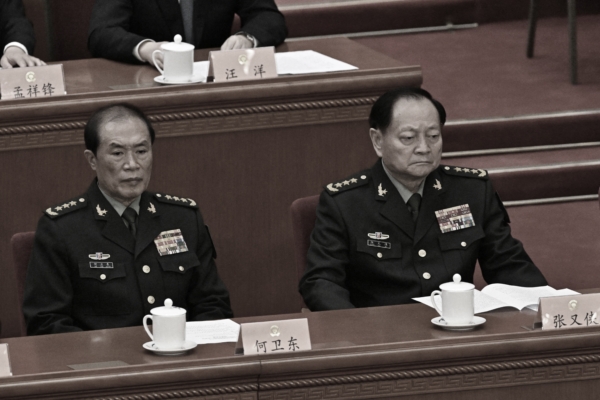
Recently, two high-ranking officials in the Chinese military, Vice Chairman of the Central Military Commission Zhang Youxia and Commission Member Liu Zhenli, were embroiled in a corruption scandal. When asked by reporters if this situation would affect cross-strait relations, a spokesperson for the Taiwan Affairs Office of the Communist Party of China hesitated for about ten seconds while flipping through documents before asserting that “there is no restricted zone for punishing corruption” and emphasizing the goal of “reunification” with Taiwan without renouncing the use of force.
Experts believe that the arrest of Zhang Youxia by Xi Jinping, the leader of the Chinese Communist Party, is a part of political power struggle within the party and poses a serious challenge to Xi’s future leadership of the military. The response of the Chinese government’s spokesperson shows a lack of confidence in addressing the situation.
The recent shake-up in personnel has reduced the number of members of the Central Military Commission from seven since the leadership change in 2022 to just Xi Jinping, the Chairman of the Commission, and the newly appointed Vice Chairman Zhang Shengmin.
Following the downfall of Zhang Youxia, Chinese official media outlets have adopted a low-profile approach, unlike previous high-profile coverage of similar cases involving other senior officials. The spokesperson Zhang Han only addressed the issue when asked by a reporter during a press conference held by the Taiwan Affairs Office on the 28th.
When questioned by Taiwanese journalists about the turmoil in the Chinese military leadership and its impact on cross-strait relations, Zhang Han initially hesitated and then reiterated the party’s commitment to combating corruption and maintaining control over Taiwan-related matters, without explicitly forswearing the use of force.
Civil rights activist Wu Renhua shared a video online, commenting on the spokesperson’s evasive response and implying that it reflects a common tactic of the Chinese government to deflect sensitive questions.
Analysts have pointed out that the spokesperson’s statements reveal a lack of confidence, which mirrors the unusual silence that followed the announcement of the investigation and arrest of Zhang and Liu.
Regarding the spokesperson’s allegations of corruption against Zhang Youxia, respected Taiwan-based political commentator Ding Shufan suggested that the fundamental issue might be a political disagreement between Zhang and Xi, rather than just corruption allegations. He emphasized that the hollowing of the top military leadership could have significant long-term repercussions and strains relations within the military.
Furthermore, the spokesperson’s statements about “striving for peaceful reunification” while not ruling out the use of force were considered unremarkable by media commentator Qi Leyi. Qi suggested that the spokesperson’s statements were likely in line with the official narrative rather than providing any new insights.
Ding Shufan and Qi Leyi both highlighted the extensive infiltration efforts by the Chinese Communist Party in Taiwan, emphasizing ongoing concerns about national security.
The turmoil within the Chinese military leadership has raised concerns in Taiwan, with Defense Minister Gu Lixiong monitoring the situation closely and underscoring Taiwan’s commitment to national security in the face of internal unrest within the Chinese Communist Party.
As the Chinese military faces internal turmoil, Xi Jinping may increasingly use the banner of “reunification” to exploit pro-China factions in Taiwan to achieve its goal of occupying Taiwan, according to a political commentator. This situation underscores the importance of Taiwan’s efforts to counter infiltration and maintain its security against external threats.