
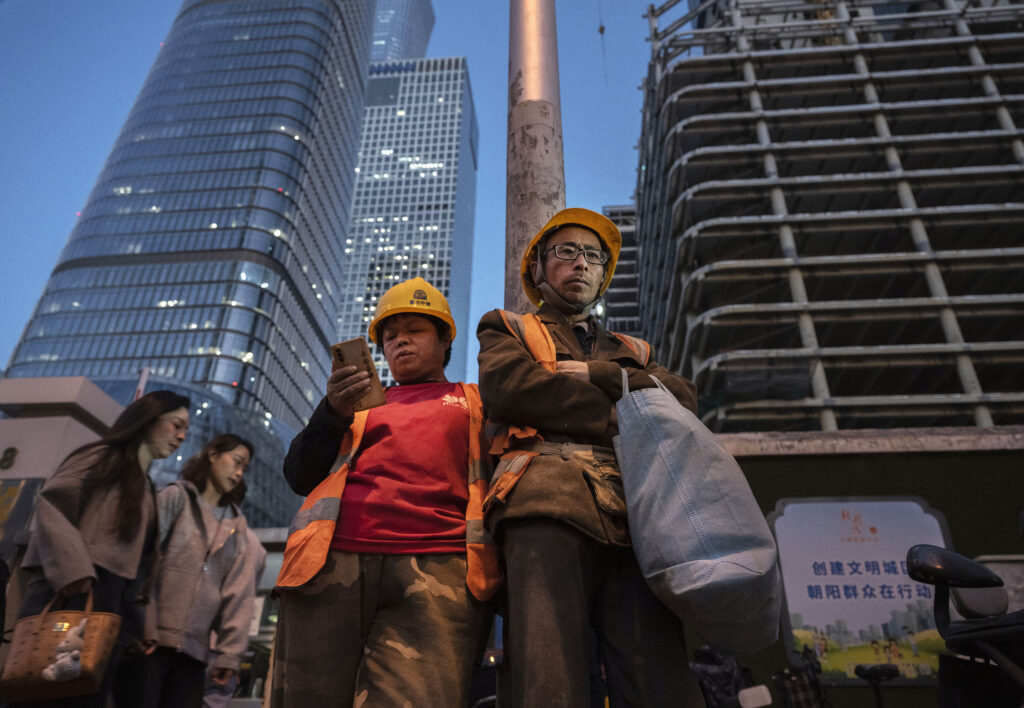
China’s economy continues to face significant pressure, leading to a decrease in residents’ willingness to consume and growing uncertainty concerning income and employment prospects. As a response to these challenges, many individuals are tightening their budgets and reducing their overall consumption. On November 17, the phrase “The Era of Living on Low Battery” trended on Weibo, capturing the public’s attention and sparking discussions online.
Finance blogger “Xiao Peng Tong Xue 2026” described the term as a phenomenon that has become a hot topic toward the end of 2026. He emphasized that this shift is not merely about passively giving up but represents a proactive change in which the public is shifting to a dual energy-saving mode in terms of both energy and consumption. Instead of comparing themselves with others, people are turning inward and focusing on a collective mindset adjustment.
Emotional well-being blogger “Shou Ji Yi Dui Ju Zi” highlighted broader macroeconomic factors contributing to this change. She noted the failure of the traditional equation of effort to reward, the narrowing pathway to homeownership and educational opportunities, and a spike in the household savings rate, which has soared to 42.8%. Since August 2026, when the idea of “Living on Low Battery” first gained traction, people have increasingly announced their abandonment of grand narratives and the mental fatigue that comes with them, opting instead to anchor their lives around essential activities such as eating, sleeping, and saving money.
Entertainment blogger “Qi Yuan DZ” mentioned, “As a community, we have collectively switched to an energy-saving mode akin to a smartphone on 10% battery. We are no longer engaging in blind social interactions or attending meaningless dinners; we have stopped impulsive spending, clutching every penny we have. We are avoiding unnecessary pressure, allowing ourselves to complete tasks at a minimum acceptable level. This is not about giving up; it’s a form of self-protection for adults, reclaiming energy spent on outward consumption, tightening our financial grip, stabilizing our emotions, saving resources, and gradually finding our shine.”
Another entertainment blogger, “i Xiao Dai Dai_”, added, “Living on a low battery does not imply giving up; it signifies a conscious effort to simplify life. It involves cutting out ineffective expenditures, reducing social fatigue, and conserving both energy and funds for necessities. In these uncertain times, it represents a rational choice for ordinary people to maintain stability and reduce risks, moving away from the blind overspending to chase after extravagant lifestyles.”
Originally, the term “low battery” described a lack of charge in mobile devices; it has now evolved to describe a modern lifestyle characterized by fatigue, reduced spending and social interactions, and meticulous budgeting. This shift in lifestyle attitudes is closely intertwined with the current economic landscape in China and the confidence residents have in consumption.
Data released by the National Bureau of Statistics on November 16 further corroborates these observations. In October 2026, the total retail sales of consumer goods across the country increased by only 0.4% year-on-year, showing a decline of 0.7 percentage points from September. From January to October of this year, the retail sales growth was merely 1.0%. In October alone, revenue from the food and beverage sector saw a minuscule year-on-year increase of 0.7%, while the retail sales of goods only grew by 0.3%, reflecting a lackluster consumer market.
Investment and industrial production also exhibit signs of fatigue. In October, the industrial value-added growth for large-scale enterprises was 4.8% year-on-year, falling short of the 5.3% anticipated by a Reuters survey, and demonstrating a noticeable slowdown compared to September’s 5.5%. From January to October this year, fixed asset investment saw a year-on-year decline of 8.1%, an increase in the decline compared to 7.2% over the first nine months, and underperforming relative to market expectations of a 7% decrease.
Amidst the backdrop of economic downturns and increasing pressures on jobs and income, the public is increasingly inclined towards saving and controlling expenditures. The evolution of internet slang from “consumption downgrade” and “reverse consumption” to the recent “simply living” reflects a profound transformation in the attitudes of the populace.