
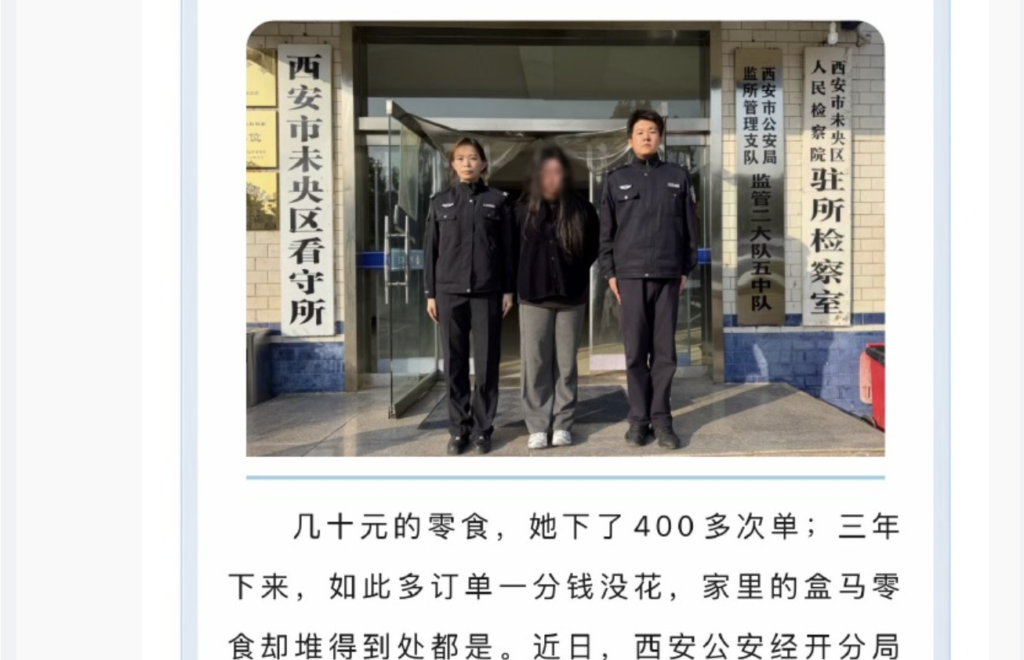
A 29-year-old woman from Xi’an, Shaanxi Province, has been taken into custody for alleged fraudulent activity involving online shopping and the use of a refund mechanism. Over the course of three years, she managed to apply for refunds on more than 400 orders without ever returning the purchased items, resulting in a total loss for merchants exceeding 17,000 yuan (approximately $2,400).
The Xi’an Public Security Bureau recently disclosed this case through their official Weibo account. In early November, local police were alerted by staff from the Hema supermarket chain, who had noticed irregularities during their internal audit of user data. From the beginning of 2023 until November, the woman had placed orders almost daily, with all 400-plus transactions citing similar excuses for refunds, primarily related to the unsatisfactory quality of food, such as “bad taste” or “not fresh.” However, the products were never sent back to the store.
This woman, who has been studying for graduate school exams from home for several years, reportedly found herself increasingly frustrated with her lack of success. One day in 2023, she ordered a batch of snacks and stumbled upon the refund process on the online shopping platform, discovering that selecting a specific reason allowed her to request a refund without returning the goods. This revelation became a source of thrill for her, offering a temporary relief from her mounting academic pressures.
Following her initial success in obtaining a refund, she began to repeat this process whenever she felt anxious. The routine of ordering and then applying for “refunds only” became ingrained in her actions. Over the span of three years, she placed more than 400 orders, averaging one every three days, with products ranging from snacks and beverages to everyday necessities.
On November 5, authorities executed a search of her residence, uncovering a cluttered living space filled with Hema snacks and household items. Some of the products were only partially consumed, while others had yet to be unboxed.
The police statement emphasizes that her actions were motivated by a desire for illegal gain, as she concocted fraudulent reasons for refunds to deceive the platform and acquire goods without payment, thereby clearly indicating criminal intent. She has since been subject to criminal detention.
The exposure of this case sparked widespread discussion among netizens. Some commenters argued that she had exploited the “refund only” mechanism, originally designed to protect consumer rights, turning it into a profit-making tool. By consistently fabricating reasons for refunds and deceiving merchants, she has now placed herself at significant legal risk.
Other internet users took a more humorous approach, suggesting that after repeatedly failing her graduate exams, her current predicament might ironically represent a “relief” from her academic struggles, as she now faces criminal charges rather than academic assessments.
The misuse of e-commerce refund policies is not an isolated incident. In October of this year, another case was reported in Minhang, Shanghai, where a customer applied for refunds on 399 items within a span of less than three months. This case involved over 8,000 yuan, with the customer fabricating reasons such as “dislike,” “unwanted,” or claiming that properly intact items were rotten or moldy. After requesting refunds, she continued purchasing the same products.
Additionally, another incident highlighted the coercion of merchants through similar refund processes. A man from Jiangyin, Jiangsu Province, began utilizing the “refund only” mechanism in 2022 to submit false quality complaints against merchants. After complaints were rejected, he would place significant orders with related stores and immediately request refunds, leading to substantial losses in packaging, logistics, and platform service fees. Authorities discovered that over three years, he maliciously ordered from more than 900 online stores, resulting in over 27,000 orders and generating losses exceeding 62,000 yuan. He was sentenced to one year and six months in prison on December 30, 2025.
Furthermore, in August this year, another case in Minhang, Shanghai, involved an individual utilizing refund loopholes to resell products illegally. A woman named Zhu would purchase items such as spicy noodles from an e-commerce platform and then re-ship them to buyers on a second-hand trading website, fabricating logistics information to request refunds. Within less than a year, she allegedly profited nearly 130,000 yuan through this fraudulent scheme and was subsequently detained by authorities on charges of fraud.
These incidents underline the ongoing challenges and vulnerabilities associated with online retail systems, highlighting the urgent need for improved protections against such abuses of consumer rights policies.