
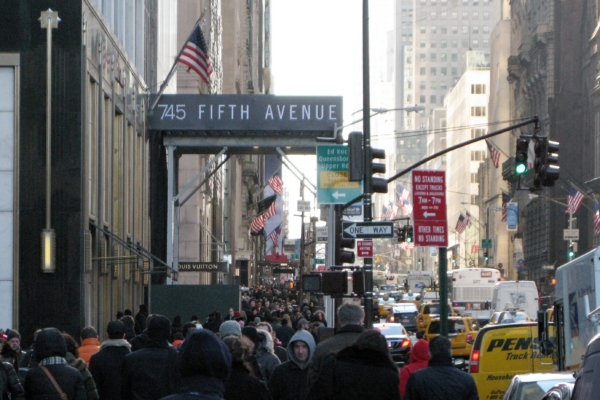
New York City’s Fifth Avenue has reclaimed its status as the world’s most expensive retail street. According to data from commercial real estate services firm Cushman & Wakefield, rental prices in the upscale retail area along Fifth Avenue have surged by an average of 35% over the past year, reaching an astounding $2,700 per square foot annually. This increase significantly outpaces the average 3% growth seen across major global retail districts. This development not only reflects the confidence of luxury brands in the New York market but also indicates a continued recovery in the city’s commercial real estate sector.
The findings come from Cushman & Wakefield’s 36th edition of the “2026 Global Retail Streets Report,” which studied rental rates, leasing activity, and market development trends across retail districts in 147 cities worldwide. The report highlights a general slowdown in rental growth for top-tier global retail districts, with average rents in core markets rising by only 3%. Among the 147 areas surveyed, 49% experienced rent increases, while 32% remained stable and 19% saw declines. In the United States, average retail rents increased by 5.8%.
Fifth Avenue stands out with its impressive rise, specifically in the section from 49th to 60th Streets, reclaiming the top spot as the world’s most expensive retail location—a jump of two places from the previous year. The area witnessed a stunning 35% increase in rental prices, placing it firmly ahead of London’s New Bond Street and Milan’s Corso Montenapoleone, which ranked second and third respectively, with rents remaining unchanged.
In the past year, 153 retail leases were signed or opened in the world’s top 30 retail streets, covering more than 815,000 square feet of space. Based on average market rents, the total annual rent value surpasses $647 million, with over 80% of the leasing activity attributed to new entrants in these districts, and international brands occupying approximately 90% of the total area.
The report emphasizes that the fashion industry remains a significant driving force behind retail leases, followed closely by health and beauty sectors. Furthermore, the rise of large flagship stores and immersive shopping experiences is gaining prominence.
Contrary to the belief that physical stores are diminishing in value due to the rise of artificial intelligence and e-commerce, the report suggests that brands are increasingly prioritizing customer experience, brand image, foot traffic from tourists, integration of physical and online sales, and utilizing technology to enhance personalized shopping services.
The report also investigates the impact of various factors such as artificial intelligence, tariffs, geopolitics, inflation, and diverging consumer spending power on the retail sector. A noteworthy finding indicates that the top 20% of income earners in the U.S. account for 60% of the nation’s consumer spending, helping to explain the sustained demand for high-end luxury goods.
The most prestigious retail area spans Fifth Avenue between 49th and 60th Streets, stretching from near Saks Fifth Avenue to the southeastern corner of Central Park, extending roughly half a mile. This stretch is home to renowned luxury retailers such as Tiffany & Co., Bergdorf Goodman, and the flagship Apple store, drawing in large crowds of shoppers and tourists, thus providing invaluable exposure for brands.
At a rental rate of $2,700 per square foot, a retailer leasing over 371 square feet would face an annual rent exceeding $1 million. For flagship stores that typically occupy much larger spaces, the rental expenses are substantial.
Analysis from The Wall Street Journal shows that Fifth Avenue’s resurgence starkly contrasts the recent slump in retail during the pandemic and preceding years. In 2019, business closures driven by high rents and the rise of e-commerce saw rental prices in the area plummet to approximately $1,500 per square foot.
A market turning point emerged in late 2023, when the Italian fashion house Prada invested over $800 million to acquire the building housing its Fifth Avenue store along with adjacent properties. Shortly thereafter, luxury brand conglomerate Kering followed suit, purchasing real estate for nearly $1 billion. These substantial property acquisitions indicate strong confidence in the long-term value of this prime commercial location.
Interestingly, the trend of brand presence on Fifth Avenue is no longer confined to traditional luxury goods. Tech company Meta Platforms has signed a 10-year lease to establish a Meta Lab flagship store next to the jewelry brand Harry Winston, featuring AI glasses and virtual reality equipment. The store will offer not only product displays but also experiential spaces, coffee areas, and music events, showcasing a shift towards blending shopping with immersive consumer experiences.
Retail dynamics along the southern section of Fifth Avenue, particularly between Bryant Park and 49th Street, are also evolving. Storefronts that once primarily housed souvenir shops and discount merchandise are increasingly being replaced by outdoor and athletic brands like Arc’teryx, The North Face, and On, alongside fashionable brands targeting younger consumers.
Real estate operator Josh Rabina commented that the area near Bryant Park has seen a significant decline in low-cost, cluttered retail stores. His family real estate firm recently secured a lease with Utah-based outdoor clothing brand Kühl, bringing the brand into the new retail space of a skyscraper at 520 Fifth Avenue.
According to Cushman & Wakefield’s third-quarter 2023 report on Manhattan’s retail market, the vacancy rate for storefronts on the upper section of Fifth Avenue has also decreased. As of the third quarter, the vacancy rate stood at 13%, down 4.4 percentage points from a year ago.
As the holiday shopping season approaches, Fifth Avenue is expected to witness increased foot traffic. Reports indicate that every December, this commercial corridor experiences peak pedestrian traffic of up to 1.5 million people per day. With stores beginning to adorn their windows with festive displays and decorative lights, this iconic New York shopping street is gearing up for its busiest time of the year.
The resurgence of rental prices on Fifth Avenue aligns with rising rents for high-end office buildings and increasing hotel rates in Manhattan, collectively signaling a revitalization of New York’s premium commercial market.