
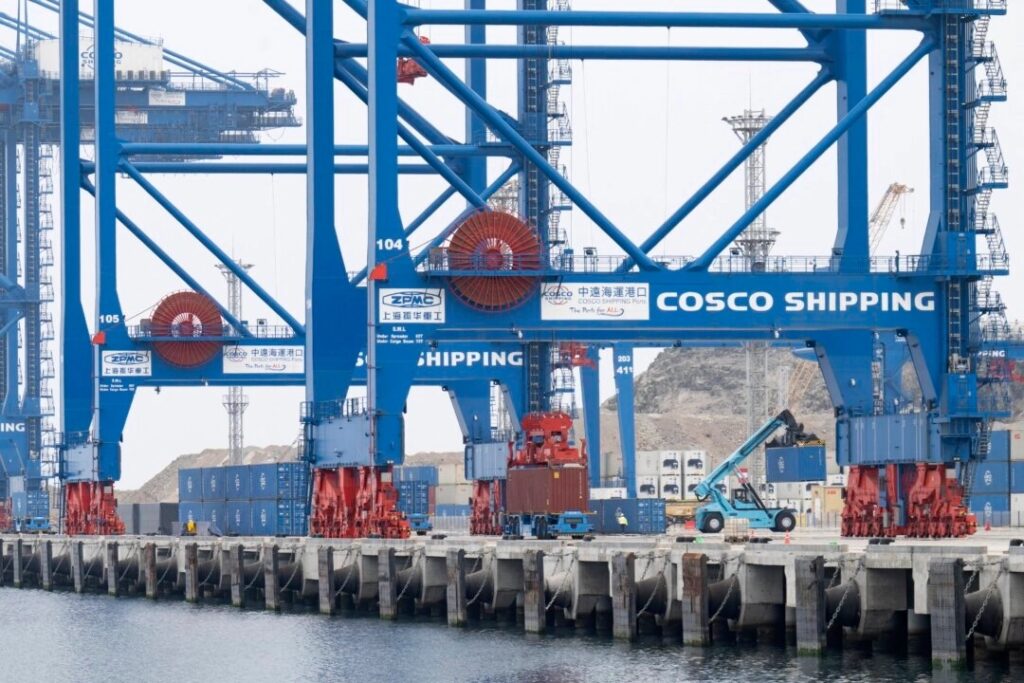
Latin America is increasingly becoming a crucial battleground for economic and geopolitical influence between the United States and China. Following the involvement of Chinese state capital in the Chancay Port project in Peru, the U.S. has recently announced a grant of $4.5 million to support the infrastructure design of the Port of Callao in Peru. Experts suggest that the goal behind this investment is two-fold: to upgrade the port and enhance military cooperation, serving as a counterbalance to the growing trade, political, and potential military influence of China in South America through state-owned enterprises.
On November 12, the U.S. State Department issued a news release indicating that Deputy Under Secretary of State for Arms Control and International Security, Thomas G. DiNanno, visited Peru and Colombia from November 1 to 7. During his visit, he met with Peru’s Defense Minister, Deputy Foreign Minister, and Deputy Interior Minister to discuss strengthening bilateral defense and security coordination.
Moreover, the U.S. has announced the provision of $20 million in Foreign Military Financing for fiscal year 2026 to assist Peru in establishing aerial refueling capabilities for F-16 fighter jets. They have also signed a memorandum of understanding on nuclear cooperation with Peru.
During his visit, DiNanno announced that the U.S. would provide $4.5 million through earlier fiscal year Foreign Military Financing (FMF) projects for the design phase of the Port of Callao infrastructure project, thereby laying the groundwork for subsequent upgrades and improvements in port security.
DiNanno also took the opportunity to visit the Port of Callao to observe the progress of U.S.-supported modernization and security projects underway there.
The Port of Callao is currently Peru’s busiest commercial port. According to data released by global port operator DP World, the south terminal operated by DP World at Callao processes approximately 60% of the nation’s container cargo.
Meanwhile, Chancay Port, located less than 80 kilometers to the north of Callao, is set to open in 2024, with operations being run by a company under China COSCO Shipping Group. This port is currently a significant deep-water port project funded by Chinese capital in South America.
Analyzing the simultaneous investments by the U.S. and China in the ports of Callao and Chancay, researcher Shen Mingshi from the Taiwan National Defense and Security Research Institute remarked, “The primary aim of U.S. assistance to Peru is to counteract the strategic and logistical advantages established by the state-controlled Chancay Port along the South American Pacific coastline, utilizing both critical infrastructure defenses and commercial financing.”
Shen believes the first goal is to create a competitive port system in response to the Chinese-led Chancay Port, which in turn could lead to a diversion of cargo traffic.
He argues that this situation extends beyond mere commercial rivalry; it also involves whether the U.S. can maintain its traditional economic and strategic influence along the Pacific coast of South America.
Senior military commentator Mark pointed out that the “2025 National Security Strategy” released by the U.S. at the end of 2025 re-emphasizes Monroe Doctrine, asserting the importance of establishing U.S. dominance in the Western Hemisphere. Currently, China is the largest trading partner of Peru, with the U.S. in second place.
He noted that the U.S. had somewhat neglected Latin America in recent years, allowing the CCP to expand its influence. Over the past decade, China has continuously strengthened its economic ties with Latin American countries, leading many to increasingly depend on the Chinese market. This dependency gives China the opportunity to influence local policies. Additionally, China might leverage potential bribes and other gray-area tactics to gain further political influence through financial incentives.
Chancay Port, developed in collaboration between China COSCO Shipping Group and Peru’s Volcan Mining Company, is expected to begin operations in November 2024, with full-scale commercial operations set for June 2025, boasting a design capacity of 1 million twenty-foot equivalent units (TEUs).
South America is a crucial source of minerals and agricultural products globally; however, due to the lack of deep-water ports on the West Coast able to accommodate ultra-large container ships, many goods previously had to be transshipped via the Panama Canal or the West Coast of the United States to reach Asia. The construction of Chancay Port is set to alter some of these traditional logistics routes.
Both interviewed experts assessed the resource and shipping advantages that Chancay Port brings to China.
Shen Mingshi emphasized that China has been able to establish point-to-point direct shipping between China and South America through Chancay Port, estimating that the trans-Pacific journey could be shortened to about 23 days while reducing logistics costs by approximately 20%.
“This significantly reduces dependency on the Panama Canal or shipping lanes controlled by the U.S.,” he noted.
From Mark’s perspective, the uniqueness of Chancay Port lies in China’s ability to link construction, operations, shipping, and trade through state-led enterprises, positioning Chinese companies favorably across the entire industry chain.
He contended that this model is not simply about maximizing profits from the port itself; rather, it is about leveraging the port to expand China’s trade, export surplus capacity, and enhance its economic influence overseas.
However, Shen Mingshi cautioned that Chancay Port still faces limitations regarding land transportation connections, making its overall throughput capacity still fall short when compared to the existing significant throughput of Callao Port.
Within this context, a strategic game is unfolding over the regulatory authority and usage of Chancay Port between the U.S. and China.
In February, the U.S. State Department’s Bureau of Western Hemisphere Affairs posted on social media platform X, stating that gaining access to inexpensive funds from the CCP comes at the cost of losing sovereignty. Some U.S. lawmakers have also remarked on the port’s potential for dual-use military purposes, which could pose a direct military threat to the Western Hemisphere.
Following an appeal by Peru’s regulatory authority for transportation and infrastructure investment, a Peruvian court ruled on July 1 that the government could implement regulations on the port owned by Chinese capital. This ruling reversed an earlier decision from January which had initially exempted Chancay Port from certain oversight by Peruvian regulatory entities.
International media widely regarded this ruling as a diplomatic victory for the U.S., helping to contain the CCP’s increasing influence in Latin America.
Currently, both the CCP and Peru emphasize that Chancay Port is strictly a commercial project and not designated as a military facility.
Nevertheless, Shen Mingshi posited that “these commercial ports can indeed provide military support without the presence of military bases. This is certainly possible.”
He elaborated that while commercial ports may not directly accommodate naval vessels for military resupply, they could nevertheless offer vital services such as fuel, freshwater, food, and general mechanical repairs.
Shen further noted that Chancay Port, under the operation of COSCO Shipping, heavily relies on automated management systems. Port operators can track ship movements, cargo transportation, and logistics efficiently through these systems.
He believes such systems could allow China to monitor the dynamics of shipping along the South American Pacific coast, including the activities of U.S. and allied naval vessels.
“Consequently, Chancay Port also serves as a key facility for reconnaissance, surveillance, or intelligence transmission,” he remarked.
Mark concluded that, from a long-term strategic perspective, port operations, shipping networks, and local political influence are factors that cannot be overlooked.
He argues that the current relationship between the Peruvian government and the United States is relatively close, suggesting that in the current political climate, Peru is unlikely to easily approve the use of Chancay Port by Chinese naval vessels. Nevertheless, whether the port may take on other functions in the future will ultimately hinge on decisions made by the Peruvian government.