
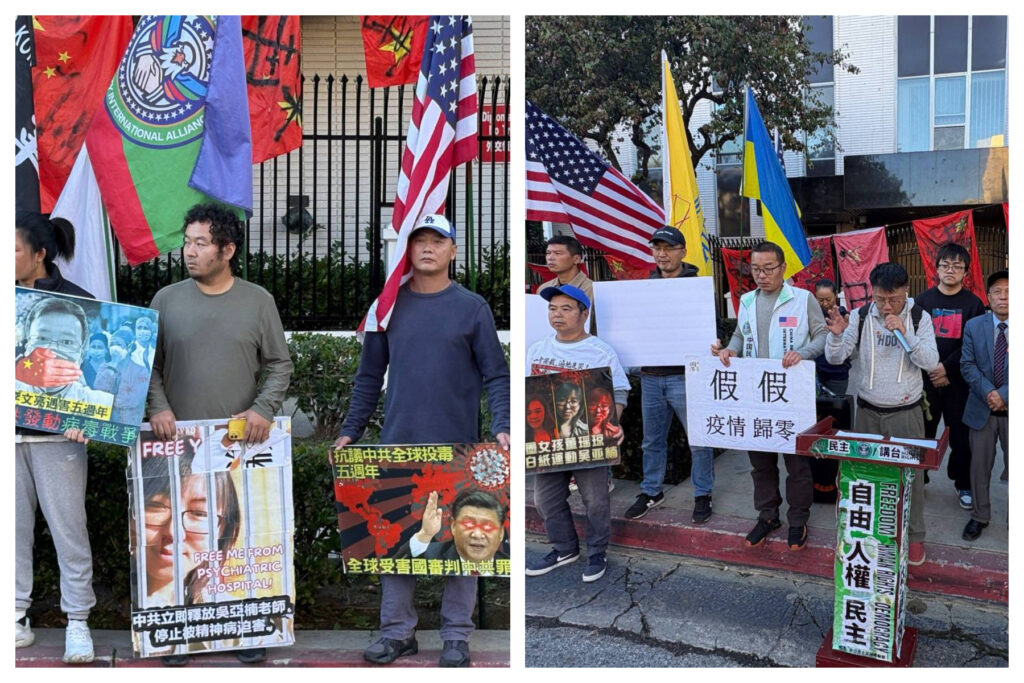
On November 24, four years ago, a devastating residential fire occurred in Urumqi, Xinjiang during the strict lockdown measures imposed by the Chinese Communist Party (CCP) in response to the COVID-19 pandemic. The delay in escape and rescue efforts due to these harsh control measures led to the tragic loss of at least ten lives. This incident ignited the “White Paper Movement,” symbolizing a profound call for freedom of expression.
As the four-year anniversary of the Urumqi fire approached on November 22, 2026, overseas dissent groups and pro-democracy activists gathered outside the Chinese consulate in Los Angeles. Through the display of banners, speeches, and exhibitions, they remembered the victims of the Urumqi fire and the courageous youth who stood up during the White Paper Movement, while also honoring all those who lost their lives, freedom, and normal life during the lockdowns.
At the end of 2019, the COVID-19 virus broke out in Wuhan, spreading rapidly across China and the globe. In response to the pandemic, the CCP implemented an extreme “zero-COVID” policy that included citywide lockdowns. The Urumqi fire in 2022 sparked widespread anger and concern over how these measures hindered rescue efforts, leading to the widespread emergence of the White Paper Movement. Participants in this movement symbolically held blank A4 sheets of paper to protest against the limitations on free speech and expression, and the movement gained traction in universities across the country, eventually extending to overseas demonstrations in solidarity.
In the aftermath, many students and young people who participated in the movement faced interrogation, arrests, restrictions on their travels, or even involuntary commitment to psychiatric hospitals. Some chose to flee abroad, while others who remained in China adopted a more low-profile existence, living under constant surveillance and pressure.
During the event, a spokesperson for the Hong Kong Liberal Democratic Party, expressed, “Four years ago, the severe residential fire in Urumqi resulted in at least ten deaths. This tragedy shocked Chinese society. Following the event, many university students and citizens took to the streets, holding a blank piece of paper to protest against the lockdown, media censorship, and the restrictions on free speech. This was the ignition of the ‘White Paper Movement,’ which reverberated around the world.”
He further noted that prior to the outburst of the White Paper Movement, Hong Kong had also endured stringent pandemic controls. “Hong Kong is an international financial, shipping, and free trade hub, but under prolonged lockdowns, the movement of citizens is heavily restricted, logistics are severely disrupted, and normal relations with the international community have been impacted. Many businesses, transport workers, and ordinary employees have borne a heavy price. The tragedy of the Urumqi fire reminds us that when power goes unchecked and the people are restricted from even questioning, society can pay a heavy toll.”
Liu Yinquan, a former history professor from a domestic university, the leader of the China Social Democratic Party, and head of the China Anti-Political Persecution Alliance, articulated, “The Urumqi fire incident is a microcosm of many tragedies that occurred during the lockdown. The government’s responsibility is to extend a helping hand in times of difficulty. However, the CCP’s extreme lockdown policies have plunged countless Chinese citizens into suffering and despair. In some places, community gates were even sealed with barbed wire, restricting residents’ movement. Pregnant women couldn’t reach hospitals in time to give birth; individuals suffered strokes and couldn’t receive timely medical care due to lockdowns. Many others lost their lives simply because they could not access the necessary medical assistance. The CCP tramples on the lives of its citizens, and we cannot remain silent!”
Liu also expressed gratitude for individuals like Peng Lifar, who voiced their resistance during the Sitong Bridge incident, as well as for the young people and all participants of the White Paper Movement who courageously took to the streets to express their demands.
“I urge all Chinese people not to remain silent and not to bow to fear! Cherish every opportunity to express your opinions and bravely stand up for your rights.”
Liu Min, a participant from the White Paper Movement in Sichuan, reflected on the aftermath of the Urumqi fire. “Back then, after the fire, many people just wanted to lay flowers for those who lost their lives, to mourn them. Some wanted to ask whether the lockdown measures delayed rescue efforts. But before they could speak, they had to worry about whether it would land them in trouble. Eventually, people raised blank pieces of paper. Though devoid of any words, each sheet carried a silent protest and unspoken sentiments.”
He went on, “I always hope that one day, China will become a country that truly respects the freedom and dignity of its people. On that day, residents can mourn publicly for whomever they wish; if government policies are wrong, citizens can openly criticize without fearing suppression or retaliation. Four years have passed, and I still want to ask: When will the people of China truly have the right to speak freely?”
Yin Shuangmiao from Shenzhen, Guangdong, shared her firsthand experience with China’s pandemic control and quarantine measures. “After training, I worked in Shenzhen for a year. That year, nucleic acid tests, health codes, and lockdown measures became unavoidable parts of life. That experience felt like enduring a prolonged year of white terror, constantly living under unease and fear. The health code became a pivotal management tool during the lockdown era, illustrating how technology can be wielded to restrict individual movements and freedoms.”
She expressed hope, “A blank piece of paper has since become a symbol for many to voice their thoughts and pursue freedom. I wish that one day, we can meet again under the sunlight, at that intersection of Urumqi Middle Road.”
A volunteer participant at the scene, Wang Zhiling, emphasized, “We are here to mourn all of the victims during the pandemic period, but we must also question why a policy that affects the lives of thousands can continually be determined by a few individuals? Those who bear the consequences are denied even the right to question. Repeated lockdowns over three years have forced many businesses to close, left numerous workers without income, and made it exceptionally difficult for some patients to seek medical care.”
Wang posited, “Public policies that impact the safety of people’s lives should accept public scrutiny regarding their decision-making processes and accountability. However, when people demand explanations and accountability, they often face censorship, account bans, or even detainment, while the powerful refuse to publicly acknowledge their mistakes or accept responsibility. Each blank piece of paper symbolizes mourning for the deceased, dissatisfaction with the lockdown, and ordinary people’s demand for freedom of speech. Today, we commemorate the White Paper Movement to remember those who still stood up amidst fear.”