
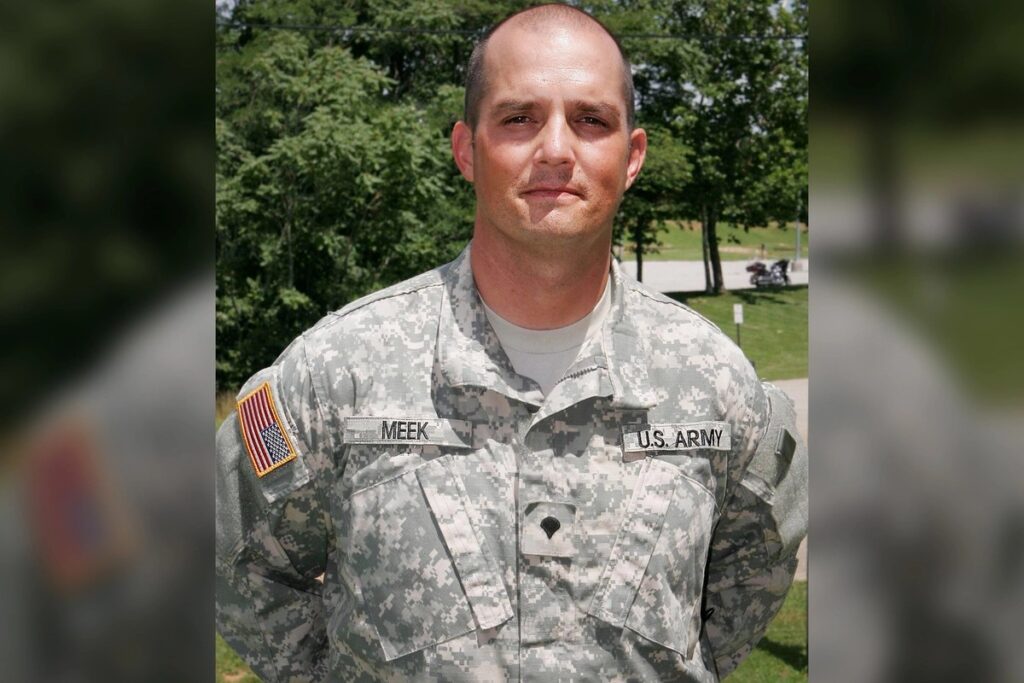
David Meek survived a devastating ordeal, yet he continues to carry the heavy weight of his memories as he navigates life.
On a busy street in Kabul, Afghanistan, Meek watched in horror as flames and billowing black smoke rose into the air. At that moment, his convoy was driving down the road, and what unfolded was transmitted in real-time to the operations center in Kabul. Meek and other officers could only watch in dread as their worst fears came to fruition: a suicide bomber had attacked, claiming multiple lives.
From 2011 to 2021, Meek served three tours of duty overseas with the U.S. Army. Following the September 11 attacks, he joined America’s “War on Terror.” At the age of 37, he was one of the older recruits in his cohort. To this day, he recalls young trainees, some as young as 17, lying in their bunks weeping.
Before joining the military, the now 55-year-old Meek worked in education for nine years in California, serving as both a teacher and high school principal. Education was a passion for him; he aimed to help young people realize their full potential, just as he had overcome significant challenges himself as a troubled student. He was abandoned, expelled from school, and struggled with a reading level equivalent to that of a third grader, but ultimately, he proved to himself that he was capable of pursuing higher education. Despite his success in education, he felt a calling to serve in the military, believing it was his true destiny.
The tragedy he witnessed during his first tour in Afghanistan in 2011 profoundly impacted him. At the time, he was a transportation officer stationed at a military base in Kabul, managing the logistics for thousands of personnel. His responsibilities included arranging the supply of fuel, equipment, food, and ammunition; organizing training for soldiers and determining their assignments; coordinating the arrival of contractors; and ensuring transportation for personnel. The base was a flurry of activity, with constant demands and operations.
Security tasks had to be meticulously planned, with no room for error. Meek was particularly worried about a specific type of armored bus used to transport personnel within Kabul. This bus, known as the “Rhino,” was a common transport vehicle not just for U.S. soldiers but also for Afghans, Canadians, civilian contractors, coalition forces, and other military partners, often used for routine trips between military bases and even outings for shopping.
Meek always considered the Rhino to be a weak link in the security chain. He was responsible for coordinating the bus’s stops each day, remaining vigilant and intentionally staggering the schedules at various stops. The enemy was constantly searching for exploitable vulnerabilities, so he strived to disrupt predictable patterns. He consulted military documents for itineraries and effective security strategies.
“This bus was an obvious high-value target,” Meek remarked during an interview. “Its roof was unarmed, without a machine gunner, leaving it vulnerable. There was ongoing concern about whether it should leave the base at all, and everyone knew it was just a passenger vehicle—information easily accessible on Google.”
On the morning of October 29, 2011, just 45 days after arriving in Afghanistan, Meek received word of the attack. A Taliban suicide bomber had infiltrated the bus convoy and detonated an explosive near an ancient palace that had previously been bombed by the Russians. Meek rushed to the operations center and accessed surveillance from a drone—a tool they referred to as their “eye in the sky”—to view the still-smoking wreckage. Chaos initially reigned as casualty figures fluctuated. Meek and his team scrambled to answer continuous phone calls, desperately trying to ascertain the situation on the ground.
In the end, the attack resulted in 17 fatalities. Among the dead were 13 individuals on the bus, including a soldier from Meek’s unit, and four local residents killed on the street.
Hours later, Colonel Kurt Ryan ordered Meek and his unit to take a 48-hour stand-down. Ryan recognized that they needed to step away and regroup. “You could see the colonel was very astute,” Meek recalled. If the respite was too brief, the soldiers risked breaking under pressure; if it were too long, they risked feeling stagnant within their cramped container-sized barracks, whimsically referred to as “LEGO houses.”
Following that brief hiatus, significant policy changes ensued. Meek recounted how the Rhino armored bus was permanently taken out of service, and security measures were revamped entirely. Daytime transportation missions ceased, with all operations scheduled for nighttime. This alteration effectively kept civilian vehicles from mingling with military convoys, and any vehicles straying too close would face non-lethal warning shots.
He also formulated a system akin to an airline passenger manifest, eliminating the vague accountability of roll calls. Each passenger’s name and seat number had to be meticulously recorded in a system. Moreover, no one was allowed to hitch rides to the market using the transportation arrangements.
However, while logistical issues soon found resolution, the broader impact of the 13 lives lost and the emotional scars left on Meek ran far deeper than his military service.
He survived, but the trauma he bore nearly cost him his life.
“I kept blaming myself. I felt that if I had chosen a different time, people might have been spared,” Meek lamented. He retired from the Army as a major in 2025 and now reflects on those experiences from his home near Paso Robles, California.
“For years, whenever I saw a stone dropped into water, I would try to count the ripples that expanded outward. I see those ripples as lives destroyed—always thinking that somewhere a child lost a father because of my logistical decisions and had to grow up without him.”
The 2011 attack did not mark the end of Meek’s military journey. Over the following decade, he was driven by a common psychological conflict faced by combat veterans: once back on American soil, he felt out of sync, as if everything at home was moving in slow motion. Paradoxically, he found a sense of belonging amidst the perilous and frenetic environment of a war zone.
In 2012, a German shepherd mix named Zina brought some solace to Meek’s life. Once a bomb-sniffing dog, Zina sustained injuries and became a mascot for the Kabul base. She not only aided Meek but also provided emotional support to fellow soldiers, serving as a significant pillar in his life. However, Zina’s death in 2020 left him inconsolable.
With each return home from deployments, Meek’s mental state gradually deteriorated. He described waking up each morning to check the weather back at the base as his first task. He found himself irritated by seemingly trivial complaints from civilians. In restaurants and public spaces, he was constantly scanning his surroundings, a habit that unsettled even his closest friends and family.
At that time, Meek was unaware that he was suffering from post-traumatic stress disorder (PTSD) and was grappling with severe survivor’s guilt.
“My family said I became increasingly reclusive after returning,” he recalled. “I was always finding excuses to stay home, cancelling previously planned activities.” This alienation also affected his children; his sixth-grade son Samuel began to exhibit rebellious behavior.
“To him, it seemed as if his dad had abandoned him,” Meek noted. “My son started displaying traits I had never seen before while I was around him.”
This trauma slowly eroded his mental and physical well-being. “When I woke up in the morning, my pillowcase would often be stained with blood,” he disclosed. “In my sleep, I would scratch my scalp uncontrollably until I broke the skin and bled profusely.”
The blow of PTSD also severely impacted Meek’s relationships. A decade after the attack, his marriage fell apart. On November 5, 2021, he came home to find his wife’s belongings removed. She had left him.
Weeks later, he survived a suicide attempt, having swallowed a whole bottle of trazodone in a desperate bid for relief but did not die. Seeking help, he turned to his neighbor Glen, a Vietnam War veteran who had been supportive over the years.
Meek recalls that during that period, his thoughts raced like a spinning top. One night, while out with friends, he found himself unable to speak, his lips trembling yet unable to articulate a single word. He learned through a segment of “60 Minutes” about a veteran exhibiting similar symptoms, realizing that such experiences were common among those suffering from PTSD. However, he also discovered a treatment option—stellate ganglion block—where medication is injected into the neck, effectively “engaging the brakes” on his racing mind.
Discussing the decision to undergo treatment, Meek remarked, “It was one of the best decisions I’ve ever made, as it opened the door for meaningful therapy to commence.”
Following the treatment, Meek began to see gradual improvements in his condition.
Yet, his past accomplishments, in many ways, served as obstacles to his recovery. “I came from a troubled family, overcame obstacles, and eventually became a principal,” he stated. “Then I enlisted and earned a Bronze Star. I always felt I had no space to express my true feelings because everyone saw me as an exceptional person.”
During his ongoing therapy sessions, he began to let down his defenses. He started to understand that he did not have to perform at an eight out of ten every day; it was acceptable to admit that some days, he might only be functioning at a two.
“If the therapist doesn’t understand what the issue is, they can’t assist you,” he said. “I began sharing everything in my sessions, whether it was the good, the bad, or the ugly, even if some of it was embarrassing to speak of. Once they comprehended my full situation, the treatment could genuinely make progress.”
In November 2022, disaster struck on the streets of Orange County, California. A group of men awaited Meek outside a restaurant. He had intervened when they were harassing a young woman inside, provoking their retaliation. The men suddenly attacked him, stabbing him multiple times, inflicting wounds from below his navel to his chest. Ironically, this assault helped Meek break free from the survivor’s guilt that had plagued him for so long.
Meek described the attack as a wake-up call, “the best thing that ever happened to me.” This former soldier, who had been steeped in battlefield life, desiring death and relying on alcohol to numb himself, finally emerged from that dark state. His perspective on life underwent a significant transformation as he began to find joy in life’s simple pleasures.
“This week, it’s my turn to do the dishes. I used to dread it, but now I find myself looking out the window while washing up,” he shared.
Today, Meek continues to live and expresses gratitude for his life. His passion for education remains unwavering, as he now supports at-risk youth and children with autism facing their own life challenges. He hopes to give back to society.
“There was a time when someone stood above me, shouting down, ‘Wow, how did you fall so deep?’” Meek stated. “I want to be that person who climbs down to sit beside them, patiently waiting for them to speak. When they’re ready, I’ll help them step by step as they slowly climb their way back up that ladder.”
Next spring, Meek is preparing to remarry. His fiancée, Kendra, supports him through his journey.
“I have shared all my experiences—good, bad, and ugly—with her. Some of those stories would deter most people,” he said. “But she has remained patient and believes I’m becoming a better version of myself every day.”