
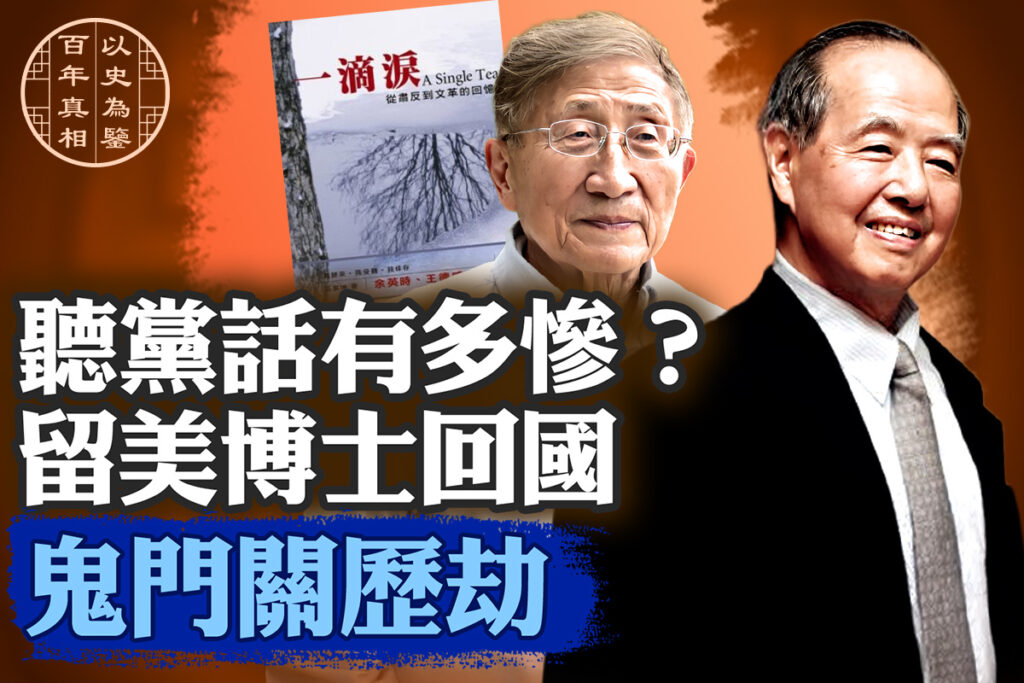
In 1993, an English memoir titled “A Single Tear” was published in New York, instantly creating a sensation in the Western world.
The author, Wu Ningkun, recounts a pivotal moment from his past when he decided to abandon an impending PhD degree in the United States and return to China. As he prepared for his departure, he asked his classmate, Li Zhengdao, who had come to see him off, why he too did not choose to return to serve his country. Li Zhengdao’s response was simple yet profound: “I don’t want to be brainwashed!”
Wu’s return to China was the beginning of an arduous journey filled with hardships. Decades later, as he stepped outside the borders again, he gained a visceral understanding of what it truly meant to experience the Communist Party’s “brainwashing.”
This program aims to revisit the harrowing history faced by Chinese intellectuals during this tumultuous period.
The narrative begins during the wartime years, when the sounds of cannon fire echoed across the nation.
Born in September 1920 in Yangzhou, Jiangsu, Wu Ningkun attended Yangzhou Middle School. The outbreak of the Second Sino-Japanese War in July 1937 led to the dissolution of Yangzhou Middle School. In a poignant farewell assembly, students and teachers gathered in the school hall to sing “On the Songhua River.” As they reached the lines, “When can we return to our beloved hometown?” tears flowed freely amongst the crowd, leaving a profound impression on Wu.
Just two years later, the gifted Wu was accepted into the Foreign Languages Department at Southwest Associated University (also known as “Xinan Lianda”). His teachers were prominent figures such as Shen Congwen, Wu Mi, and Bian Zhilin, while his peers included talents like Wang Zengqi and Yang Zhenning.
In the summer of 1941, Wu, having just completed his sophomore year, responded to the school’s call to “take up arms” by joining the American Volunteer Group, later known as the Flying Tigers, as an English translator assisting the U.S. Air Force in their mission to support China during the war. By October 1943, he had traveled to the United States to serve as an interpreter for Chinese airmen undergoing training there.
In March 1948, Wu enrolled at the University of Chicago to pursue a PhD in English and American Literature. There, he forged close relationships with fellow students and alumni, including Zhao Luoru and Li Zhengdao.
A turning point in his life occurred in July 1951 when he received an urgent telegram from Zhao Luoru, who had returned to China after completing his doctorate and was working to establish the Spanish Department at Yenching University. Encouraged by President Lu Zhiwei, Zhao invited Wu to return to China to “build a new China.” After a few days of contemplation, Wu made the fateful decision to abandon his degree and head back home—only one step short of his doctorate.
Upon hearing this news, his older brother in Taiwan and sister in Hong Kong were alarmed and sternly warned him against trusting the Communist Party’s rhetoric, cautioning that it was nothing but a “flood beast!”
Despite their grave warnings, young Wu was unwilling to heed their advice.
On July 18, 1951, under the brilliant sun of San Francisco, two young Chinese intellectuals stood side by side at a crowded dock. One was the analytical and composed physicist Li Zhengdao; the other, Wu Ningkun, was a passionate literary youth brimming with ambition.
As they gazed at a massive passenger ship in the harbor, Li Zhengdao turned to Wu and asked, “Are you really leaving?” Wu’s eyes shone with idealism as he replied, “My country is calling!” He then inquired, “Why won’t you return?” After a brief pause, Li simply stated, “I don’t want to be brainwashed.” Wu was bewildered, wondering, “What does being brainwashed even mean?”
As the whistle of the U.S. President Cleveland steamed sounded, Li knelt down, retrieving a pen. With careful strokes, he inscribed on Wu’s old luggage: “Beijing Yenching University Wu Ningkun.”
Upon arriving at Yenching University, Wu threw himself into lesson preparation and teaching with great enthusiasm, while hastily trying to catch up on the Marxism he barely understood. Though the challenges of teaching could be surmounted, he found himself lost amid the political movements. Within two months of his return, he experienced the chilling effects of political campaigns firsthand.
In September 1951, Wu, alongside thousands of senior intellectuals, attended a lengthy address by Zhou Enlai in Beijing regarding the “ideological transformation of intellectuals.” This marathon report lasted from the afternoon into the late night for seven hours. Zhou called for the intellectuals to “transform their thoughts” and clearly delineate their stance against “American imperialism” and the “old society.”
Before long, Wu encountered the harsh realities of what “thought reform” truly entailed. Once a prestigious Christian university, Yenching had become a focal point of scrutiny during the thought reform movement.
In 1952, Yenching was merged with Peking University, and Lu Zhiwei found himself compelled to conduct self-criticisms before faculty and students. Wu was particularly struck and horrified one day when Lu’s daughter publicly criticized her father for his “reactionary influence,” declaring her severance from him.
In his memoir, Wu noted that this shocking scene affected him more profoundly than any political theory. He realized that this movement aimed not only to alter political perspectives but to “completely destroy the foundational trust and emotions between individuals.”
In the spring of 1957, Mao Zedong declared that intellectuals should offer criticism of the Party—a campaign that would later be labeled a “conspiracy” orchestrated to compel “monsters and demons” to surface.
At that time, Wu was blissfully unaware of the impending danger. He foolishly envisioned a springtime for intellectuals and, with sincere passion, voiced sharp critiques at a “Criticism Conference” about various phenomena of political control at his school. Uplifted, he even proclaimed in English, “Give me liberty, or give me death!”
Initially, the school administration responded with tolerance and a degree of leniency. However, the optimism of the “Beijing Spring” quickly evaporated with the initiation of the “Rectification Movement,” which dramatically shifted, transforming overnight into the “Anti-Rightist Movement.” The Dean, who also served as the Party secretary, ominously informed Wu that his “three anti” crimes could warrant a death sentence. However, the Party, in its generosity, chose instead to brand him as a “far-right element,” dismissed him from his position, and sent him for labor re-education.
By April 1958, Wu bid farewell to his pregnant wife and was transported to Beijing’s First Prison, a temporary holding facility for political prisoners before they were formally dispatched elsewhere.
Wu carried with him only a single suitcase—marked with Li Zhengdao’s inscription, “Beijing Yenching University Wu Ningkun.” Inside, apart from basic clothing, were two books: Shakespeare’s “Hamlet” and a selection of poems by Du Fu. During his ensuing years of endless suffering, the line “To be, or not to be” from Hamlet became a daily struggle for Wu.
Shortly after, he was placed on a train headed north with around four to five hundred other intellectuals and officials also labeled “far-right.” They eventually arrived at the Xingkai Lake Agricultural Farm—a location mockingly referred to as “Beidahuang,” situated in the desolate Sino-Soviet border region of Heilongjiang.
The labor camp was purposely sited in such a barren place to leave its inhabitants with no escape. Here, besides armed sentries, the brutal natural elements posed another significant threat. Winter temperatures in Beidahuang often plummeted to below -40°C. Anyone attempting to leave the camp would freeze within hours.
At Xingkai Lake, one of their most grueling tasks was to construct flood dykes. In the frigid landscape, the frozen ground was as hard as rock. They first had to smash the surface with heavy steel rods until their hands went numb before chipping away at it to create a small crack in the ice. The mud they unearthed felt as heavy as stones. While grappling with extreme malnutrition, they were required to carry these heavy clumps to the embankments.
Another daunting task was harvesting reeds in winter, as this was the farm’s only source of fuel and construction material. An endless expanse of reeds sprawled along the shores of Xingkai Lake. Wu and other laborers had to wade through knee-deep snow as they worked. In those desolate moments, lines from T.S. Eliot’s “The Waste Land” would invade his thoughts: “April is the cruellest month…”
Around 1960, as Sino-Soviet relations deteriorated and severe famine struck the country, the Xingkai Lake Agricultural Farm began to scale back personnel and transfer inmates. Wu, along with a group of “seriously ill” intellectuals, was relocated to the Qinghe Farm in Tianjin. There, he witnessed even greater mortality than at Beidahuang and found himself in a critical state due to prolonged hunger.
Wu suffered from severe nutritional edema, his skin stretched tight and shiny, leaving deep impressions when pressed. He faced difficulty breathing, and even walking became a challenge—this was the so-called “trilogy”: first came emaciation, followed by swelling, and ultimately death.
At Qinghe, death became a mechanical part of daily life. Wu, struggling to maintain his weakened body, had to join others in wrapping deceased fellow detainees in tattered mats and carry them to a nearby rise or ditch for burial. Those who had once debated literature and politics together were now mere mounds in the frozen earth, marked by no gravestones.
In desperation, Wu wrote a letter to his wife, urging her to come and see him one last time. Upon receiving the letter, Li Yikai was shocked and hurried to the market to buy stir-fried noodles, sugar, and other supplies. With their young child in tow, she traversed multiple trains and long-distance buses before arriving at that desolate farm, delivering what proved to be “life-saving food” to Wu.
Wu remained somewhat fortunate; in 1961, he was permitted to “seek medical treatment outside” due to illness and returned home from the Qinghe Farm for recuperation. He survived while countless innocent souls, just as brilliant as he, were buried beneath that desolate expanse, unable to wait for their own “life-saving food.”
However, Wu was not destined for a peaceful life thereafter. The Cultural Revolution erupted in 1966. This time, he was no longer the prisoner in a remote location; he was confined within his university, trapped in what was mockingly dubbed the “cow shed,” witnessing the total collapse of human relationships amid dual assaults on his spirit and body.
The “cow shed” was not a real barn but a makeshift detention center created by repurposing classrooms, offices, or storage rooms to confine intellectuals labeled as “monsters and demons.”
Every day, Wu was required to wear a white cloth badge proclaiming “counter-revolutionary.” As a former elite student at the University of Chicago, his daily tasks involved cleaning the campus and scrubbing toilets under the watchful eye of Red Guards. Each morning, he had to line up with other “monsters and demons” and shout out his misdeeds before a portrait of “Chairman Mao,” participating in the so-called “confession to the people.”
By 1979, Wu was finally vindicated and returned to teach at Peking University. By this time, his body felt increasingly heavy, but his spirit was elevated. He continued to write fervently through the lens of his suffering and translated two significant works: the first was F. Scott Fitzgerald’s “The Great Gatsby.”
In 1952, Wu had been denounced for discussing this novel in class, accused of promoting “the decadent lifestyle of American imperialism.” Yet fate had a rewarding twist: he was invited to translate this very book into Chinese.
His translation of “The Great Gatsby,” published by Shanghai Translation Publishing House in 1982, was remarkably precise and elegant. Although many new translations emerged later, Wu’s version remains irreplaceable as one of the earliest high-quality translations of foreign literature in post-Cultural Revolution China, enlightening countless youth in the 1980s who yearned for civilization.
In 1979, after some inquiries, Wu finally met Li Zhengdao at a hotel in Beijing, who had returned to give lectures. By this time, Li had achieved great success, while Wu, who had once yearned to “return to the embrace of his motherland” to “build a new China,” had endured twenty-two years of brutal suffering and indignity.
When Wu entered the luxurious suite at the Beijing Hotel, Li Zhengdao stood up to greet him, impeccably dressed in a tailored suit, radiating confidence. He was a revered Nobel laureate, just concluding discussions with high-ranking officials of the Communist Party.
Wu felt the vast chasm that existed between them. Faced with a countenance that bore the marks of torment, Li seemed unsure of how to respond. For someone who had ascended to the peaks of science in a free world, grasping the absurdities of “sacrificing kin for greater principle” and the “cow shed” proved both emotionally and logically challenging.
After leaving the Beijing Hotel, Wu found himself preoccupied with a question: “What if I had remained, and Li Zhengdao had returned? Would the outcome have been different?”
After retiring in 1991, Wu settled in the United States, leading a simple and tranquil life in a senior apartment in Virginia.
Although his eyesight was nearly gone due to illness, Wu experienced a strong sense of purpose. He understood that if he did not chronicle the history of torture endured by Chinese intellectuals, it would vanish with the passing of his generation.
Encouraged by his family, Wu published the English version of “A Single Tear” in 1993 in New York, which quickly resonated throughout the international literary community. Through this memoir, Western readers had a shocking glimpse into the stark realities faced by Chinese intellectuals during the latter half of the 20th century.
Wu’s candid revelations earned him the ire of the institution he had worked for prior to retirement, leading to the confiscation of his housing and suspension of his pension until he was ultimately raided.
On August 10, 2019, the elderly man, who had traversed the tumultuous landscape of the 20th century, peacefully passed away in the United States, at the age of 99.
He left behind not only “A Single Tear” but also an eternal question: What do we lose when a regime declares war on its own intellectual elites? Wu Ningkun’s life of suffering yielded this immortal testament, becoming the most piercing denunciation of a dark era.
Thank you for joining us on today’s program. We hope you found our discussion engaging and enlightening. If you enjoyed this episode, please don’t forget to like, subscribe, and share. We look forward to seeing you next time.