
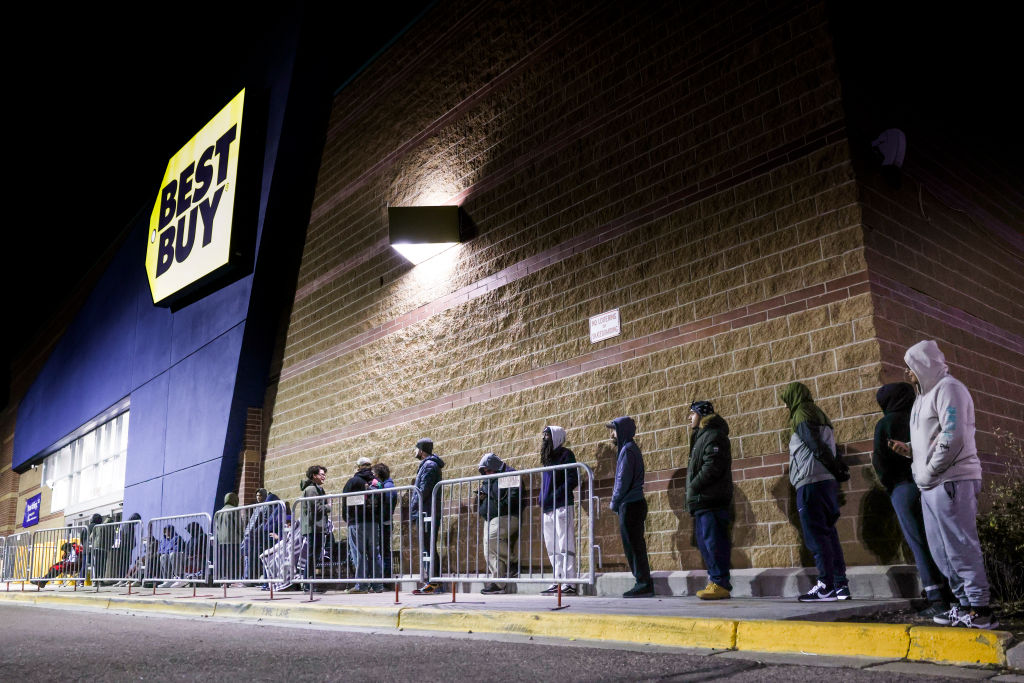
The annual shopping frenzy known as “Black Friday” officially commenced this past Friday, drawing crowds of eager consumers ready to take advantage of significant discounts. Although many retailers began their promotional activities weeks ahead of Thanksgiving, a substantial number of shoppers still chose to visit stores in person to snag discounted items. Notably, some department stores opened their doors as early as 6 a.m., and lines of enthusiastic shoppers formed outside well before dawn.
As American families concluded their Thanksgiving celebrations filled with good food and cherished moments with loved ones, they now turned their attention to one of the biggest shopping events of the year. “Black Friday,” which takes place the day after Thanksgiving, is followed by “Cyber Monday,” where consumers can find even more online deals.
With the Thanksgiving holiday wrapping up, shoppers across the country flocked to department stores, hunting for discounts on electronics, household goods, and various other items. Major retailers rolled out exceptional deals, aiming to attract those seeking the best offers for the Christmas season.
In Manhattan, New York City, the flagship Macy’s store at Herald Square opened at 6 a.m. on Friday. Even before sunrise, consumers were lined up outside, ready to be among the first to enter. Once the doors opened, thousands of shoppers streamed inside, clamoring for bargains.
Despite online promotions being available well in advance, some consumers opted for the in-store experience. A shopper who traveled from Miami to New York shared with the Associated Press that participating in Black Friday has become an annual tradition for him, and this year he was particularly excited to experience the unique atmosphere at Macy’s.
This year, Macy’s offered several discounts, including reductions of 25% to 40% on handbags and 20% to 50% on athletic shoes.
At a Target store in New York City, hundreds of consumers lined up outside, hoping to be among the first to receive gift cards offered to the first 100 shoppers—the values ranged from $25 to $1,000. Each store was set to have one lucky customer receive a $1,000 gift card, creating a buzz among those waiting in line.
The Target store opened at 6 a.m. on Friday, and the gift cards were distributed on a first-come, first-served basis.
This year, severe weather including strong winds and rain impacted parts of the United States, leading to flooding and power outages. Consequently, Macy’s Thanksgiving Day Parade in New York was postponed to Saturday due to wind warnings. Nevertheless, the inclement weather did not entirely deter consumers from venturing out for their shopping.
According to the National Retail Federation (NRF), holiday retail sales in the United States are expected to reach approximately $1.013 trillion from November to December 2026, reflecting a 4.1% annual increase—an increase that surpasses last year’s growth rate of 3.1%.
However, rising prices have also played a significant role in driving sales. The latest Consumer Price Index (CPI) report from the U.S. Department of Labor indicates that inflationary pressures continued to build significantly for the third consecutive month in October. This trend is largely attributed to increased costs in food and housing, as well as rising oil prices due to ongoing conflicts between the U.S. and Iran.
On the consumer confidence front, falling gasoline prices have helped improve shopping sentiment, but households still face pressures from housing, food, and other daily expenses.
A Deloitte survey indicated that average spending per consumer during the period from Black Friday to Cyber Monday is expected to remain on par with last year at $624; however, the percentage of people participating in holiday shopping has reached a ten-year high of 87%.
Beyond brick-and-mortar stores, online shopping continues to gain traction. According to data from Adobe Digital Insights, U.S. consumers spent $82.5 billion on online shopping from November 1 to 22, an increase of 9.1% compared to the same period last year.
Artificial intelligence (AI) is also gradually transforming the way consumers shop. Data from Salesforce reveals that consumers are increasingly using AI to compare prices, research products, and hunt for deals. Almost one-fifth of shoppers are beginning their purchasing journeys with AI tools.
Salesforce also noted that during this year’s Cyber Week, sales influenced by AI and digital agents are projected to reach $75.8 billion, accounting for approximately 21% of total sales. Across the board, price comparison and product recommendations dominate the applications of AI in retail.
Additionally, traffic driven to retail websites by AI has more than doubled compared to the same time last year, with consumers recommended products through AI being twice as likely to complete a purchase compared to typical online shoppers.
Electronics emerged as one of the most heavily promoted categories this Black Friday. A recent Reuters survey of retailer websites revealed that Walmart had slashed the price of an 85-inch Vizio Quantum TV from $698 to $498, while Best Buy reduced the price of a 65-inch TCL TV from $469.99 to $229.99 and an HP laptop from $799.99 to $449.99.
As the shopping weekend extends from Black Friday to Cyber Monday, Apple has launched a promotion featuring gift cards valued up to $300.
A recent NRF survey indicated that in the toy category, products such as Hot Wheels cars and tracks, LEGO sets, and Barbie dolls remain among the most popular gift choices.
Retailers have also introduced discounts on beauty products, household supplies, and appliances. For instance, Walmart reduced the price of a Blackstone griddle from $224 to $150, and beauty retailer Ulta Beauty offered deals on brands like Sol de Janeiro, Tarte, MAC, and Morphe.
Retail analysts have pointed out that Black Friday is no longer confined to a single day of sales; it has gradually evolved into a shopping season spanning several weeks. Consumers are not only purchasing Christmas gifts but also taking advantage of discounts on essentials like shampoo, cleaning supplies, and everyday clothing items.