
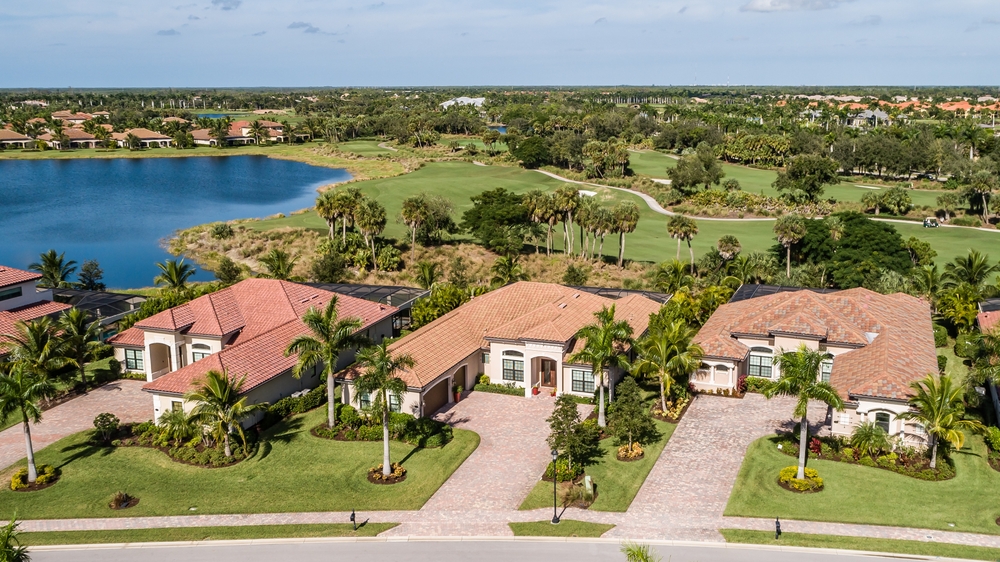
A recent report highlights ongoing trends in the U.S. real estate market, emphasizing Florida’s sustained appeal to international buyers during the third quarter of this year. Florida continues to rank as the top destination for overseas buyers seeking properties in the United States, with California following closely behind in second place. However, Texas is rapidly gaining popularity among foreign investors and may surpass California as early as next year.
This insightful report was published on November 25 by Realty site Realtor.com. The data reveals that Canadian buyers remain the largest group of overseas potential buyers in the U.S. real estate market, making up 35.9% of all overseas users browsing American property listings. This figure marks an increase from 32.3% during the same period last year. The most attractive states for Canadian buyers continue to be Florida, Texas, and California. Conversely, interest from European buyers in U.S. real estate has fallen to its lowest level for the third quarter since 2019.
During the third quarter of this year, nearly 22% of overseas users’ browsing activity for property listings was directed toward Florida, significantly higher than California’s 10.8% and Texas’s 10.3%.
Interestingly, California has witnessed a decline in its allure for overseas buyers. The state’s share of interest has dropped from a peak of 16.6% in 2020 to the current 10.8%, which is even lower than the 14.2% recorded in 2019. In contrast, Texas has seen its share of overseas buyer interest increase consistently since 2022, with the gap between Texas and California shrinking from 5.7 percentage points in 2019 to just 0.5 percentage points today.
Looking at specific cities, Los Angeles, Riverside, and San Diego are the most popular locations in California for overseas buyers, accounting for 4.7%, 1.4%, and 1.2% of the total browsing activity by international users, respectively. In Texas, Dallas and Houston are leading, with shares of 3% and 2.4%.
A report from the Texas Realtors in August of this year indicated that from April 2025 to March 2026, overseas buyers purchased 7,780 homes in Texas, an increase from the previous year’s total of 7,500. This volume constitutes 2.3% of the state’s total residential real estate transactions, with a median sale price of $375,000.
Jennifer Wauhob, the chair of the Texas Realtors association, remarked that the relatively lower property prices, coupled with Texas’s robust economy and high quality of life, are significant factors attracting international buyers to the state.
On a broader scale, Miami has emerged as the top-ranked city for overseas buyers, accounting for 8.3% of total browsing activity among international users. This is followed by New York and Los Angeles at 5.9% and 4.7%, respectively. Other cities in Florida, such as Orlando and Tampa, are also gaining traction, with shares of 2.9% and 2.5%.
A report released this January by the Miami Realtors association indicated that in 2025, one in every five homes purchased by overseas buyers in the U.S. will be located in Florida. Moreover, within Florida, half of these purchases will take place in the Miami metropolitan area.
Last year, overseas buyers acquired a total of 5,300 homes in South Florida, with an overall sales volume reaching $4.4 billion—an increase of approximately 42% from $3.1 billion in 2024.
The association attributes this surge in overseas purchases to the depreciation of the dollar against various major currencies and ongoing political instability in Latin America, prompting more international buyers to invest in real estate in Miami.
In the third quarter of this year, Canadian users accounted for 35.9% of the overall browsing activity on American property listings, a figure that closely matches the respective percentages of 36.1% and 36.9% during the same periods in 2023 and 2024.
In contrast, European interest in U.S. real estate appears to be waning. During the third quarter, users from the United Kingdom and Germany represented 6.2% and 3.7% of overall browsing activity, respectively.
Realtor.com notes that alongside the decline in European interest in U.S. real estate, there has also been a reduction in travel activities from Europe to the U.S., which could suggest a cooling interest among Europeans in both traveling to and purchasing properties in the States.
Nevertheless, among the U.S. properties being browsed by European users, New York and Texas have seen increases in their shares of interest, reaching 8.1% and 8% respectively. This reflects a shifting perspective toward specific markets within the United States, highlighting ongoing opportunities and changes within the international real estate landscape.