
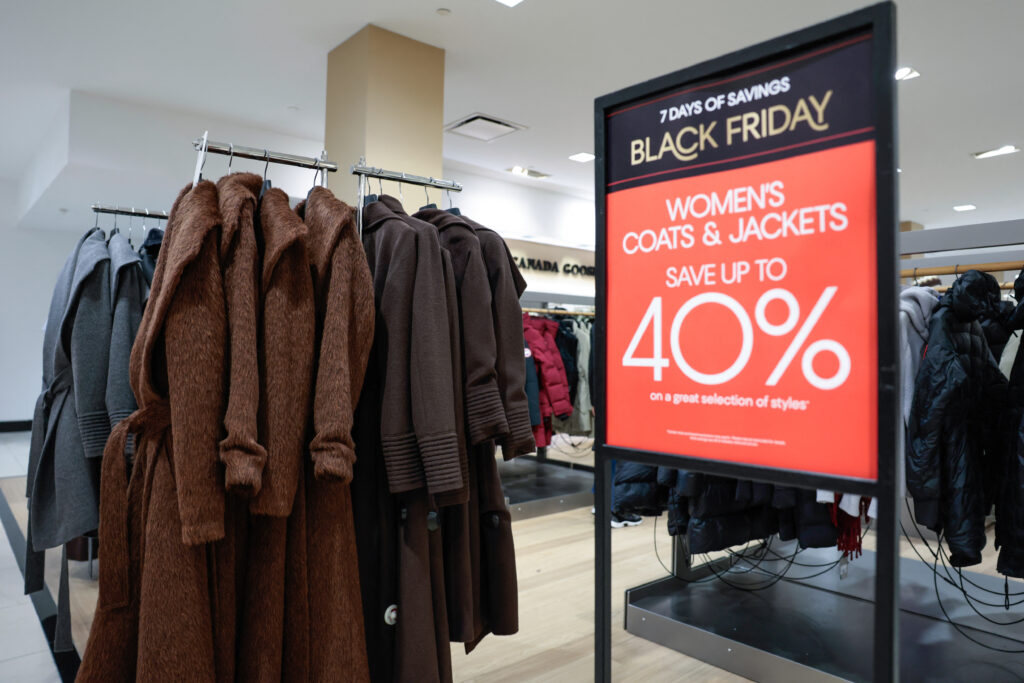
The annual “Black Friday” shopping festival has arrived in the United States, drawing considerable attention from consumers eager to snag the best deals. Despite ongoing inflation and persistent pressures from rising living costs, Americans remain enthusiastic about shopping this holiday season. Predictions indicate that holiday retail sales are set to exceed $1 trillion, with the proportion of consumers planning to engage in shopping activities from Thanksgiving to “Cyber Monday” reaching a new 10-year high.
The National Retail Federation (NRF) has forecasted that holiday retail sales from November to December will increase by 4.2% compared to last year, totaling approximately $1.013 trillion. Similarly, both Mastercard’s Economic Institute and EY-Parthenon anticipate sales growth of more than 5%.
Reports have emerged from Reuters indicating various economic forecasts suggesting that consumer spending during this holiday season could rise between 4% to 6%. However, it is important to note that most of this increase is attributed to inflation, with the current inflation rate in the United States sitting at 3.8%, approximately one percentage point higher than the levels observed over the last two years.
A survey conducted by Deloitte in October revealed that around 87% of respondents plan to participate in the five-day shopping event from Thanksgiving through November 30, marking the highest participation rate in a decade.
Data from tech company Adobe suggests a robust start to the holiday shopping season, with U.S. consumers spending a staggering $82.5 billion online from November 1 to 22, reflecting a year-over-year growth of 9.1%, surpassing expectations. The company predicts that total online sales during the holiday shopping season, concluding on December 31, will increase by 6.7% to reach $275.1 billion.
In a bid to attract customers, many retailers have rolled out promotional campaigns earlier than usual this year, with some even starting discounts before Halloween. According to Salesforce, discounts in November have increased by 8% compared to the same period last year, while the average price of physical goods has dropped by 1%.
Nevertheless, experts from Adobe predict that the best deals may still materialize over Thanksgiving and Black Friday. For instance, the average discount on televisions is expected to be around 23% on Black Friday, significantly higher than the 11% discount observed in the first 22 days of the month.
Under the pressure of rising living costs, American consumers are also becoming more strategic in their spending. An NRF survey conducted in November indicated that 82% of consumers are taking measures to control their holiday expenditures, such as opting for less expensive gifts and cutting back on other expenses.
Research by consulting firm Kearney shows that, for several months, middle and lower-income consumers have increasingly shifted towards purchasing cheaper products, demonstrating a greater tendency to reduce spending compared to affluent consumers.
Felicia Cox, a 50-year-old resident of Los Angeles, shared with Reuters that while her holiday budget will remain largely unchanged, inflation has altered her shopping choices. “I want to buy more gifts that people will actually use or need,” she remarked, “I feel like people cannot afford to buy as many things as before.”
As Black Friday promotions extend over several weeks, some consumers are also taking the opportunity to stock up on essential items. Adobe’s data shows that online sales for personal care items, household cleaning supplies, and basic clothing have increased by 40%, 33%, and 27% respectively compared to their average monthly levels in October.
Vivek Pandya, Adobe’s Digital Insights Director, commented to the Associated Press, “Usually, when we think of holiday shopping, we think of luxury goods like handbags and jewelry, but we are quickly seeing that shoppers are also taking advantage of this shopping season to stock up on essentials.”
Simultaneously, due to rising costs of materials derived from petroleum, including plastics, toy prices have surged by 13.2% since the beginning of the year. This rise in prices has caused consumers to shy away from higher-priced items, prompting Mattel, the manufacturer of Barbie dolls, to adjust its full-year revenue forecast downward.
The recent decline in the stock market has also introduced a level of uncertainty regarding holiday spending.
Reuters noted that most holiday spending projections were made prior to this stock market pullback. Analysts at UBS stated in a report that the decline in the stock market could diminish the wealth effect, which previously encouraged affluent consumers to spend liberally on electronics and accessories.
Artificial intelligence (AI) is also transforming the way Americans shop. With consumers becoming more price-sensitive, AI-assisted price comparison tools are gaining traction. Adobe’s data indicates that traffic to online retail sites through links from AI tools has more than doubled year-over-year this month.
John Furner, CEO of Walmart, mentioned this month that customers using the company’s AI shopping assistant, Sparky, spent an average of 40% more per order compared to those who did not use it.
Additionally, Andy Jassy, CEO of Amazon, revealed last month that U.S. shoppers utilizing the AI assistant Alexa spent 50% more than those who didn’t use it.
Salesforce estimates that during this holiday shopping season, one in five orders globally will be influenced by AI product recommendations.
Furthermore, retailers are becoming increasingly adept at utilizing AI to adjust prices swiftly. Ryan Orabone, a consultant at Spaulding Ridge, believes that as both buyers and sellers are observing market trends, the most substantial discounts may only surface closer to Christmas.
“My advice to shoppers is to be patient,” he told Reuters, “Don’t rush to buy as soon as you see the first deal.”