
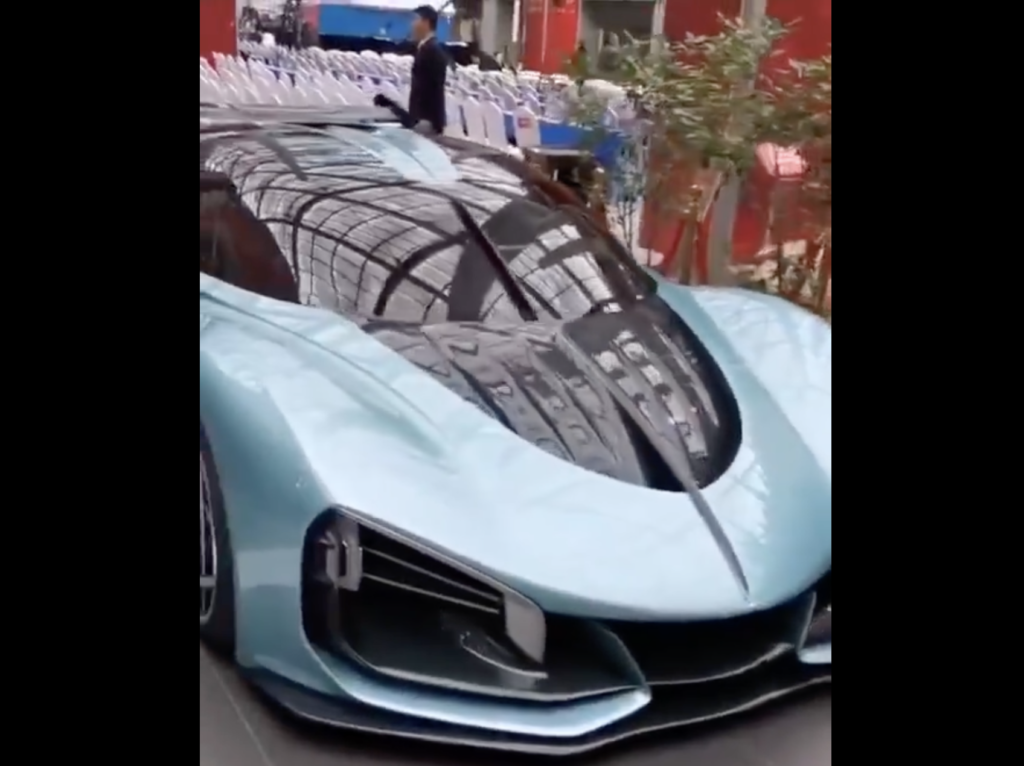
The ambitious international car manufacturing project, the Hongqi S9 supercar, planned by China’s First Automobile Works (FAW) Group over five years ago, has ultimately been left unfinished. The originally intended factory site in Italy was so idle that it became a field for corn cultivation. The former chairman of FAW has since been ousted, and related cooperative companies have plunged into debt disputes and judicial liquidation. However, the unusual political and business connections that lie behind this project remain shrouded in mystery.
In March 2021, a blogger posted a video stating that the world’s only Hongqi S9 was undergoing testing, exclaiming, “Look here, this is the Hongqi S9, which accelerates from 0 to 100 km/h in just 1.9 seconds. It’s a pure electric sports car, and there’s only one of its kind globally. Today, we are witnessing its test run.”
At the Shanghai Auto Show in April 2021, a striking black and red supercar made an appearance at the Hongqi booth. Xu Liuping, then chairman of FAW, announced that the Hongqi S9 was officially open for global bookings, with an initial limited release of 99 vehicles. The supercar boasted a claimed output of over 1,400 horsepower, a 0-100 km/h acceleration time of under two seconds, and a top speed exceeding 400 km/h, with a pre-sale price reaching as high as 1.45 million USD (about 10 million CNY).
Following this, the Hongqi S9 supercar frequently surfaced in Italy, drawing comments from online users who noted its resemblance to the Swedish supercar manufacturer Koenigsegg.
At that time, American automotive design firm Silk EV collaborated with FAW, planning an investment of 10 billion CNY to establish research and development, as well as manufacturing bases in Changchun, China, and Italy, with the goal of creating a luxury Hongqi S series of supercars. The ambition was not only to secure a foothold in the luxury car market in China but to also make inroads into the exclusive global supercar market dominated by brands like Ferrari and Lamborghini.
In August 2021, the joint venture Silk-FAW, formed between FAW and Silk EV, announced that the production version of the Hongqi S9 would debut at Milan Design Week in early September. Silk-FAW had previously announced a major investment of 10 billion CNY (approximately 1.5 billion USD) and planned to commence production at a new facility in Italy’s “Motor Valley” in Reggio Emilia, with projections for production to begin by early 2023.
Silk EV brought together a team of well-respected figures from the Italian automotive sector, including Walter de Silva, formerly the design head at Volkswagen Group, who was appointed vice president of design responsible for the Hongqi S series; and Amedeo Felisa, former CEO of Ferrari, who was recruited as a senior advisor.
However, five years later, reports from Caixin indicate that the Hongqi S9 has failed to enter mass production as planned, with the Italian factory remaining unbuilt. The once-ambitious multinational car manufacturing project has succumbed to debt disputes and judicial liquidation.
Due to the stagnation of the project, by March 2022, the planned factory showed no signs of construction, with multiple delays in land transactions. In August 2022, Italian media revealed that Silk-FAW had 17 employees pursuing wage claims due to salary arrears. In early September 2022, a local newspaper interviewed the landowners, who stated that, unable to sell the land, they had begun planting corn and wheat in anticipation of a harvest for the coming year.
On February 22, 2023, Silk Sports Car Company, the Italian branch of Silk-FAW, formally notified local authorities of their decision to abandon the previously signed investment agreements. Concurrently, the company faced inquiries from law enforcement regarding its application to the Italian national investment promotion agency, Invitalia, for 38 million euros in public funds, despite having made little tangible construction progress. However, the accusations did not lead to any public criminal charges.
By May 16, 2024, an Italian court ruled that Silk-FAW’s operating company in Italy would undergo judicial liquidation. The once-promising Hongqi overseas car manufacturing initiative ultimately failed to materialize.
Silk EV had established partnerships in the Cayman Islands for project financing, leading Italian creditors to apply for liquidation in a Cayman court in November 2025 due to unrecouped debts. On December 5, 2025, the court ordered the liquidation of two financing entities associated with Silk EV. Upon the appointment of liquidators, it became clear that the issues ran deeper than just inability to repay debts; they discovered that the only identifiable asset within the United States was a $10,000 advance held by a law firm.
According to Jonathan Krane, founder of Silk EV, he lived in China from 2004 to 2009, establishing business collaborations with multiple local government agencies.
In 2013, Krane founded the asset management brand KraneShares. In July 2017, CICC announced its acquisition of a 50.1% stake in KraneShares, with the transaction price undisclosed. In 2018, Krane transitioned into the electric vehicle sector by founding Silk EV, quickly pursuing collaboration with FAW.
By June 2026, CICC sold its stake to Krane and a management acquisition platform, ending nearly nine years of control.
Reports suggest that although Krane spent a significant period conducting business in China and amassing financial and commercial resources, he previously lacked experience in developing and manufacturing whole vehicles, casting the Silk EV and FAW collaboration as somewhat unconventional.
Silk-FAW had once claimed backing from several large Chinese financial institutions. On March 25, 2021, representatives from Silk-FAW held a meeting with officials from the Industrial and Commercial Bank of China, China Construction Bank, Bank of China, Bank of Communications, Jilin Bank, and BOC International. The project team subsequently announced that these institutions had agreed to become strategic partners for the Hongqi S series, providing financial support for its development and production in China and Italy, although specific financing amounts were not disclosed.
However, questions regarding the involvement of Chinese local governments, CICC, state-owned banks, and potential conflicts of interest with Krane have not been publicly reported by Caixin.
Under an earlier agreement, Silk EV planned to contribute 1 billion CNY through its wholly-owned company for an 85% stake in the operating entity, Cayman-based Silk Sports Car Company Group Ltd. Meanwhile, FAW did not contribute cash but offered the rights to use the Hongqi brand for ten years, retaining the remaining 15% stake through FAW Hong Kong.
In October 2022, as the Hongqi S9 project faced challenges in Italy, both FAW and Silk EV publicly asserted their commitment to continue their collaboration, expressing confidence in the project’s prospects. However, within just a year and a half, both parties found themselves resorting to arbitration as their business relationship disintegrated.
The model catalog on the official Hongqi website has long since removed any mention of the S9.
Xu Liuping, who vocally promoted the Hongqi S9 at the Shanghai Auto Show, departed from FAW in 2023. On May 23, 2026, he was placed under investigation while serving as the secretary of the party group at the All-China Federation of Trade Unions.
Xu Liuping was a candidate member of the 20th Central Committee of the Communist Party. The former chairman of FAW, Xu Jianyi, was also ousted on March 15, 2015.
Founded in 1953 and based in Changchun, FAW Group, a Chinese state-owned enterprise, is known for its traditional automobile brands like Hongqi, Jiefang, and Benni, as well as for launching joint ventures with international companies such as Volkswagen and Toyota.
Like Moutai, Hongqi is a high-end brand favored by the elite. However, against the backdrop of increasingly fierce competition within China’s automotive industry, FAW is facing considerable challenges. A report from the Changchun Industrial and Information Technology Bureau in June indicated that FAW’s production and sales in Changchun have been declining, raising serious concerns about the company’s survival.
In June of this year, residents of Changchun revealed that “FAW Volkswagen” had begun implementing half-month work stoppages, with monthly salaries drastically reduced.
Public data shows that FAW’s output in 2020 was 3.727 million vehicles, which dropped to 3.307 million by 2025, marking a decrease of 420,000 units over five years. Concurrently, the profitability of FAW fell to 4.1% in 2025, below the average industrial profit margin in China.