
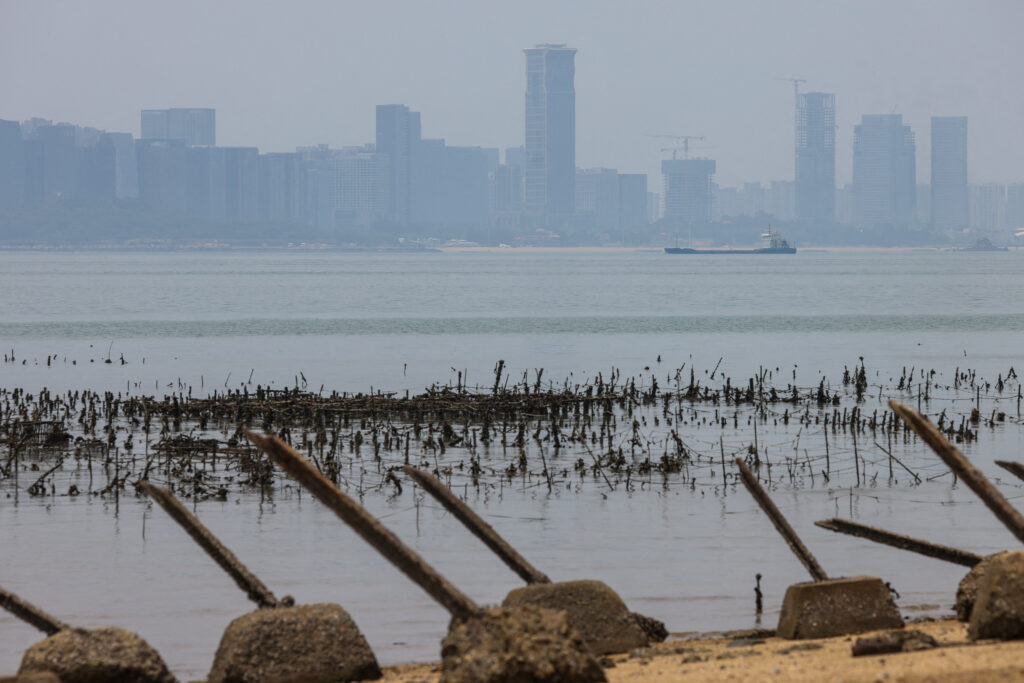
Recent satellite imagery and research reports indicate that the Chinese Communist Party (CCP) is conducting an extensive amphibious landing exercise in Dacheng Bay, located in Fujian Province, which faces Taiwan. This drill, lasting several weeks, entails the innovative use of civilian vessels to construct a makeshift floating bridge approximately 800 meters long, aimed at testing new landing methods. A senior security official confirmed to Reuters that the exercise remains ongoing as of Friday, November 27.
According to Jason Wang, the Chief Operating Officer of the geospatial intelligence analysis company ingenieSPACE, the Chinese military appears to be practicing tactics that are difficult to detect, providing logistical support for troops that may be involved in potential invasion actions against the first island chain.
Wang commented, “By utilizing civilian vessels to create a floating bridge, they can transport heavy equipment and military supplies from deeper waters to the shore, thereby expanding their options for landings along the coast of Taiwan.”
The senior security official highlighted that this particular exercise is designed to “practice the rapid seizure of small islands” and conduct simulations based on potential emergencies that may occur along the first island chain, indicating a highly targeted focus.
Reports from Reuters first detected this exercise on November 1, approximately 280 kilometers from the main island of Taiwan. Analysis of satellite imagery from November 1 to 16 revealed several vessels maneuvering within the bay, assembling and dismantling the floating bridge. The vessels participating in the drill include four barges and four landing crafts, along with smaller support boats and ships from the Chinese navy.
ingenieSPACE noted that no specialized bridging equipment was identified during the exercise, suggesting that the Chinese military may be practicing the use of existing civilian ships to temporarily set up facilities for troop and equipment landings.
Additionally, Wang cited a blurred synthetic aperture radar (SAR) image acquired by the company, which revealed signs of electronic interference activity within the exercise area.
The security official indicated that this drill appears to be part of the CCP’s “strategic military exercises” for this year and falls under the category of routine exercises, albeit occurring later in the year compared to previous year’s timelines. However, the official did not specifically relate this exercise to the “Nine-in-One Local Elections” scheduled in Taiwan for Saturday.
The Ministry of National Defense in Taiwan has stated that it is well aware of the Chinese military activities occurring at Dacheng Bay, including the use of civilian vessels for training. It is currently assessing the impact of these activities on cross-strait security and regional peace.
The Ministry of National Defense of China did not respond to requests for comments from Reuters. On Thursday, when questioned about recent drills by the Chinese military in the region, the ministry claimed their training was “completely legitimate and reasonable.”
The security official pointed out that the Chinese military is increasingly prioritizing operations related to island combat. However, he cautioned against overestimating the real combat value of these exercises, stating, “There remains a significant gap between innovation and fantasy.” In a wartime scenario, the barges would effectively become “live targets.”
In April of this year, the U.S. Naval War College’s China Maritime Studies Institute (CMSI) released a research report co-authored by Jason Wang and others. This report highlighted that the Chinese Communist Party has been utilizing civilian roll-on/roll-off ships for military activities since as early as 2014. Currently, these vessels have evolved from mere logistical support resources to integral components of the Chinese military’s formal combat capabilities.
Researchers believe that leveraging civilian ships enables the Chinese military to significantly enhance maritime transport capacity in a shorter time frame, thus reducing the necessity of constructing costly specialized amphibious fleets. This strategy may also render military logistics operations more challenging to detect.
The report indicates that the Chinese military is deliberately blurring the lines between military and civilian activities, increasing uncertainty and surveillance costs for both the United States and Taiwan. Deploying dual-use vessels complicates the identification of the CCP’s military intentions, thereby compressing the time available for external warning and decision-making.
Moreover, the report pointed out that a large-scale amphibious exercise conducted by China last August integrated several key training elements—such as floating bridges, simultaneous landings at various locations, and anti-landing obstacles—into a simulated campaign. This shift marks a transition for the Chinese military from general training towards more practical exercises directly addressing potential scenarios in the Taiwan Strait.
However, researchers also caution that, “Although these exercises are becoming increasingly complex, they all take place under ideal weather conditions, with ferries unloading amphibious vehicles in calm waters.”
On November 23, a report released by the U.S. think tank Center for Strategic and International Studies (CSIS) revealed that between late October and early November, the Chinese military intensified its activities in various waters of the Western Pacific, showcasing its capability to exert pressure on multiple U.S. allies and partners simultaneously. Nevertheless, there is currently insufficient evidence to suggest that these activities constitute a coordinated large-scale military exercise.
The report highlighted a significant new development during this period, specifically the simultaneous operations of naval formations from three Chinese military regions alongside the Liaoning aircraft carrier strike group in the Philippine Sea. This involved at least 16 naval vessels and five coast guard ships, marking one of the largest naval deployments by China outside the first island chain to date.
The report concluded: “In the event of a sudden crisis in the Taiwan Strait, it is highly probable that China will have to undertake actions targeting both Taiwan and potential foreign interventions concurrently.”