
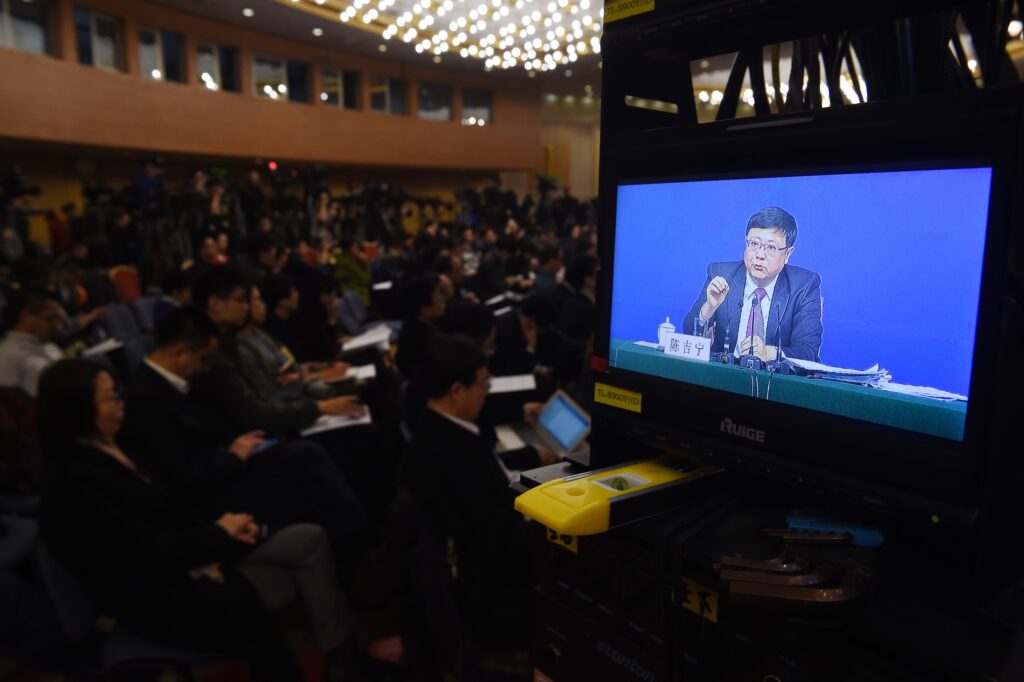
On November 24, 2026, a shocking revelation emerged as Chen Jining, a member of the Central Political Bureau and Secretary of the Shanghai Municipal Committee of the Communist Party of China, was unexpectedly removed from his position. This sudden dismissal has sent ripples of surprise and speculation across both domestic and international circles.
Yuan Hongbing, a scholar based in Australia, commented that individuals like Chen, who are seen as elite intellectuals, often harbor a disdain for the Chinese Communist Party leader Xi Jinping. He believes Chen’s downfall is tied to internal factional disputes within the party.
In an interview with a media outlet on November 27, Yuan shared insights indicating that Chen had privately expressed a desire to reinstate the “Reform and Opening Up” policies reminiscent of the Deng Xiaoping era. This ambition reportedly reached Xi Jinping through the party’s security apparatus, which contributed to his downfall.
“The path Chen advocated was a call to shift from Xi Jinping’s current self-revolution doctrine back to Deng Xiaoping’s focus on economic development,” explained Yuan.
Yuan disclosed that the central authorities in Beijing had engaged in discussions with Chen to realign his ideological stance. Although Chen ostensibly complied, returning to Shanghai and publicly declaring his unwavering support for Xi, he was secretly plotting with his confidants and certain elder families to strategically propose a return to Deng’s reform agenda at a more opportune moment.
Earlier reports indicated that immediately following the conclusion of the Fifth Plenary Session of the Central Committee, Chen was summoned by the General Office of the Communist Party Central Committee.
Born in February 1964, Chen Jining represents a generation of so-called technical elites who emerged after the reforms initiated by Deng Xiaoping. After graduating from Tsinghua University in the 1980s, he spent a decade in the UK and later transitioned from academia to high-ranking bureaucratic positions, thus entering the core decision-making apparatus of the government.
Recently, Mao Shoulong, a professor at the School of Public Administration at Renmin University of China, commented via a social media platform that figures like Chen, Liu Jiwei, and Ma Kai belong to a lineage of technocrats evolved during the era of former Premier Li Keqiang. Mao suggests that Chen’s removal marks the collapse of the promotion model that benefitted such technocrats.
According to information from Bloomberg, officials who previously worked with Chen revealed that he rarely spoke of his overseas experiences, particularly after assuming the role of Secretary of the Shanghai Municipal Committee. A source familiar with the situation indicated that Chen was aware of the highest leadership’s lack of trust in his international background.
Yuan remarked that over the past two years, it should have dawned on Chen that he was operating under the sharp scrutiny of Xi Jinping, who had substantially lost confidence in him and could act against him at any moment.
In response to the decision regarding Chen’s investigation by the authorities, the Standing Committee of the Shanghai Municipal Committee convened an emergency meeting that same night, where they unambiguously expressed their strong support for the central leadership’s decisions and made arrangements for subsequent work and stability maintenance across the city.
Yuan highlighted that what instills the greatest fear in Xi Jinping is the potential for an open clash of political lines within the Communist Party. He noted that Xi’s own political, ideological, and economic paths have not only led to a significant economic downturn and difficult living conditions for the populace, but have also prompted widespread dissatisfaction among the masses and discontent among officials.
“Xi Jinping’s deepest fear is that someone within the party can publicly challenge him on ideological and economic grounds. Especially if that individual occupies a position within the top leadership of the Central Committee,” Yuan added.
Moreover, Yuan revealed that within the vast ranks of Communist Party officials, there is a growing undercurrent of contempt for Xi Jinping that has reached alarming levels. This sentiment is particularly prevalent among educated officials from the post-60s and post-70s generations, exemplified by individuals like Chen. “A saying has emerged within the Communist system, implying that even a minor section chief feels competent enough to replace Xi Jinping, believing that their capabilities surpass his,” he concluded.