
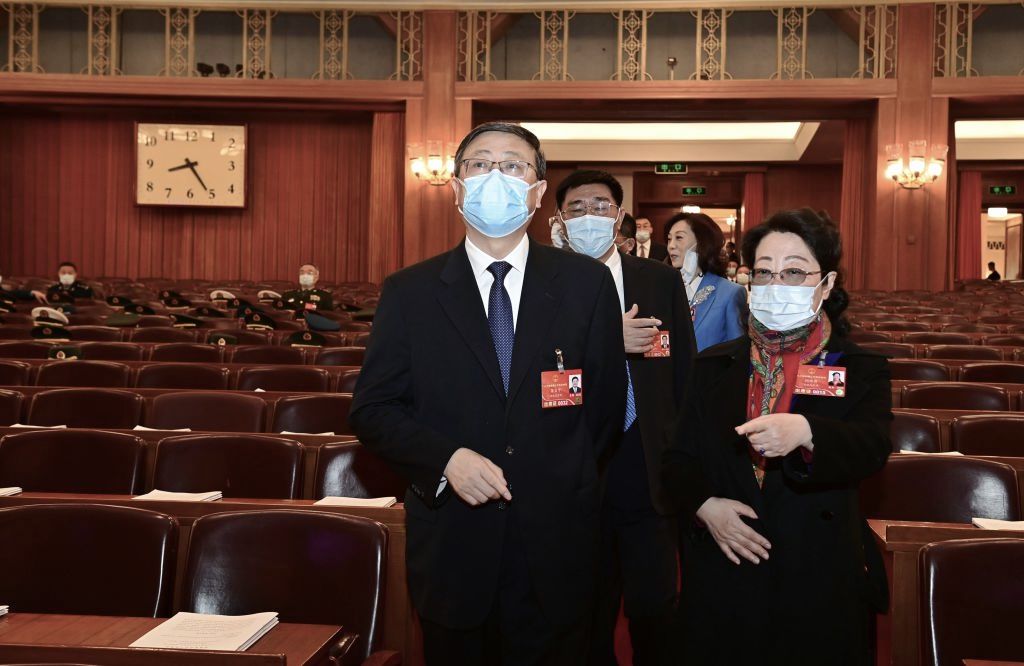
On November 26, 2026, the sudden downfall of Chen Jining, the Secretary of the Shanghai Municipal Committee, sent shockwaves both domestically and internationally, leading to a flurry of rumors regarding the circumstances surrounding his ouster. Reports suggest that internal conflicts within the Shanghai government coupled with intense competition over substantial funds, valued in the billions, were pivotal factors in his abrupt removal.
According to a source who chose to remain anonymous, Chen’s downfall is not merely attributed to issues related to his wife, Hu Qing. Instead, it appears to be deeply entrenched in the division of interests regarding several large industrial funds and projects backed by the Shanghai State-Owned Assets Supervision and Administration Commission (SASAC). This conflict has allegedly stirred tensions within the so-called “Shanghai Gang,” which includes influential figures like Li Qiang and Cai Qi.
During his tenure in Shanghai, Chen was known for spearheading various large-scale industrial investment projects, particularly in areas such as artificial intelligence, big data, and semiconductor technologies. The capital invested in these projects reportedly reached astronomical figures, amounting to thousands of billions of yuan. Despite the impressive investment, the distribution of profits generated from these projects appears to have disrupted the existing networks of interests held by Li Qiang, Cai Qi, and others within Shanghai.
The source revealed that many stakeholders, including affiliates of Li Qiang and Cai Qi, felt marginalized by the benefits stemming from Chen’s projects. “Chen made decisions in favor of his interests, disrupting the existing balance and angering many local leaders who felt entitled to the profits,” the source explained.
Furthermore, the tension over the division of these substantial funds has become a significant issue in local political dynamics. The source also hinted at Hu Qing’s involvement in these dealings, suggesting that benefits were not appropriately allocated, leading to dissatisfaction among key political figures.
“Several funds in Shanghai allegedly provided financial support to individuals who should not have received it, including those connected to Xi Jinping’s family, resulting in obvious discontent aimed at Chen,” added the source.
While details about those connected to the “Xi family” and the specific enterprises involved remain undisclosed, public records indicate that in July 2024, Shanghai officially unveiled a mother fund with a total scale of 100 billion yuan aimed at promoting key industries such as integrated circuits, artificial intelligence, and biotechnology. Besides direct investment from state assets, the fund was structured to leverage social capital through a “parent-child fund” model that generated significant private investment.
In addition to the controversies surrounding the industrial funds, the source indicated that Chen’s centralized governance style had also resulted in growing dissatisfaction amongst the Shanghai Municipal Party Committee and its corresponding political factions.
During his time in office, Chen mirrored Xi Jinping’s centralization strategies, establishing multiple committees that effectively concentrated power that was traditionally shared with the city government and other committee members.
“He emulated Xi’s approach by creating various committees, which ultimately undermined the authority of two previous mayors. Both of those mayors had political backgrounds connected to Cai Qi and Li Qiang,” the source stated.
When Chen Jining took the position of Secretary of the Shanghai Municipal Committee in October 2022, he collaborated closely with Mayor Gong Zheng, who had a robust career in the customs sector before transitioning to various leadership roles in Zhejiang Province.
Gong Zheng was succeeded in September 2023 by Zhu Zhongming, another figure with ties to the political landscape molded by Li Qiang. Zhu Zhongming, initially from the Zhejiang fiscal system, has been viewed as a protege of Li Qiang.
The source emphasized that Chen’s actions in Shanghai directly weakened the authority of mayors and other local party officials, sparking widespread disagreements amongst the Shanghai Party Committee.
“This is not just one person reporting Chen; there was a collective discontent among the entire Shanghai committee,” the source alleged. “The standing committee was not implementing democratic centralism effectively.”
“Everyone held grievances, which were evidently communicated to the top leadership, including concerns about his wife’s involvement in interests and dealings, but not through the Disciplinary Committee,” the anonymous source said, adding that Xi Jinping had recently called for all provincial and municipal standing committees to enact democratic centralism.
“Provincial committees cannot allow a single secretary’s opinion to dominate decision-making; the collective input must be considered before reporting to higher authorities.”
Just before Chen’s dismissal, the Central Committee had emphasized the strict enforcement of democratic centralism during its Fifth Plenary Session held in late October, marking this practice as paramount in the comprehensive campaign against corruption. Subsequently, revised regulations outlining the limited scope of powers for local party secretaries were disseminated, forbidding any singular leader from overriding collective decisions.
Despite all the changes, official statements from the Communist Party did not draw a direct connection between these new regulations and the case of Chen Jining.
Since Xi Jinping’s rise to power, he has set up or made adjustments to various committees, consolidating decisions that were previously distributed among different political bodies into a centralized system under his control.
The source noted that Chen’s centralized governance approach in Shanghai provided ground for political rivals to criticize him.
“Chen implemented a one-man rule style in Shanghai. His actions were meant to fulfill the tasks assigned to him by Xi, but the tighter he controlled things, the more leverage others found to undermine him,” the source elaborated.
Additionally, there were reports that following Chen’s detention in Beijing, his wife, Hu Qing, was also taken into custody shortly after.
“When Chen was subjected to what’s called a double regulation process, his arrest led to Hu Qing being detained immediately thereafter,” the source revealed.
It was also noted that their daughter was reportedly in Hong Kong, and an investigative team from the Central Commission for Discipline Inspection had arrived there recently.
The source did not clarify the exact nature of the investigations being conducted in Hong Kong or whether any measures had been taken toward Chen’s daughter.
Public records showcase that Hu Qing graduated from Tsinghua University with a degree in environmental engineering and later attained a PhD from Imperial College London. Her career spanned multiple fields, including business, central enterprises, and academia. From 2011 to 2015, she held several senior leadership positions in environmental corporations and later contributed to research at Southern University of Science and Technology.
It is significant that 2015 was also the year Chen Jining transitioned from being the President of Tsinghua University to becoming the Minister of Environmental Protection. The source indicated that the issues involving Chen’s family can be traced back to his tenure as minister.
“In fact, when did his wife’s problems start? It was during his time as Minister of Environmental Protection; many projects were given to her,” the source commented, comparing the situation to another corruption case involving Ma Xingrui.
While Chen is viewed as a scholar-turned-official who may not have directly accepted bribes, there are concerns about his family’s involvement in profit-making activities related to his political influence.
After Chen was appointed to Shanghai, reports suggested that his wife became embroiled in local industrial investment projects as well. The challenges surrounding these encounters ultimately reached Xi Jinping through local officials and their political networks.
As of now, there has been no official announcement regarding investigations into Chen Jining’s family.
The source further revealed that Chen’s secretary was also taken in, indicating that the ongoing investigations in Shanghai will likely focus on several government departments related to Chen.
“His secretary was taken away. The head of the Shanghai SASAC, along with officials from the housing and urban-rural development department, and those from the Shanghai Financial Management Bureau may face scrutiny,” the source stated.
The Shanghai SASAC appears to be a focal department in this case. “This is primarily about the SASAC’s head, as they were responsible for operating these funds, which require state resources. Additionally, the departments overseeing artificial intelligence and big data may also be implicated,” the source explained.
He mentioned that since Chen was transferred to Shanghai, he had failed to make significant personnel adjustments there. Hence, the fallout from the Chen Jining case may not cause a widespread culling of local officials as in other high-profile cases. However, those directly involved with the substantial industrial projects that Chen promoted may become the focus of future investigations.
“There weren’t many personnel promotions during Chen’s time in Shanghai. Therefore, it won’t ensnare too many people, mostly mid-level officials, perhaps one at the deputy provincial level; others will likely remain unaffected,” the source continued without disclosing the names of potential deputy-level officials who might be implicated.
Despite Chen Jining’s four years as Secretary of the Shanghai Committee, the source emphasized that he did not entirely control the political landscape there. The major personnel and political resources in Shanghai remained significantly influenced by his predecessor, Li Qiang.
“Li Qiang has maintained influence; even after Chen Jining’s arrival, there weren’t substantial personnel adjustments,” the source stated, noting that the officials in place were loyal to Li Qiang.
Li Qiang served as Secretary of the Shanghai Municipal Committee beginning in October 2017 before ascending to the position of Premier of the State Council in March 2023.
The source further elucidated that historically, local leaders have often utilized anti-corruption campaigns to assert dominance and eliminate the influence of predecessors in establishing their own teams.
“Every provincial party secretary’s initial task is to gain authority through anti-corruption efforts,” the source affirmed.
However, Chen Jining failed to solidify control over the local administration in this manner. “Because he couldn’t initiate purges, all personnel were connected to Li Qiang, including the current mayor who was also appointed by Li Qiang.”
The source suggested that Chen’s actions in Shanghai, whether in establishing committees or centralizing power, could be relayed directly to Li Qiang.
“Many communications from the Shanghai Standing Committee meetings went directly to Li Qiang,” the source claimed.
In this context, while Chen sought to consolidate decision-making through committees, he faced great difficulty restructuring the existing personnel framework in Shanghai.
When the allocation of large-scale industrial projects incited disputes affecting the interests of Li Qiang and Cai Qi’s networks, local officials and businessmen at odds with Chen could bypass him and leverage their political relationships to communicate grievances to party leadership above.
The source opined that such dynamics were among the critical reasons for Chen’s derailment in the lead-up to the Twenty-First Congress.
Additionally, Chen Jining’s industrial investment issues in Shanghai were reported to involve several associates connected to Tsinghua University, as well as ties to former Beijing Vice Mayor Xia Linmao.
Having studied at Tsinghua University and later the UK, Chen Jining enjoyed a lengthy tenure at the university before serving in various high-ranking government roles, including Minister of Environmental Protection and eventually Secretary of the Shanghai Municipal Committee.
The source disclosed that upon Chen’s entry into office in Shanghai, many associates from Tsinghua also relocated to Shanghai to capitalize on local business opportunities, although specifics about the individual described as the “Beijing public mistress” and the Tsinghua affiliations involved were not provided.
When Chen moved to Shanghai, it became apparent that many individuals, particularly from Tsinghua’s School of Economics and Management, were establishing businesses. The source also critiqued that many of these people acquired funding without fulfilling their obligations.
“There are those who took millions or even billions without delivering on their promises, resulting in significant public outrage within the Shanghai circle,” the source remarked.
However, the source insisted that Chen Jining did not personally enrich himself through bribes, but the primary concerns lay with his family and their associated networks of benefits.
“Chen didn’t pocket anything directly, but he was still connected to these dealings, which siphoned off substantial funding. Many individuals would address their issues through connections to Li Qiang or by other influences,” the source offered.
Attention was also drawn to the whereabouts of Dai Binbin, the former vice governor of Shaanxi Province and head of the Public Security Bureau, who reportedly had a close relationship with Chen Jining and was one of the officials promoted during Chen’s tenure as mayor of Beijing.
“This person is exceptionally close to Chen. Watch for this individual; he’s likely to be dealt with,” the source warned.
Public records indicate that Dai Binbin, an alumnus of Tsinghua University, had significant involvement in Beijing’s state-owned enterprises and governance. He served as secretary general in the Beijing government, directly supporting Chen Jining during his mayoral term before being assigned to his current vice governor position in Shaanxi.
As of now, there have been no official announcements pertaining to investigations involving Dai Binbin.
Prior to Chen Jining’s unexpected downfall, the political and bureaucratic tide surrounding Tsinghua University and its affiliated factions seemed to be dwindling.
On October 22, 2026, Xia Linmao, a Deputy Mayor of Beijing and member of the city’s municipal committee, was placed under investigation. Xia, who also holds a doctorate in engineering from Tsinghua University, had served in various capacities during the administrations of both Cai Qi and Chen Jining.
Just four days later, Tsinghua University announced that it was under review by the Central Third Inspection Team.
While Chen Jining entered the Communist Party with a scholarly background, he had already developed an expansive political and business network prior to his official government service.
A report by China News Weekly in 2017 indicated that in the early 2000s, Chen helped initiate the “Water Industry Salon,” which convened every month or two. This forum included representatives from both state-owned and foreign enterprises and engaged officials from the Ministry of Construction, Environmental Protection, and Water Resources, facilitating discussions on market reforms and policies affecting the water sector.
Meanwhile, Hu Qing was also noted for her long-term engagement in environmental research, corporate management, and providing policy advice to the government.
Historically, Tsinghua University has been a breeding ground for engineering bureaucrats, but the actualization of a “Tsinghua faction” is often attributed to the rise of Chen Xi. Following the Eighteenth National Congress, Chen Xi held various positions, including as an influential member of the Organization Department for ten consecutive years, utilizing his authority in personnel assessments to facilitate career advancements for Tsinghua associates and students.
By the time of the Twenty-Second National Congress, the Tsinghua faction had reached its peak, with both Chen Jining and Li Ganjie occupying significant positions within the Political Bureau, effectively managing key party roles.
However, the tide began to turn in the spring of 2025 when Li Ganjie was surprisingly removed from his central role. Following that, in October, former university president Wang Xiqin stepped down under unclear circumstances. In May 2026, Cai Qi took over leadership at the Central Party School as Chen Xi transitioned out of his role.
Notably, in July 2026, Ni Yuefeng, a Tsinghua engineering doctorate, resigned from his position as Secretary of the Hebei Provincial Party Committee. Meanwhile, in August, Qin Weizhong prematurely stepped down as Mayor of Shenzhen, followed by an official announcement regarding his removal in September.
The fallout continued through October and November, marked by the consecutive investigations and dismissals of Tsinghua-connected officials, within Xu Linmao of Beijing and Fang Hongwei of Xi’an.
Until November 24, Chen Jining, who was considered a prime candidate for a key political position, unexpectedly fell from grace, prompting Tsinghua University to swiftly detach its affiliation from him, leading many to view this as the downfall of the Tsinghua faction and severing Shanghai’s traditional direct access to the higher echelons of power.