
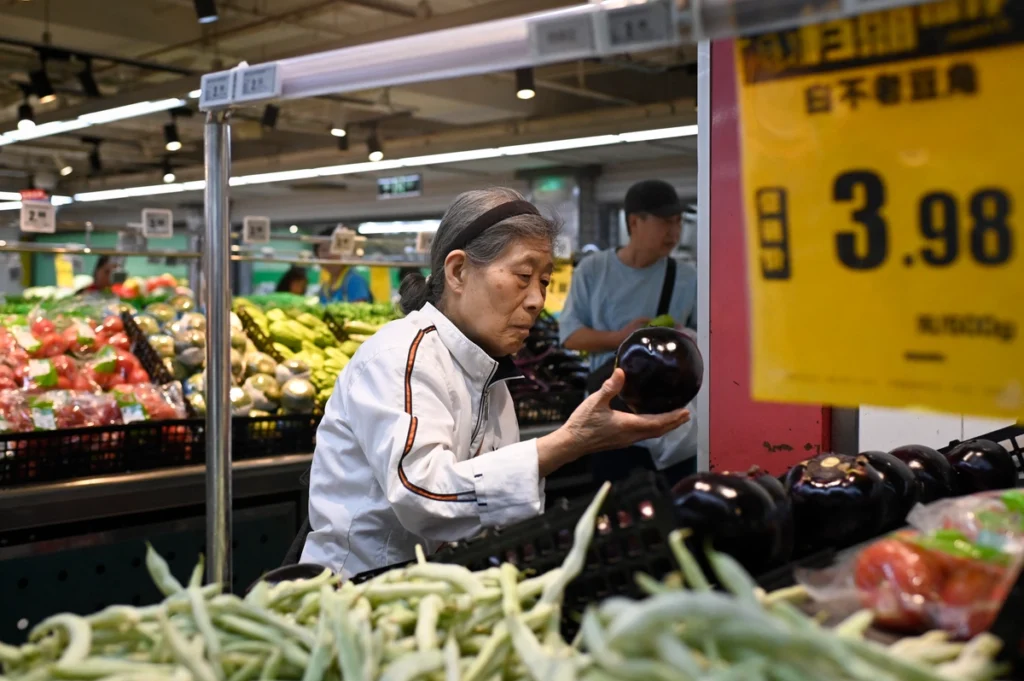
Recent reports highlight that China is facing a significant downturn in consumer spending, which has raised alarms despite the government’s attempts to downplay the issue. The Communist Party authorities have consistently denied claims of a “downgrade in consumption,” yet their narrative has been met with skepticism from the public. As a result of reduced incomes, many consumers have become more budget-conscious, leading to the rapid expansion of discount supermarkets, often referred to colloquially as “penny pincher markets.”
According to data released by the National Bureau of Statistics of China, the total retail sales of consumer goods for the first ten months of this year showed only a 1.0% increase compared to the previous year. In October alone, retail sales saw a minimal growth of just 0.4%.
In a troubling sign for the economy, recent reports from Beijing and Shanghai—two of China’s most affluent cities—indicate a decline in retail sales during October. In Beijing, retail sales dropped by 12.1% compared to the same month last year, marking the steepest decline since January 2025. Similarly, Shanghai reported a 4.5% decrease in retail sales, continuing a trend of negative growth that has persisted for seven consecutive months since April 2026.
Economic expert Huang David pointed out that as cities with some of the highest per capita incomes in China, Beijing and Shanghai should ideally exhibit resilience in their consumption markets. However, he noted that both cities are showing clear signs of contraction. Notably, the areas that still show growth in consumer goods are primarily in essential categories such as food and clothing items, suggesting a shift towards more defensive spending habits among the middle class, who are now more cautious about their expenditures.
In response to these trends, the propaganda department of the Zhejiang Provincial Committee of the Communist Party issued a statement claiming that the notion of consumption downgrade is a false proposition. They argued that although foot traffic in physical retail spaces has declined, this is merely a shift in consumption patterns rather than a decrease in consumption vitality. Changes in the luxury goods market were interpreted as a transition from essential material consumption to spending on experiences, health, and emotional well-being.
While acknowledging that some individuals are facing difficulties due to job changes and income fluctuations, the authorities emphasized that such experiences are only true for a segment of the population. This official stance has sparked widespread disagreement among netizens, with many expressing their discontent in online forums. One user remarked, “It’s hard to say whether consumption has downgraded or not, but one thing is for sure: I hesitate to spend money because salary cuts are very real.” Another user candidly admitted, “I don’t know about others, but I have definitely downgraded.”
One commentator pointed out the government’s narrative as “turning an economic issue into a mere semantic game,” rebranding “consumption downgrade” as “upgraded consumption structure,” and transforming “unaffordable” into “unwilling to buy,” while framing “spending less” as “rational consumption.”
The commentary further criticized the conflation of the concepts of freedom of choice and the lack of options, highlighting the disturbing reality that many citizens are being forced to manage their budgets in a manner that is being presented as a progressive shift. They cautioned that the real threat lies not in consumers exercising caution but in the authorities presenting forced frugality as a form of ideological advancement.
As the government continues to deny that consumer spending has weakened, ordinary people are increasingly turning to supermarkets that offer deeper discounts. Reports have shown a notable rise in the popularity of discount supermarkets, humorously dubbed “penny pincher markets,” which are rapidly expanding across the country.
For example, on November 21, the German discount supermarket chain ALDI launched six new stores in Hefei and Wuhu, marking its entry into the Anhui province. The company’s website reveals an ambitious goal of opening over 150 locations in China by year’s end, with recent expansions primarily focused in Shanghai and Jiangsu. More than 600 items in these stores are priced at or below 9.9 yuan, accounting for approximately 30% of their total 2,000 products.
ALDI has calculated that an average family of three could save about 600 yuan per month by exclusively purchasing their low-priced items for all three meals, totaling nearly 7,000 yuan in savings over a year.
Another fast-growing discount chain, Ultra Box, is rapidly expanding its footprint, adding around 200 new outlets this year to bring its total to nearly 700 across the country. At Ultra Box, consumers can find fresh eggs priced at 17.9 yuan for 30, amounting to about 0.6 yuan per egg.
Additionally, JD.com has announced plans to open three new discount supermarket locations in Handan, Hebei, and Chuzhou, Anhui, on November 27. Meanwhile, the CR Vanguard-owned Suqiao discount store chain has already opened three locations in Nanjing since its first store was launched in September.
These developments suggest a significant shift in consumer behavior as shoppers increasingly seek out economical options in a challenging economic climate.