
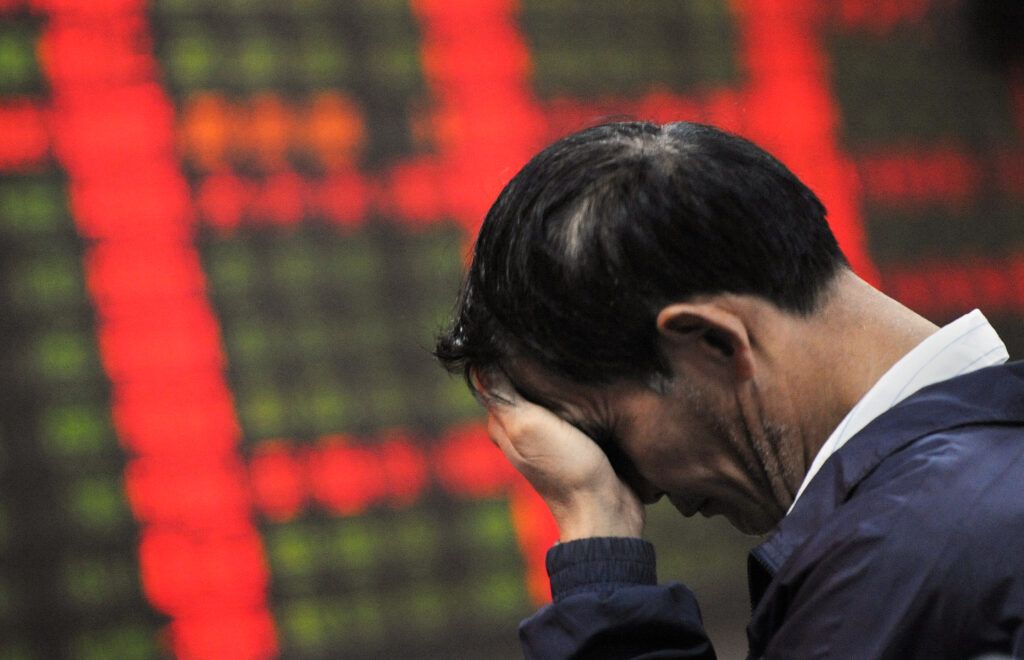
On November 25, 2026, China’s A-shares faced another significant setback, as the Shanghai Composite Index dropped by 2.03%, closing at 3,476.47 points, a breach of the critical 3,500-point mark. Meanwhile, the Shenzhen Component Index fell by 3.24%, the ChiNext Index dipped by 4.19%, and the Sci-Tech 50 Index experienced a decline of over 5%. Out of the 4,925 stocks listed across the Shanghai and Shenzhen exchanges, a staggering 4,925 recorded losses, with only 585 showing gains. The trading volume for both markets reached 1.3831 trillion yuan, representing a decrease of 272 billion yuan compared to the previous trading day, marking a slump of approximately 16.4%.
Several sectors that were previously hot topics in the market, such as semiconductors, computing hardware, and physical AI, all faced declines. This was not merely a case of a few stocks adjusting; it was a collective release of market confidence.
Analysts attribute this sudden plunge to a global adjustment in technology stocks, while others point to the weakening fundamentals of the Chinese economy. These factors undoubtedly play a role, but focusing solely on the economic data and the stock market misses an increasingly significant aspect of the picture: the continuous expansion of Xi Jinping’s personal power and the ongoing high-level purges under the guise of anti-corruption measures, which are starting to have a more pronounced impact on China’s political, economic, and capital markets.
Let us first examine the actual economic data from China.
From January to October 2026, fixed asset investment across the nation saw a year-on-year decline of 8.1%, with private investment plunging by 11.4%. Notably, the drop in private investment was significantly steeper than the 4% reduction recorded for state-owned investments, illustrating a sustained lack of investment enthusiasm among private enterprises.
In October, the total retail sales of consumer goods grew by only 0.4% compared to the same month the previous year, down from 1.1% in September. Additionally, industrial production growth slowed to 4.8%, below September’s rate of 5.5%.
These figures suggest that consumer spending has not genuinely recovered and that industrial growth is also decelerating, with investments continuing to contract.
Particularly alarming is the 11.4% decline in private investment. This trend indicates that the issue extends beyond mere funding shortages; it reflects a pervasive lack of confidence among businesses regarding future demand, the policy environment, and investment returns.
The stock market ultimately reflects expectations regarding corporate profitability and capital returns. If businesses are hesitant to invest and households are reluctant to spend, how can publicly listed companies expect to generate profits?
On November 24, 2026, the Central Commission for Discipline Inspection (CCDI) announced that Chen Jining, a member of the Central Political Bureau and the Secretary of the Shanghai Municipal Committee, is under investigation for serious disciplinary violations. Chen is no ordinary local official. He has held senior positions, including president of Tsinghua University, Minister of Environmental Protection, and Mayor of Beijing, before becoming the Secretary of the Shanghai Municipal Committee in 2022 and joining the Central Political Bureau.
Shanghai, being China’s largest economic hub and a city where foreign investment, finance, and international enterprises are highly concentrated, is particularly affected by the implications of such a high-ranking official’s investigation.
Moreover, Chen Jining is not an isolated case.
According to a Reuters report on November 25, 2026, since 2025, four current members of the Central Political Bureau, who were elected in 2022, have been investigated or removed from their positions. These cases include:
1. He Weidong: Former Vice Chairman of the Central Military Commission, purged in 2025.
2. Zhang Youxia: Former Vice Chairman of the Central Military Commission, announced to be under investigation in January 2026.
3. Ma Xingrui: Former Secretary of the Xinjiang Party Committee, investigated in 2026.
4. Chen Jining: Secretary of the Shanghai Municipal Committee, announced to be under investigation on November 24, 2026.
To highlight, among the 24-member Central Political Bureau, four current members have faced investigation or removal over a brief period. Such shaking up of the political elite is quite unusual in the history of the Chinese Communist Party.
While official reports use terms like “suspected serious violations,” the details of the investigations, the evidence, and the complete procedures lack transparency. Consequently, the public cannot ascertain the specific nature of each case based solely on these announcements.
This raises the question: Why is there so much frequent high-level purging within a political system that consistently emphasizes centralized leadership?
The military is one of the most heavily scrutinized areas under Xi Jinping’s purges.
In February 2026, the Center for Strategic and International Studies (CSIS) released a report analyzing the extensive purges Xi has conducted among high-ranking officials in the People’s Liberation Army (PLA) in recent years. Tracing around 176 senior leadership positions in the PLA, the research identified at least 101 senior military officers—who previously held roles in the Central Military Commission or equivalent district-level commands—who have been dismissed or have gone missing.
After excluding overlaps, around 52% of senior military leadership positions have been affected by these purges.
The leadership team formed in the Central Military Commission in 2022 has subsequently been nearly emptied due to ongoing purges.
This is an extraordinarily high percentage.
If the issue were merely isolated incidents of corruption, why would the purges have expanded to such a vast military command structure?
The CSIS analysis points out that, alongside corruption, factors such as political loyalty, military autonomy, obedience levels, and the performance of military leadership may have influenced the reasoning behind such extensive purges.
Military forces require professionalism, experience, and stability within their command structure, not a culture where everyone prioritizes demonstrating loyalty to the supreme leader. The relentless reshuffling of senior generals risks undermining the military’s command experience, organizational continuity, and internal trust.
In such a political environment, how could concerns about political risk in China not grow?
According to data from the CCDI for 2025,
a total of 1.012 million cases were filed, resulting in disciplinary actions against 983,000 individuals—including 69 senior officials at the provincial level or higher and 4,155 bureau-level officials. These numbers reflect the severity of corruption issues in the Chinese officialdom and the massive scale of anti-corruption efforts.
The concern here is not merely how many individuals have been prosecuted but rather the lack of effective checks and balances on power.
In a political atmosphere where judicial, supervisory, and political authority is highly concentrated within the same party-state system, anti-corruption investigations lack adequate independent external oversight, making it difficult for the public to comprehend the evidence and procedures in various cases.
While anti-corruption initiatives can combat graft, they cannot replace the need for institutional reform.
If supreme power goes unchecked, and officials’ careers hinge on the will of their superiors, then today’s investigated individual could be tomorrow’s target as well. Such a climate fosters not stable rule of law but widespread insecurity.
The stock market does not merely reflect economic data; it also prices in the institutional environment and future expectations of a country.
Investors are more fearful of unpredictable future policies than they are of short-term economic downturns.
Firstly, businesses lack a sense of security.
Private enterprises require a stable legal environment, property rights protections, and predictable policies. When the political winds can change at any moment, businesses will curtail long-term investments and shift funds to lower-risk markets.
Secondly, officials fear accountability.
The Communist Party prioritizes political loyalty over professional capabilities, leading officials to prioritize avoiding mistakes and not upsetting superiors over discussing how to develop the economy. This outcome results in declining administrative efficiency, rigid policy implementation, and a lack of motivation for reforms at the local government level.
Thirdly, capital shuns extra political risks.
Foreign investors and domestic stakeholders assess a market not merely based on GDP, corporate profits, and stock valuations, but also on legal protections, policy consistency, and predictability in government decision-making.
The more frequent the high-level political purges, the harder it is for investors to anticipate the future direction of policies. The ramifications of these uncertainties may not all manifest in a single day’s market downturn, but they gradually influence capital allocation, investment intentions, and valuation levels.
The substantial decline in A-shares on November 25 cannot be attributed solely to Chen Jining’s investigation; it is equally important to acknowledge the global downturn in technology stocks and the weak performance of the Chinese economy.
However, political purges have emerged as an undeniable risk factor in the pricing of Chinese assets.
In the latter half of 2026, net inflows from the state-backed “national team” into broad-based A-share ETFs exceeded 450 billion yuan. (This figure is based on institutional estimates of market capital flow, rather than official disclosures of precise funding amounts.)
The government has continuously employed state-owned funds to prop up the market, even reducing margin financing requirements to encourage investors to borrow money to buy stocks. After lowering the margin requirement, a potential increase in borrowing power amounting to nearly 400 billion yuan exists — a theoretical number, rather than actual cash infused into the market.
But the outlook remained bleak. On November 25, the Shanghai Composite Index still dipped below 3,500 points, with nearly 5,000 stocks declining and technology stocks suffering significant losses.
This situation does not stem from inadequate capital inflow; instead, it highlights that the government has not addressed the fundamental issues facing the market.
The stock market requires corporate profitability, consumer spending, private investment, and a stable institutional environment—not simply government efforts to keep the index afloat.
When investors are concerned about the economic outlook, entrepreneurs are wary of policy changes, and capital fears political risks, even substantial state funds can merely offer temporary support to certain stocks without fostering genuine market confidence.
The deeper issue lies in Xi Jinping’s prioritization of power consolidation and political purges while expecting the capital markets to regain confidence in an environment devoid of institutional guarantees—a contradiction in itself.
Money can buy stocks, but it cannot purchase trust; while the government can support the index, it cannot sustain an economy plagued by insecurity.
The challenges China faces today are not due to a lack of policy rhetoric or administrative commands. What is truly lacking are institutional protections, governmental credibility, and market confidence.
Since Xi Jinping came to power, there has been a consistent concentration of personal power, coupled with an increasing tight grip of the party over enterprises, finance, society, and economic activities.
While anti-corruption efforts should ideally build a more transparent government, in the absence of independent oversight and transparent processes, anti-corruption campaigns may simultaneously serve as tools for political purges.
With purges reaching from high-ranking military officials to local dignitaries, from Political Bureau members to heads of financial systems, the scope of these investigations is ever-expanding.
The leaders of a nation should focus primarily on improving living standards, developing the economy, safeguarding property rights, and establishing stable institutions.
However, in today’s China, political loyalty has been prioritized above all else, with individual power taking precedence over institutional development. This is the crux of the problem.
The government can mobilize state funds to buy ETFs, lower margin financing ratios, and continually roll out stimulus policies while requesting financial institutions to cooperate in maintaining market stability.
Yet, the government cannot compel residents to increase consumption, cannot command entrepreneurs to restore confidence, and cannot instruct foreign capital to trust a market characterized by unpredictability in policies and political environments.
While the stock market downturn has its economic reasons and global influences, the long-standing lack of confidence in China’s capital market is deeply rooted in even more profound political factors.
A state that places personal power above institutional construction and prioritizes political control over economic development ultimately pays a price far exceeding mere stock market declines; it risks fostering a society that loses faith in the future as a whole.
The stock market may rebound, and the economy might experience cyclical recoveries, but without resolving institutional problems, political risks will continue to suppress the long-term development of the Chinese economy.