
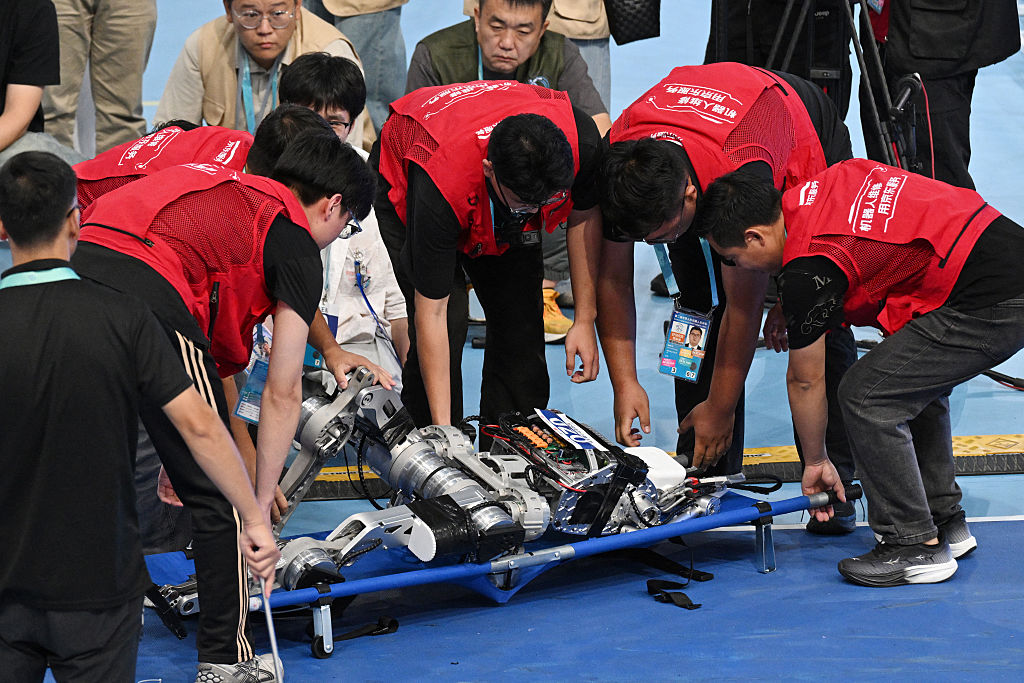
Since 2025, at least 29 robotics companies in mainland China have entered bankruptcy proceedings, dissolved, or halted operations. Among these is Shenzhen Yinghe Robotics, which had raised approximately 800 million yuan in funding but is now undergoing bankruptcy liquidation. To date, at least 63 employees of the company have reported unpaid wages.
Recent statistics released by the financial publication “First Financial” on November 25, drawing from sources such as “IT Juzi” and “Qichacha,” highlight this troubling trend. Included in the list of companies facing insolvency is Datang Robotics, which had previously attracted investments from major firms like SoftBank Group. The report further noted that the financing in the mainland robotics sector was nearly 70 billion yuan last year, while in the first three quarters of this year alone, it has surpassed 100 billion yuan.
Founded in 2020 in Shenzhen, Yinghe Robotics garnered investments from ByteDance and Meituan-related entities. Early statements from investors indicated that the company had raised around 800 million yuan in two rounds of funding. However, documents from the bankruptcy liquidation reveal that Yinghe’s revenue for last year was only 4.33 million yuan, while its net losses reached a staggering 67 million yuan.
In July, the Shenzhen Intermediate People’s Court accepted Yinghe’s bankruptcy liquidation application and convened the first creditors’ meeting in October. Public notices regarding employee claims indicated that Yinghe owed approximately 5 million yuan in unpaid salaries. Some staff members had left the company as early as 2023 but remained unpaid to this day.
Similarly, Shanghai Shenlan Robotics also entered bankruptcy liquidation in May of this year. A public announcement on September 7 revealed that confirmed employee claims from the first four batches involve 102 individuals, with total unpaid wages and compensation amounting to approximately 21.05 million yuan.
In Jiangsu, Suzhou Zhicheng Power, a manufacturer of pool cleaning robots, has struggled with cash flow as some payments for sold products have not been recovered, impacting its operations. In September, creditors applied to the court for bankruptcy restructuring. The company subsequently claimed that it was seeking a preliminary restructuring and was still operating normally at that time.
In June, the official media platform for Nanjing reported that Wujing Power, only four months post-establishment, had signed framework orders worth nearly 500 million yuan with multiple state-owned enterprises. However, by October, someone claiming to be an employee of the company told the “Daily Economic News” that operations had ceased and his wages had been withheld since August. Previously interviewed as the company’s CEO, Yuan Haihui also mentioned he could no longer contact the actual controller, Cui Xiaofei.
Shenzhen-based Mechamand, a supplier of robot components, faced challenges as its founder, Shao Tianlan, raised concerns on social media about certain robotics companies inflating their income through related-party transactions. In subsequent interviews, he expressed that companies eager to go public before their business models are mature may be shifting their operational risks onto public investors.
Fu Yifu, a researcher from Su Bank, highlighted previously that significant orders for robots often come with strict acceptance criteria, requiring companies to invest upfront in production arrangements. Sometimes, it may take over a year to recover payment for these products. Moreover, the costs associated with on-site debugging and further development after robot delivery can escalate.
In February, Chinese President Xi Jinping observed demonstrations of humanoid robots in Beijing’s Yizhuang district. The government work report released in March emphasized embodied intelligence as an industry slated for cultivation. The Economist, in June, analyzed that Xi hopes to stimulate economic growth through new industries, replacing the older model reliant on land sales and construction.
In a report from Reuters on August 27, it was noted that in the first half of this year, governments at various levels in China spent at least $230 million on humanoid robots and related equipment, up from $62 million during the same period last year.
During a visit to a robot training center in Liuzhou, Guangxi, Reuters observed a humanoid robot struggling to move cargo boxes. A staff member remarked that the speed or output of these robots in completing simple tasks is only about 20% of what humans can achieve. The center has plans to sell robot training data to factories, but staff indicated that high operational costs and low data selling prices keep the center reliant on subsidies to operate.
Li Tingqian, an economist and political commentator, expressed in a September interview that the Chinese government is funneling vast financial resources into immature humanoid robot projects. He cautioned that once the subsidies become unsustainable, it will become evident whether these projects can maintain operations based on actual market demand.