
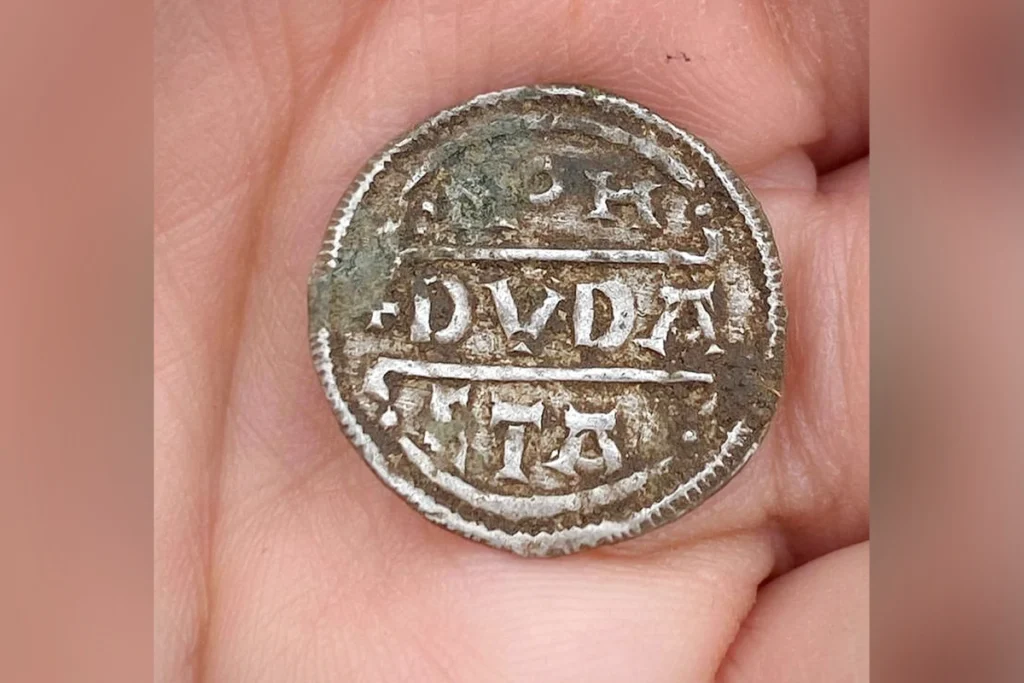
In the tranquil fields of Bickmarsh, located a 45-minute drive south of Birmingham, UK, life has returned to its peaceful state after a thrilling archaeological dig unearthed a remarkable collection of ancient coins. The electronic hum of metal detectors and the sound of spades breaking ground have gradually faded, allowing the serene countryside to reclaim its quietude after an intense search for historical treasures.
A total of 63 coins were excavated from the soil and have since been meticulously cleaned and cataloged according to archival standards. This remarkable find, known as the Bickmarsh Hoard, stems from the 9th century and may provide new insights into life during the Viking incursions into England.
The excavation began on a warm summer morning in July 2022. Simon Hall, the operations manager of Go Detecting (Midlands) Ltd, which is based in Solihull, witnessed the moment when these silver coins began to emerge from the earth. On that day, metal detecting enthusiasts uncovered 25 coins, creating an atmosphere of excitement and wonder amongst the team.
With each new discovery, the thrill among the group was palpable, as Hall later shared with a local newspaper, the Stratford-upon-Avon Herald. “Everyone was completely captivated; this is not something that happens every day,” he enthused.
Realizing the significance of their discovery, Hall and his fellow detectorists acknowledged their responsibility under the UK’s Treasure Act, which mandates reporting such finds to officials of the British Museum’s Portable Antiquities Scheme (PAS). The site was soon sealed off to preserve its integrity, and archaeologists from Worcestershire became involved in the investigation.
The archaeological team methodically divided the field into squares and adopted a two-stage excavation process. The initial stage involved Hall and his team using metal detectors to locate concentrations of coins, followed by a more precise digging conducted by archaeologists in targeted areas. By carefully stripping back layers of soil, researchers discovered that the coins were resting within the topsoil rather than buried deep underground.
As the dig progressed, the team uncovered even more coins, eventually revealing two concentrated areas brimming with artifacts, which led them to expand their excavation efforts further. The collection comprises a total of 63 coins from the early medieval period, with inscriptions indicating that they date back to the reign of King Burgred, who ruled over Mercia, one of the most powerful Anglo-Saxon kingdoms during that time.
In addition to the coins, the team recovered over a hundred artifacts spanning from Roman times to the modern era. Among these were 35 fragments of lead sheet, which sparked particular interest among researchers. Similar discoveries in other notable hoards in the UK have included coins wrapped in lead, such as the Lenborough Hoard from Buckinghamshire.
Modern agricultural practices likely contributed to the distribution of these artifacts across the field. However, researchers have yet to confirm whether the Bickmarsh coins were originally encased in lead sheets. Interestingly, the archaeological team did not uncover any structural remains at the site.
It was only after the coins were handed over to experts at the British Museum for evaluation that researchers began to piece together the narrative of the coins’ original owner, who may have been haunted by fears of Viking incursions. Scholars believe these coins were likely buried in the 9th century during the sweep of Viking armies across England, as a means of safeguarding wealth.
Among the most notable pieces found is a gold solidus coin imprinted with the mark of Louis the Pious, alongside two Frankish deniers originating from the European continent. The international characteristics of the coins serve as a testament to the connections formed as Scandinavian fleets raided the Frankish Kingdom and then turned their sights on the coasts of England.
Gareth Williams, a specialist in early medieval coins at the British Museum, was able to narrow down the timeline for the coins based on their markings. Most were minted during the reign of Burgred, who ruled from 852 to 874. His brother-in-law, Alfred of Wessex, ascended to the throne in 871 and halted the minting practices of previous rulers in the year Burgred died, suggesting that the Bickmarsh Hoard likely dates between 871 and 874, coinciding with documented accounts of Viking invasions.
The fears harbored by the coins’ owner were not unfounded. By 867, Viking forces had captured Nottingham, located deep within Mercian territory. King Burgred sought to buy peace with gold, but the threat loomed large until his exile to Rome in 874, after which Vikings installed a puppet king, Ceolwulf. It was a time of great turmoil.
The Worcestershire Archive and Archaeology Service noted in its official investigation report that “hoards are often buried in times of turmoil or instability. Wealth may be hidden underground with the intention of retrieving it once the danger has passed.” The shallow burial of the Bickmarsh Hoard underscores the hasty decisions made in times of crisis.
This era of upheaval redrew boundaries as Vikings expanded their territory from London to Chester, establishing new frontiers. While Worcestershire lies just beyond one of these borders, the treasure’s significance highlights the profound connections that existed between worlds at that time. Whether fleeing from Viking raiders or avoiding local unrest, the artifacts from distant lands tied the quiet village of Bickmarsh into a wider economic web that spanned across the seas. Even here, life rippled under the immense geopolitical shifts reshaping the European continent.
Since its official announcement in April, the Bickmarsh Hoard is currently awaiting assessment by the Treasure Valuation Committee. Experts estimate its value to be between £2,000 and £3,000, though its historical significance may far exceed this monetary estimate. Ultimately, the treasure could be acquired by a local museum in Worcestershire, with funding sourced from public donations and cultural heritage grants.
This amount could potentially be shared equally between the treasure hunters from Go Detecting Ltd and the landowners, who continue to stroll the serene fields of Bickmarsh just as humanity has done for centuries.