
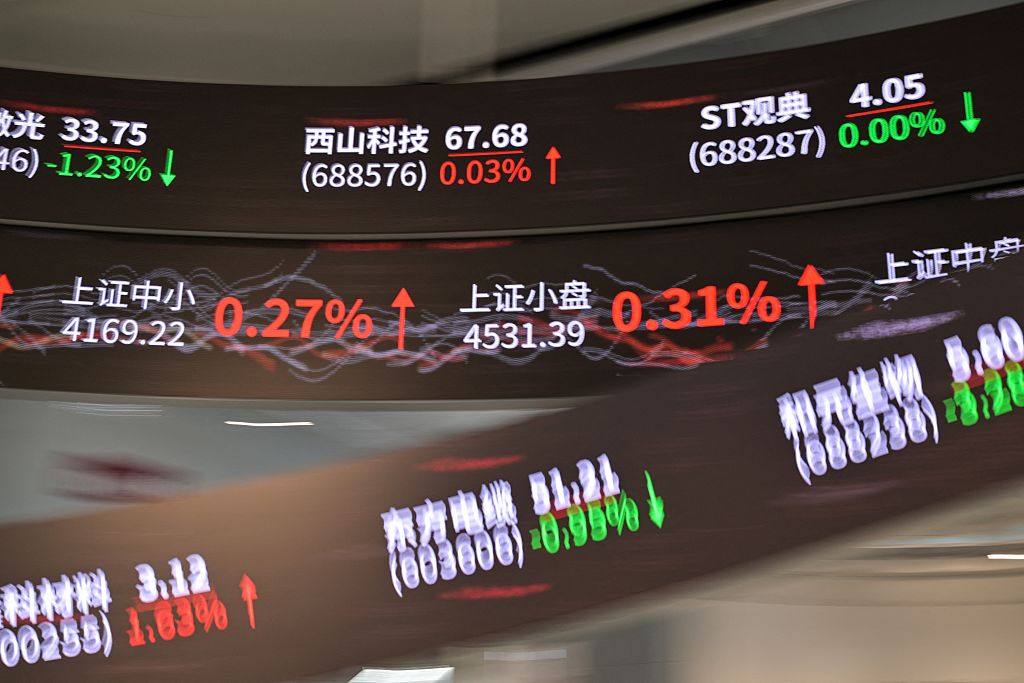
On November 25, the A-share market experienced a significant downturn, marked by a collective plunge across the three major stock indices. The Shanghai Composite Index fell below the critical 3,500-point level, with the ChiNext Index suffering a decline of over 4%. Technology stocks, in particular, emerged as the leading casualties amidst this market turmoil. Nearly 5,000 individual stocks throughout the market declined, amidst a notable surge in investor risk aversion.
The former editor-in-chief of the Chinese Communist Party’s state media outlet, Global Times, expressed his frustration on social media, remarking, “We all lost today, and it hurts.” This comment quickly gained traction and became a trending topic on Weibo, sparking lively discussions among netizens regarding the market’s state.
By the market close, the Shanghai Composite Index had dropped by 2.03%, landing at 3,476.47 points. The Shenzhen Component Index fell by 3.24%, closing at 10,086.36 points, while the ChiNext Index plummeted by 4.19%, finishing at 2,183.58 points. The CSI 300 Index decreased by 1.65%, concluding at 3,898.24 points, and the STAR 50 Index saw a substantial drop of 5.12%, ending at 1,186.14 points.
The total trading volume in the Shanghai and Shenzhen markets for the day was approximately 1.38 trillion yuan (RMB), a decrease of about 272 billion yuan compared to the previous trading day. Alongside the severe declines in index values, the trading volume also shrank significantly, indicating a waning interest from investors to engage in market activities.
Analyzing stock performance, the A-share market displayed a widespread decline. Data at the market close revealed that only 586 stocks gained in value while a staggering 4,926 stocks experienced losses. Among these, 58 stocks hit their daily price limit upwards, and 49 stocks fell to their daily limit downwards, illustrating that nearly 90% of stocks were in decline, heightening the selling pressure across the market.
Sector performance was particularly bleak for technology growth stocks, which were the main contributors to the overall decline. The electronic chemicals, semiconductor, and other electronic sectors faced the steepest declines, plummeting by 8.24%, 7.89%, and 6.42%, respectively. The battery sector fell by 6.12%, consumer electronics declined by 5.92%, automation equipment dropped by 5.94%, and communication equipment saw a decrease of 4.47%.
As of November 25, various topics related to the A-share market’s performance surfaced on Weibo’s trending list, one of which included the phrase “Hu Xijin stated today that losses are painful.”
In his social media post, Hu Xijin commented, “We all suffered losses today, and it really hurts. In fact, although stock traders may vent their frustrations, as long as they haven’t completely liquidated their positions, they still hold onto some hope for a rebound. Therefore, I want to emphasize that retail investors are among the most optimistic groups regarding the future, as they use their own hard-earned money to support a constantly retreating market.”
Video blogger “Da Ke Ya Tang” remarked, “Old Hu is genuinely worried; he hasn’t been as verbose these past few days.”
Renowned director and screenwriter “Hong Shui” posted, “Old Hu has suffered substantial losses; those who are reluctant to cut their losses just can’t bring themselves to do it.” Financial blogger “Ke Zong YYDS” noted, “If given another chance, Old Hu would undoubtedly steer clear of the market…”
Digital blogger “Guo Ren Er Ke Ji” expressed, “When the market fell today, Old Hu lamented how painful the losses are. Retail investors who haven’t liquidated their positions are still clinging to hope and awaiting a rebound. The market works this way; as long as they hold onto their shares, their fantasy will not extinguish. They may verbally decry the situation but internally, they still wish for a recovery. To put it simply, it’s not about believing in a bullish market; it’s about not wanting to give up the real money they have invested.”
Financial blogger “Ye Ai Mao” countered Hu’s statements by saying, “Hu Xijin claims that as long as stock traders haven’t liquidated their positions, they remain hopeful for a rebound. I want to remind Old Hu, you shouldn’t speak carelessly; many people can’t endure the losses and are forced to sell. How can there still be hope? This is misleading! If you support this notion, please like this comment! (Everyone is in despair, you know what I mean.)”
Meanwhile, financial blogger “Tou Yu Wen Dao” noted, “Hu Xijin stated that stock traders who haven’t liquidated their positions are still hoping for a rebound. Old Hu has truly embodied this saying: stock traders, except for the first day they enter the market wanting to make money, are primarily just hoping to recover their losses afterward. After reviewing the overall market, it feels like no matter when you try to buy back in, you’re bound to sustain significant losses. Many stocks are on a downward trajectory, exhibiting a steady decline with little respite.”
The sentiment across social media reflects the hopelessness felt by many investors, illustrating the current challenging landscape of the A-share market, where optimism is tenuously tethered to the desire to salvage past investments.