
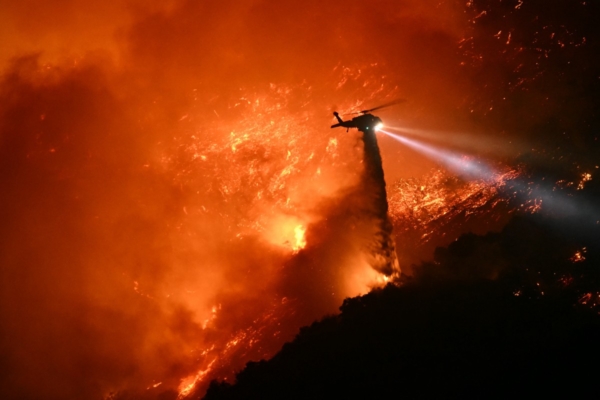
The devastating Palisades Fire in Los Angeles, which caused significant destruction in 2025, has seen a significant development in its investigation. A federal jury in Los Angeles, after deliberating for less than two days, unanimously found 30-year-old Jonathan Rinderknecht guilty on two counts of federal arson on November 20.
Prosecutors allege that Rinderknecht ignited a brush fire in the Santa Monica Mountains on January 1, 2025. This fire, later known as the Lachman Fire, smoldered underground for about a week before breaking out again on January 7. That day, strong winds exacerbated the situation, ultimately leading to the catastrophic Palisades Fire. This tragic event resulted in the loss of 12 lives, the destruction of approximately 6,800 homes, and economic damages estimated at around $25 billion.
Rinderknecht is scheduled for sentencing on March 17, 2027. The combined minimum statutory sentence for his convictions is five years, while the maximum could reach 40 years.
This trial marked the second time the case was presented in court. The first trial, which took place in June of this year, ended in a mistrial as the jury could not reach a consensus, with ten out of twelve jurors favoring a not guilty verdict. The retrial commenced on November 4.
Following the retrial, a 30-year-old juror named Cameron (who only wished to be identified by his first name) shared with a news outlet that he was the sole juror leaning towards a not guilty verdict during the initial stages of deliberation.
He mentioned that the defense’s experts had raised questions about the prosecution’s findings regarding the fire’s point of origin and cause, which made him skeptical about the reliability of the investigation. Cameron expressed his desire to hear opinions from all sides before making a final decision.
However, when asked what ultimately convinced him of Rinderknecht’s guilt, Cameron stated, “It was the suspect’s own testimony—when the fire broke out, he was the only one in the area, and there were no fireworks activities nearby.” He acknowledged that this was one of the earliest points of suspicion the jury noted and became a consensus among them.
Cameron admitted that he had initial concerns regarding the prosecution’s reliance solely on circumstantial evidence, but after weighing all the proof, he found Rinderknecht guilty overall.
This final trial differed significantly from the first, where several jurors leaning towards a not guilty verdict believed the prosecution had overemphasized the defendant’s mental health and personal struggles, leading to a backlash against the government’s approach. In the retrial, the prosecution shifted focus more directly onto the Lachman Fire itself, adopting a lighter touch in its behavioral analysis.
Rinderknecht’s father, Joel Rinderknecht, reiterated his son’s innocence following the verdict, criticizing the government’s investigation for what he described as misleading statements and calling the prosecution’s narrative “false.” He stated, “There has been a lot of misinformation, false statements, and witness intimidation… When you face the government, it feels like a gigantic machine, and you have little power.”
Prosecutors maintain that the Lachman Fire, which ignited on January 1, 2025, was the precursor to the Palisades Fire. The fire smoldered for several days underground until it erupted again on January 7, that day being marked by hurricane-level winds that rapidly spread the flames into surrounding valleys.
Significant evidence presented by the prosecution included cellphone location data, road surveillance footage, 911 call logs, and the defendant’s usage records from ChatGPT.
The prosecution argued that cellphone GPS data indicated that, during the approximate ten-minute window of the presumed ignition, Rinderknecht was located just a few feet away from the suspected fire’s origin point. There were four surveillance cameras along the access road to a hiking trail near the site, and according to the prosecution, only Rinderknecht’s vehicle was captured on camera that evening, with no other individuals detected.
Investigators from the Bureau of Alcohol, Tobacco, Firearms, and Explosives (ATF) also discovered that Rinderknecht had recorded himself calling 911, during which he asked ChatGPT if he would be accountable if a fire were to accidentally start from a cigarette. The prosecution viewed this as an attempt to create an alibi.
Furthermore, the prosecution pointed out that Rinderknecht had repeatedly asked ChatGPT to generate scenarios involving “forest fires while the rich enjoy themselves,” suggesting his discontent with wealth inequality and society at large. A passenger who shared an Uber ride with him shortly before and after the fire testified that he had made threatening and hostile remarks.
Based on this evidence, the prosecution concluded that Rinderknecht had committed arson out of a vengeful mindset toward society, subsequently attempting to cover up his actions.
Federal investigators ruled out potential ignition sources such as fireworks, cigarettes, or electrical wires, concluding that the fire was ignited by a lighter. The prosecution also referenced an experiment conducted in August, where investigators used a lighter to ignite surface dry leaves and debris collected from the fire scene, achieving a successful ignition rate of 91%.
First Assistant U.S. Attorney Bill Essayli stated after the verdict that all evidence pointed towards Rinderknecht, with no other reasonable causes for the fire. He remarked, “We believe that after reviewing all the evidence, the jury would deliver a guilty verdict.”
The defense argued, however, that the prosecution lacked direct evidence proving Rinderknecht had committed arson, suggesting the entire case was built on circumstantial evidence and flawed fire investigations.
Defense attorney Steve Haney emphasized in his closing remarks that no eyewitness had seen Rinderknecht start the Lachman Fire, nor were there any photographs or videos directly showing him committing arson. He stressed that merely being present near the fire did not equate to guilt.
Defense fire investigation expert and former U.S. Forest Service firefighter Tom Guzman also disputed the government’s fire scene investigation, arguing that the origin site had not been adequately secured following the fire, remaining open to the public in the six days leading up to the Palisades Fire, and affected by weather and firefighting efforts. Furthermore, he pointed out that investigators failed to document the fire’s point of origin correctly and did not sufficiently rule out fireworks as a potential cause. Guzman suggested that the cause of the fire should be classified as “undetermined.”
Regarding the prosecution’s lighter ignition experiment, Haney highlighted that the flames extinguished on their own in 67 tests, questioning the validity of the results in proving that a lighter was capable of igniting an actual fire. He stated, “The flames you see couldn’t even burn through a frying pan.”
Haney also countered the prosecution’s use of Rinderknecht’s mental state and personal life as arson evidence, claiming that such information merely constituted evidence about the individual, rather than proving he committed the act in question.