
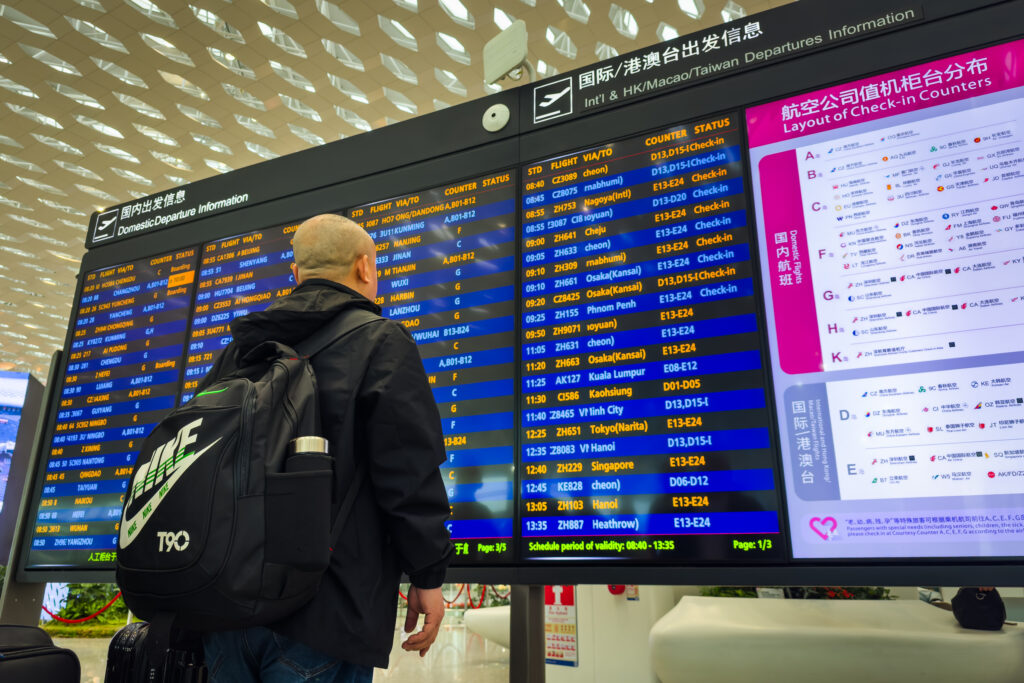
The APEC Economic Leaders’ Summit concluded in Shenzhen on the morning of November 19, prompting individual leaders from various economies to depart via their private jets. In response to the significant travel activity, local authorities implemented a strict airspace and ground traffic control system. This resulted in widespread flight delays at Shenzhen Bao’an International Airport starting from the afternoon of November 19, with some flights bound for Taipei delayed by nearly seven hours before takeoff.
According to reports, around 5 PM on the 19th, a journalist entered the Bao’an Airport’s departure lounge and observed that flights scheduled to depart from the same gate—one to Thailand at 3:55 PM and another to Brunei at 4:30 PM—had not yet boarded. The terminal was filled with stranded passengers, and the electronic displays continually indicated issues such as “Other airspace user activity” and “Traffic delay.” A closer look at the international flight gates revealed a range of delays affecting multiple services, including two flights to Taipei originally slated for takeoff at 2:35 PM, a 4:20 PM flight to Hanoi, Vietnam, and a 7 PM flight to Jakarta, Indonesia.
Flight tracking information indicated that one flight, shared between Shenzhen Airlines and EVA Air, was supposed to depart for Taipei at 2:35 PM. However, it did not take off until 9:28 PM that same evening, resulting in a delay of nearly seven hours. The evening flight carrying representatives from Taiwan’s APEC Business Advisory Council (ABAC), along with accompanying media members, also faced delayed boarding.
Amid these significant flight delays, the official website for Shenzhen Bao’an Airport displayed a message on its “Departure Flights” inquiry page stating that “flight information query functionality is temporarily unavailable due to system maintenance.” This made it challenging for the public to ascertain the exact number of delayed flights. Furthermore, the external glass of the waiting lounge was partially obscured by a partition approximately 190 centimeters high, hindering passengers’ ability to observe the real-time conditions on the tarmac and airport runways.
The ground traffic situation was equally tense. On the afternoon of the 19th, the high-profile “Sino-U.S. Dialogue” and “Trilateral Summit of China, the U.S., and Russia” took place, leading to nearly complete traffic control along the main roads in Shenzhen’s Futian District, where the main conference venue was located. This made it extremely difficult for various media outlets to leave the news center, as not only were vehicles prohibited from entering the roadways, but pedestrians also had to comply with continuous stop-and-go restrictions. Along the expressways leading to the airport, numerous special police and public security vehicles were stationed, while armed officers with riot shields stood guard outside the airport.
On November 20, Taiwan’s Central News Agency sought clarification from ground support at Shenzhen Airport regarding the recent delays and heightened controls. The airport’s response confirmed that the delays were due to the prioritized departure of the economic leaders’ private jets. They further stated, “Today, the overall delay situation has significantly eased, and we expect to return to normal operations tomorrow.”