
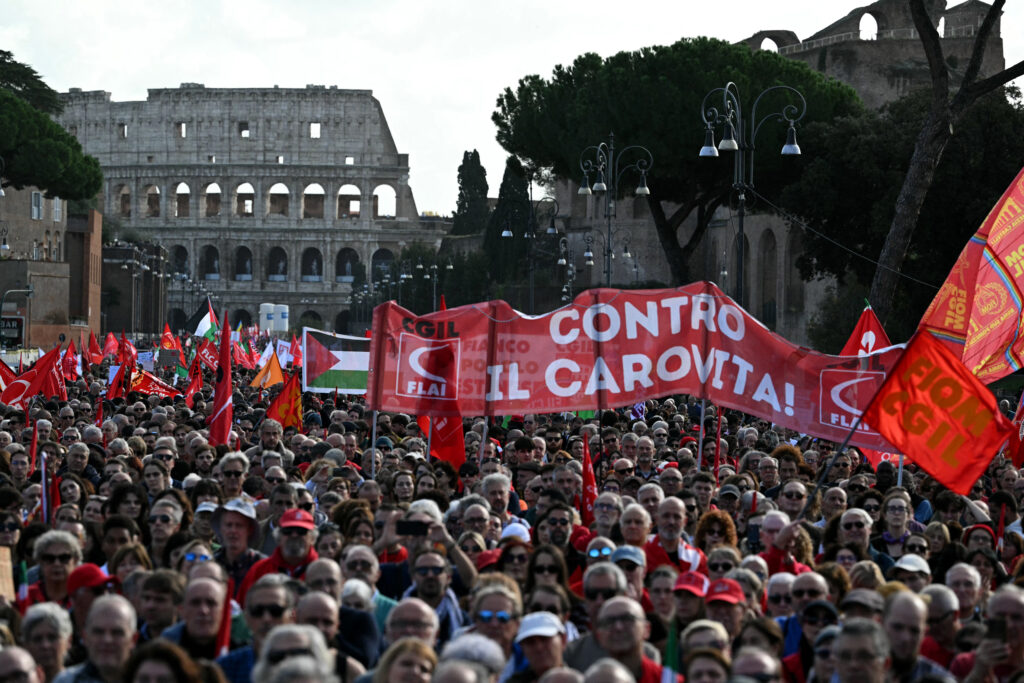
On Friday, November 20, Italy’s largest trade union, the Italian General Confederation of Labour (CGIL), called for a nationwide general strike in protest against the government’s economic policies. The union is demanding higher wages and increased public service expenditures. Thousands of students across various cities in Italy also took to the streets to protest against the rising cost of living.
This strike lasted for 24 hours and was organized by CGIL alongside grassroots unions such as Cobas. Demonstrations were held in several cities including Rome, Milan, Naples, Genoa, Bologna, Bari, and Turin, where students joined the protests against the government.
In Rome, Maurizio Landini, the general secretary of CGIL, led the march, joined by Elly Schlein, the secretary of the Democratic Party. Landini emphasized the importance of the government’s need to listen to the voices of the people who have taken to the streets.
The protests by Italian unions coincide with a new wave of youth activism across Europe. Students in Germany, France, the United Kingdom, Austria, and Belgium are also planning demonstrations to voice their grievances regarding the increasing cost of living and rising military expenditures.
According to reports, Landini stated, “Today is a very important day because the young people who are marching are not only in Italy but all over Europe.” He further noted that there is a growing demand for change among ordinary people across the continent.
The strike affected both the public and private sectors, impacting fields such as education, healthcare, local public transport, port services, and taxi operations. Anticipated disruptions were expected for schools, healthcare institutions, and public transportation services. However, essential services in busy periods for aviation and public transport were legally protected from the strike’s effects.
Previously, on October 30, Italy experienced another nationwide strike where thousands of students joined striking workers in calling for increased educational funding and relief from high living and housing costs. Following this event, student groups have continued to hold protests on campuses, with opposition to increased military spending gradually becoming a central demand among the protesters.
The Italian Parliament is currently reviewing a budget proposal put forward by the government for the year 2027. Unions believe that the proposed budget falls short in supporting citizens’ incomes and public services adequately.
In addition to wage increases to compensate for the loss of purchasing power due to inflation, the unions are also demanding that pensions be adjusted in full accordance with inflation rates and that measures be taken to prevent an increase in the retirement age.