
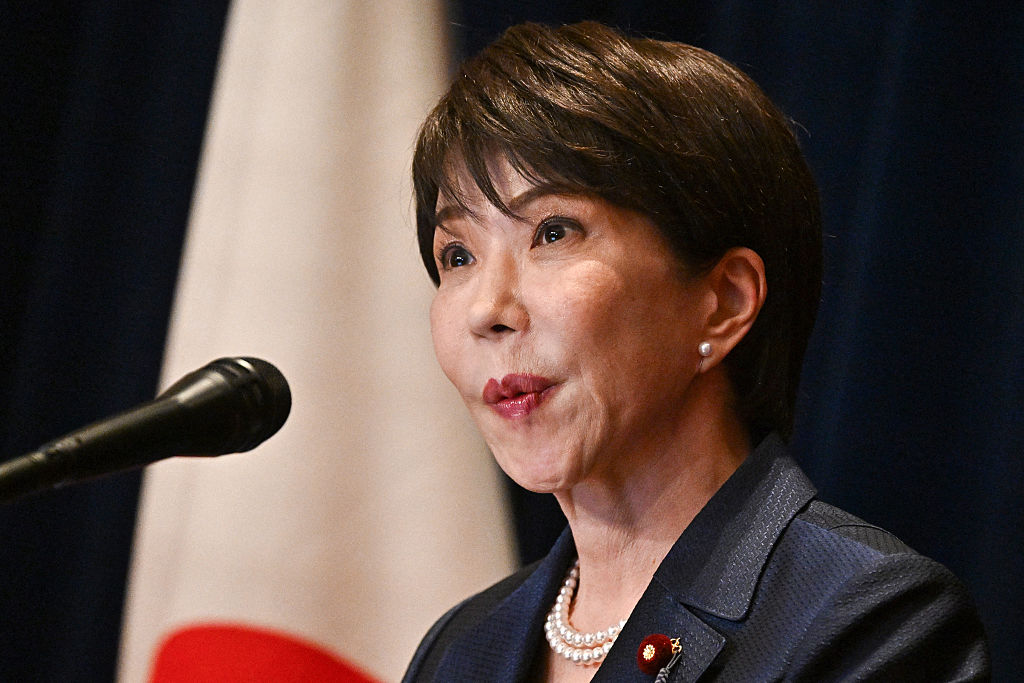
On Thursday, November 19, during the Asia-Pacific Economic Cooperation (APEC) summit, Japanese Prime Minister Sanae Takaichi reaffirmed Japan’s longstanding position regarding the Taiwan issue, which has remained unchanged since 1972.
Speaking at a press conference held in Shenzhen, China, Takaichi underscored that Japan’s stance on Taiwan, as outlined in the 1972 Japan-China Joint Communiqué, has not wavered over the decades. This communiqué was pivotal in establishing diplomatic relations between Japan and China.
When questioned by reporters about the possibility of Japan’s military involvement should a crisis arise in Taiwan, Takaichi refrained from answering the hypothetical query directly. She reiterated, however, that Japan’s government has maintained a consistent position on Taiwan since 1972, emphasizing that there has been “no change” in this regard.
Amid inquiries regarding whether Japan’s ongoing efforts to bolster its defense capabilities might instigate a regional arms race, Takaichi reaffirmed that the strengthening of Japan’s defense is essential for the protection of its citizens and maintenance of a stable and peaceful life. She characterized these measures as necessary for the nation’s security.
Takaichi highlighted Japan’s commitment to contribute to global peace and prosperity since the end of World War II, asserting, “This policy will absolutely not change in the future.” Such statements reinforce the notion that Japan remains cognizant of its role on the international stage, particularly concerning security dynamics in the Asia-Pacific region.
Earlier, on November 7, 2025, during a budget committee session in Japan’s House of Representatives, Takaichi had indicated that a military-related emergency involving Taiwan could constitute a “survival crisis situation” for Japan. In such cases, and under legal conditions, the Japan Self-Defense Forces could exercise a limited right of collective self-defense.
Takaichi explained that whether a situation could be categorized as a “survival crisis” would depend on the specific circumstances at hand. She noted that scenarios involving the deployment of naval vessels or armed attacks would significantly increase the likelihood of such a classification.
In response to her remarks, the Chinese government called for Takaichi to retract her statements and issued threats implying serious repercussions for Japan. On November 8, 2025, Xue Jian, then Consul General of China in Osaka, made comments on social media platform X that were widely interpreted as threatening towards Takaichi. Following this, Japan lodged a protest against China, leading to the deletion of the controversial postings.
Subsequently, China imposed restrictions on the export of critical minerals to Japan and suspended the importation of seafood from Japan, while also advising Chinese citizens against traveling to Japan.
The APEC summit took place from November 18 to 19 in Shenzhen, where Takaichi had a brief interaction with Chinese leader Xi Jinping, although no formal bilateral meeting occurred between the two leaders.
Overall, the developments underscore the delicate balance of diplomatic relations in the region, particularly in light of rising tensions surrounding Taiwan and Japan’s proactive defense policies.