
In a significant legal decision, a federal jury in Miami, Florida, found Haitian-American pastor Christian Emmanuel Sanon guilty on all eight federal charges related to the assassination of Haitian President Jovenel Moïse, which took place in 2021. The verdict was delivered after nearly eight weeks of trial, and it took the jury just about one day to reach their conclusion.
Sanon, who is 68 years old and holds dual citizenship in Haiti and the United States, faces grave accusations, the most severe of which involves “conspiracy to kidnap or kill someone outside the United States.” Other charges include providing material support and orchestrating military expeditions against allied nations.
The court has scheduled a sentencing hearing for February 10, 2027, where Sanon could be sentenced to life imprisonment. During the reading of the verdict, Sanon exhibited no visible reaction, maintaining his innocence throughout the trial. He acknowledged having connections with individuals who plotted to replace Moïse but denied knowledge of the assassination plan, asserting that those involved had shifted their support to other candidates prior to Moïse’s murder.
Sanon’s defense attorney, Zeljka Bozanic, stated that while the defense respects the jury’s decision, they vehemently oppose the verdict and plan to appeal the ruling.
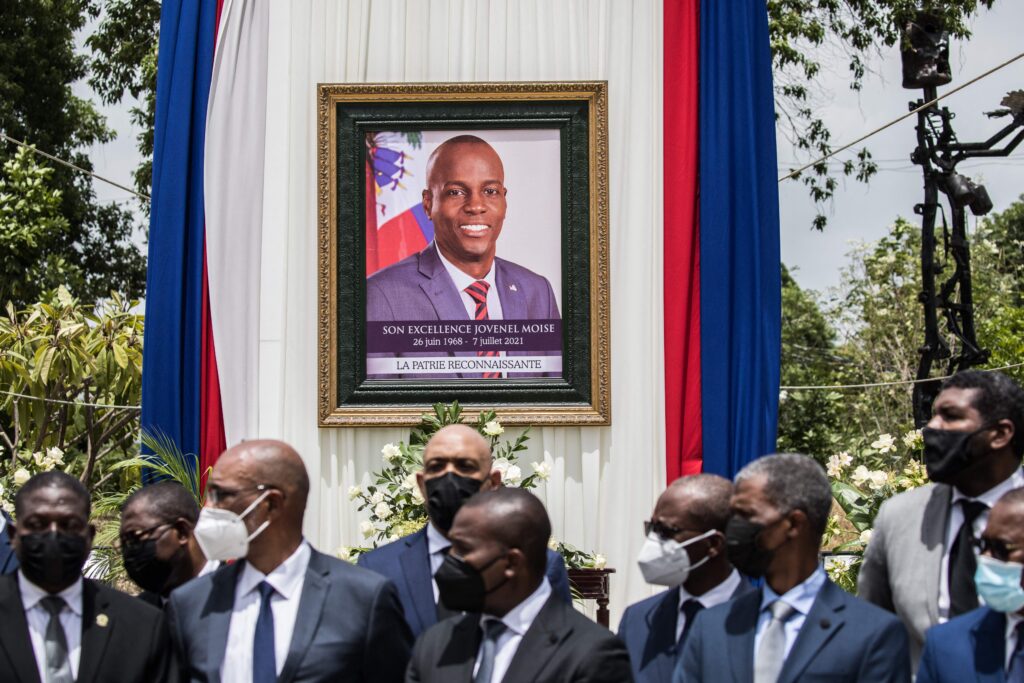
The tragic event unfolded on July 7, 2021, when a group of armed assailants, predominantly composed of retired Colombian soldiers, stormed Moïse’s home near the capital city of Port-au-Prince, resulting in his death. Moïse’s wife, Martine Moïse, was also injured during the attack.
Prosecutors highlighted that South Florida served as the prominent planning and fundraising hub for the conspiracy to overthrow Moïse’s government. Initially, the conspirators intended for Sanon to assume the presidency following Moïse’s ousting. Sanon reportedly played a role in raising funds for this endeavor, engaging a private security company based in Florida known as CTU, and arranging transportation and lodging for Colombian mercenaries heading to Haiti.
Court documents presented by the prosecution revealed that the plot involved using funds from a U.S. government assistance program established during the COVID pandemic to cover the expenses of more than twenty foreign mercenaries.
The indictment indicated that planning for the conspiracy intensified in April 2021, when Sanon met with a former Haitian senator and several American businessmen in South Florida. Prosecutors claimed that they devised a plan to award contracts concerning infrastructure, security forces, and military equipment to two Florida-based companies named Counter-Terrorist Unit Federal Academy and Counter-Terrorist Unit Security, collectively referred to as CTU.
The evidence suggested that CTU initially hired around 18 Colombian military-trained individuals to serve as Sanon’s bodyguards. Subsequently, the conspirators spent months preparing weapons and bulletproof vests while attempting to establish contact with Haitian gangs.
By June 2021, the conspirators reportedly determined that Sanon did not meet the constitutional qualifications to be president and lacked sufficient public support, prompting them to shift their backing to Wendelle Coq Thélot, a former judge of the Haitian Supreme Court. Thélot tragically passed away in January 2025 while in hiding.
Under U.S. law, conspiring to kidnap or kill a foreign national from within U.S. territory constitutes a federal offense. The Neutrality Act also prohibits launching armed actions against friendly nations from U.S. soil.
As part of the investigation into Moïse’s assassination, U.S. prosecutors have charged over 40 individuals, with approximately 12 already convicted, including five who have received life sentences.
Sanon was originally set to stand trial alongside four other men, but due to health issues, the court chose to separate his case for future proceedings. The other defendants include Antonio Intriago and Arcángel Pretel Ortiz, the heads of CTU, James Solages, who acted as CTU’s representative in Haiti, and Walter Veintemilla, a financier. Prosecutors allege that Veintemilla provided $175,000 to CTU on behalf of Sanon.
These four individuals were found guilty by a jury in May 2026 on charges that include conspiracy to kidnap or kill someone outside the U.S., conspiring to provide material support, and violating the Neutrality Act. They too face life sentences and are awaiting their own sentencing.
Furthermore, in September 2026, U.S. authorities extradited another group of suspects who had been detained in Haiti, including 17 retired Colombian soldiers and Joseph Felix Badio, a former official in Haiti’s Anti-Corruption Department, who is considered a key suspect in the case. Badio had evaded capture for over two years before being apprehended in Haiti in October 2023.
As of now, Badio’s case remains pending in the U.S., and attempts to contact his attorney in Miami for comments went unanswered.
The assassination of Moïse triggered a deepening political and security crisis in Haiti. Gang violence has surged, particularly in Port-au-Prince and surrounding areas. The United Nations has estimated that by August 2026, nearly 1.49 million people were displaced within Haiti. Reports indicate that Haiti has gone a decade without holding elections, leaving parliament and other positions vacant.
As the nation prepares for its upcoming presidential and congressional elections, potential candidates include Moïse’s widow, Martine Moïse, respected economist Etzer Emile, prominent prosecutor Jean Ernest Muscadin, who has faced accusations of extrajudicial killings, and former president Michel Martelly, who has been implicated in drug trafficking and gang financing.