
The National Palace Museum in Taiwan is set to unveil a significant exhibition titled “The Celestial Sphere’s Voyage: The Foreign Relations of the Great Qing Dynasty,” starting from the 21st of this month and continuing until February 21, 2027. This exhibition invites visitors to delve into the intricate history of the Qing Dynasty, which ruled for over two centuries, highlighting the pivotal moments during which China transitioned from a passive recipient of tributary relations to an engaged player in international politics.
This special exhibition will chronicle how the Qing Dynasty navigated the complexities of foreign interactions, ultimately signing international treaties and reshaping its role on the world stage. It sheds light on how diplomatic concepts that are often taken for granted in modern times gradually took shape in East Asia.
The exhibition is meticulously curated by Lai Yu-Ling, an associate researcher at the museum’s Department of Painting and Calligraphy, and assistant researcher Hsieh Ren-Yan. They emphasize that, in recent years, the international landscape has been marked by political divisions, economic sanctions, and conflicts, leading to a constantly shifting environment that calls for a deeper understanding of diplomatic developments.
At the heart of the exhibition lies a collection of official documents, maps, and historical records from the Qing Dynasty, along with materials preserved by the Ministry of Foreign Affairs. These artifacts trace the evolution of the dynasty’s foreign relations, from its traditional tributary system to the recognition of a modern international order and diplomatic relations.
Hsieh Ren-Yan remarks that discussions surrounding Qing Dynasty foreign relations often invoke two keywords: “Celestial Empire” and “Unequal Treaties,” which have contributed to the perception of the dynasty’s rise and decline. By presenting the exhibition under the title “The Great Qing Nation,” the curators aim to reflect the dynasty’s formal title, which was used both domestically and in international correspondence, thus articulating its standpoint more clearly.
Furthermore, the diverse geographic orientations of the Qing—from maritime engagements to inland Asian affairs—are showcased through the rich variety of diplomatic institutions and the languages of official documents. The exhibition encourages visitors to explore the Qing’s foreign activities and discover how the empire adapted to various regional needs, eventually securing a place among the nations of the world.
The exhibition is divided into three main sections: “Tributes from All Nations,” “Expedient Measures,” and “Strengthening Relations with States.” Each section utilizes the museum’s extensive collection of Qing-era foreign documents, official writings, and maps, enriched by additional materials from the Ministry of Foreign Affairs, to illustrate the progression and diversity of Qing international relations—from tributary affairs to modern diplomatic engagements.
In the first section, “Tributes from All Nations,” the early Qing worldview is displayed, centered around the Chinese concept of a harmonious order where surrounding countries were seen as vassals. During the Jiaqing era, the “Map of the Entire World Under the Qing Dynasty,” while claiming to represent the entire world, primarily details the tributary nations that communicated with the Qing through the Ministry of Rites. In contrast, regions that the Qing was newly expanding into, such as Xinjiang, Tibet, and areas in Central Asia and Europe, are mentioned more briefly, reflecting a hybrid worldview.
The second section, “Expedient Measures,” illustrates the Qing’s gradual establishment of a foreign treaty negotiation mechanism. A notable document reveals that during the Xianfeng era, the establishment of the “Office of General Affairs with Foreign Nations” initially included the term “trade” in its name, but this was later removed due to Western considerations regarding its restricted implications.
During this time, not only were new diplomatic institutions formed, but foreigners also began to occupy roles within the Qing administration. One significant record is from Robert Hart, the British advisor who served as the Customs Inspector General in China for half a century. He played a critical role in establishing a stringent customs management system, generating a stable and gradually increasing source of tax revenue for the Qing. This section will also feature major modern Chinese diplomatic documents, including the Treaty of Nanjing, the Sino-French Treaty of Tianjin, and the Boxer Protocol.
The final section, “Strengthening Relations with States,” documents the reforms following the invasion by the Eight-Nation Alliance, which pressured the Qing to establish a formal ministry dedicated to foreign affairs. This led to a new era of official correspondence between nations and paved the way for embassies to be stationed abroad, as well as participation in agreements to collectively resolve international disputes.
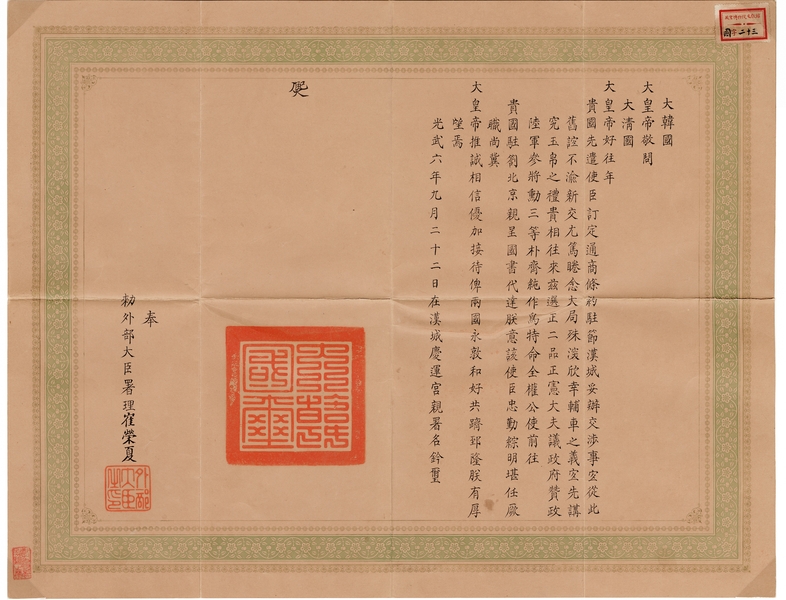
The 1902 “Diplomatic Document of Korea” signifies the establishment of the “Korean Empire,” which emerged after the Treaty of Shimonoseki declared Korea an “independent state.” The document highlights Korea’s announcement of its envoy to Beijing, marking a notable shift in diplomatic status. Another important artifact is the Chinese translation of the “Hague Convention on Peaceful Resolution of International Disputes,” ratified in 1899 and reaffirmed in 1907, which represents a key milestone in the modern establishment of international arbitration systems, solidifying the Qing’s status as a recognized participant among the nations of the world.
Through this exhibition, the National Palace Museum offers a comprehensive exploration of the Qing Dynasty’s foreign relations, inviting visitors to reflect on the complexities of historical diplomacy and its lasting impact on contemporary international relations.