
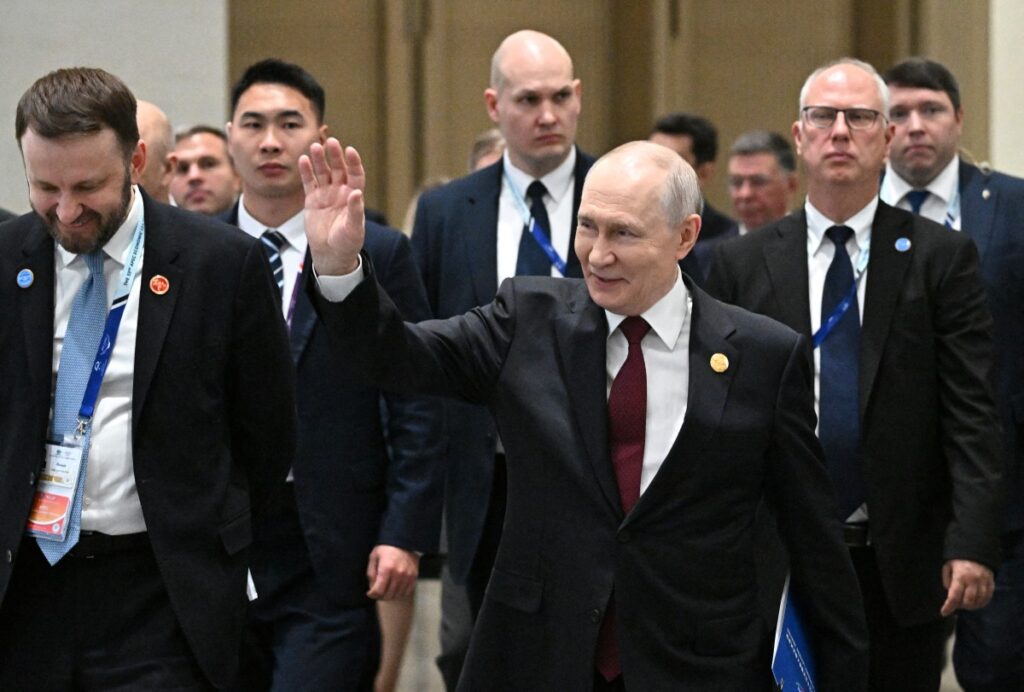
On Wednesday, November 18, Russian President Vladimir Putin arrived in Shenzhen, China, to participate in the Asia-Pacific Economic Cooperation (APEC) summit. His visit has piqued global interest, particularly due to the presence of a nuclear briefcase carried by a Russian military officer. This mysterious black briefcase is utilized for implementing nuclear strikes as ordered by Putin.
A video released by Russian state television and shared by several media outlets captures a moment when a Russian reporter approached a naval officer carrying the briefcase, inquiring whether it served as the authorization tool for nuclear strikes. The military officer confirmed this piece of information.
The reporter, Yevgeny Popov, addressed the camera, stating, “Everyone look—right behind us is the ‘nuclear briefcase’. (The camera zooms in.) See, Vladimir Putin’s aide is holding that briefcase.”
Popov then approached the officer bearing the black briefcase and asked, “Is this the ‘nuclear briefcase’ you are carrying?”
“Yes, indeed,” the officer replied affirmatively.
“Is it really that one?” Popov pressed for further confirmation.
“It is that one,” the officer reiterated, leaving no room for doubt.
Traditionally, Russia’s nuclear briefcase, commonly referred to as “Cheget,” is carried by navy officers. The name “Cheget” derives from Mount Cheget in the Caucasus Mountains. This critically important briefcase travels alongside the president wherever he goes, ensuring that he can give a nuclear strike order at any moment if necessary. Despite its significance, it is rarely captured on camera.
A journalist from RIA Novosti, a Russian state news agency, commented on Telegram under the related video, saying, “Without certain briefcases, Putin’s travels are not complete.”
In reality, the nuclear briefcase serves as a secure means of communication, connecting the Russian president with the country’s military leadership through a highly classified electronic command and control network known as “Kazbek.” This system interfaces with missile forces, reinforcing its critical role in national security. Additionally, “Kazbek” supports another system referred to as “Kavkaz.”
In comparison, the President of the United States possesses a similar briefcase termed “nuclear football.” This briefcase contains a manual for executing nuclear strikes, including a comprehensive list of potential targets for U.S. nuclear weapons. The “nuclear football” also includes a radio transceiver and several code verifiers.
For the U.S. President to authorize a nuclear strike, he must first provide a code to confirm his identity. This protocol underscores the gravity and critical nature of nuclear command structures in both nations, highlighting how they manage the omnipresent threat of nuclear warfare.
As the world closely watches the developments from the APEC summit, the presence of such critical instruments as the nuclear briefcase reminds us of the ever-looming implications of geopolitical tensions and the gravity of nuclear power on international relations.