
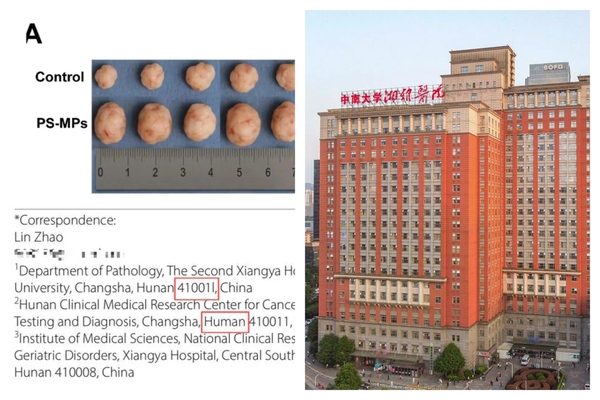
Recently, a research paper from a team at Xiangya Second Hospital of Central South University has sparked intense debate and skepticism among the public. The study, titled “Ferroptosis inhibition via the ROS-GPX4 axis drives microplastic-induced malignant progression of nasopharyngeal carcinoma,” examines the effects of microplastics on the malignant progression of nasopharyngeal cancer. It was published on December 22, 2025, in the international medical journal “Journal of Translational Medicine.”
The paper lists four co-authors with the corresponding author identified as Lin Zhao. Among its acknowledged author affiliations, the first is the Department of Pathology at Xiangya Second Hospital. However, numerous glaring errors throughout the paper have led to widespread criticism.
One major issue noted by netizens is the abnormality in the experimental scale. Astonishingly, the paper claims “12 small divisions in 1 centimeter.” Standard metric measurements dictate that 1 centimeter equals 10 millimeters, highlighting a significant error in the figures presented on pages 10 and 15 of the document, as pointed out by vigilant online observers.
Moreover, there are serious discrepancies in the institutional information provided by the authors. The English name for Hunan Province was mistakenly written as “Human,” and the last digit of the postal code was allegedly misrepresented as the letter “l” instead of the number “1.”
The images presented from mouse tumor experiments are described as unusually round and uniform, leading some social media users to derisively compare the tumors to “shrimp paste.” This prompted further inquiries into whether the pictures might have been generated by artificial intelligence, casting further doubt over the integrity of the research. Additionally, inconsistencies between experimental data and the conclusions drawn in the text have also been highlighted by critics.
It is important to note that this paper is associated with multiple research funding sources. According to the disclosed funding information, the study received support from two National Natural Science Foundations, two Hunan Natural Science Foundations, and a startup research fund from Xiangya Second Hospital. The emergence of the aforementioned anomalies has prompted questions regarding whether the experiments were genuinely conducted, if the images and data have original records, and if the utilization of research funding was handled appropriately.
In response to the controversy, on November 17, the research department of Xiangya Second Hospital announced that an investigation had been initiated. That same day, personnel from the Hunan Provincial Department of Science and Technology’s Supervision and Integrity Division stated that they had instructed the hospital to conduct an inquiry and would concurrently verify whether there were any issues of academic misconduct or violations in research procedures.
By November 18, several related topics had trended on Weibo, capturing further public interest.
Dr. “Da Huo” from the Hematology Department of Beijing Friendship Hospital commented on the situation in a post, saying, “On Monday, I saw a public account discussing this matter. Due to its absurdity, I even clicked to read the original paper and indeed found the twelve divisions in one centimeter, and the author affiliation listed as ‘human,’ while the tumor appeared like shrimp paste.”
A media professional known as “Media Old Wang” also expressed his disbelief through a post: “A ruler that has 12 divisions in 1 centimeter; a mouse tumor looking as round as a hot pot shrimp; the English for Hunan is mistakenly written as ‘Human.’ This paper from Xiangya Second Hospital, with an impact factor of 9.7, has thoroughly rubbished academic rigor. It’s ironic that netizens are using measurement scales to vet the industry. Currently, the Science and Technology Department has ordered an investigation, and the hospital claims to be involved. AI-assisted research is not inherently wrong, but using AI to manipulate experiments and procure funding alters the nature of the issue. Old Wang believes that medical papers directly relate to patients, errors in measurement can be corrected, but a breakdown of trust is hard to mend. It is crucial to clarify the facts; appropriate actions should be taken, and responsibilities must be assigned without hesitation.”